


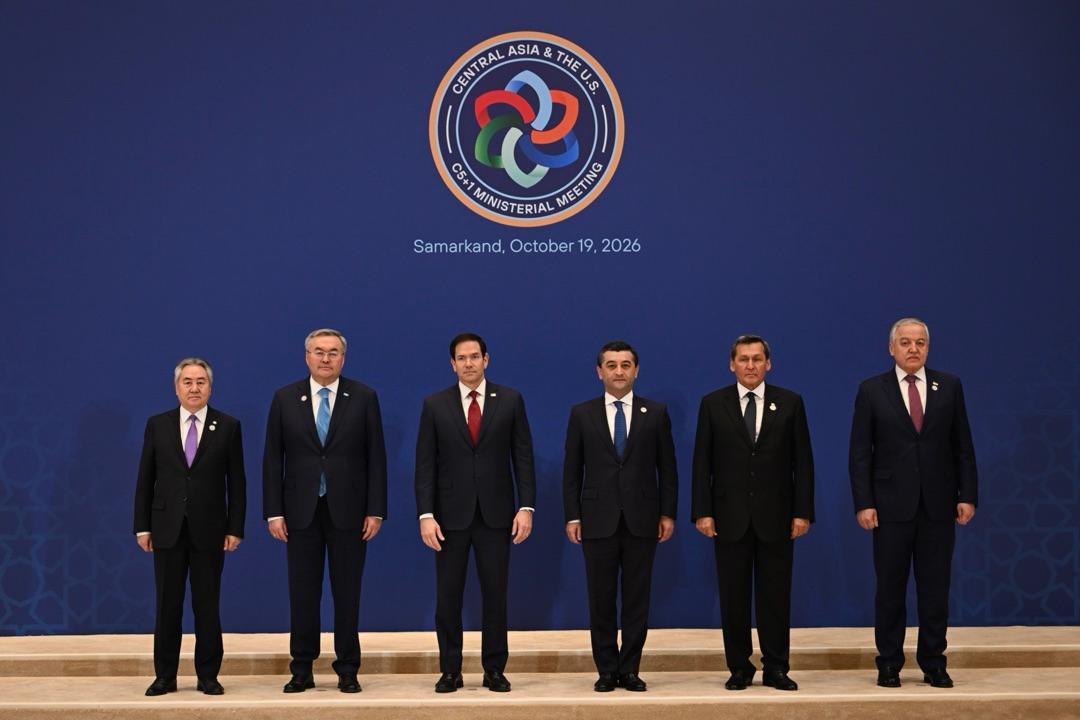
The C5+1 Ministerial Meeting, attended by the U.S. Secretary of State and the foreign ministers of the Central Asian countries in Samarkand, concluded with the adoption of a Joint Statement. The text was published on the official website of the U.S. Department of State.
The statement, released by the governments of the six countries, focuses primarily on the economic and practical dimensions of the U.S.-Central Asian partnership, including transport corridors, trade, investment, energy, mineral resources and technology.
Security and humanitarian ties complement this agenda. The document sets out general intentions and priorities but does not establish specific financial commitments or deadlines for project implementation.
Key points of the statement:
Strengthening ties between the United States and Central Asia: Particular emphasis is placed on developing the Trans-Caspian Trade Route. The statement envisages investment in transport infrastructure and the expansion of mutually beneficial trade ties.
The parties also intend to strengthen digital connections, including through education and English-language training.
Central Asia as a center of the global economy: Joint efforts to further develop the Trans-Caspian Trade Route are expected to catalyse unprecedented growth in two-way trade and investment between Central Asia and the United States.
The statement calls for the development of a competitive regional market connected with the United States through deeper regional economic integration in Central Asia. This includes expanding intraregional trade, improving transport connectivity, harmonising customs procedures and strengthening industrial cooperation.
It also highlights the need to expand opportunities for Central Asian companies to invest in and operate within the U.S. market.
E-commerce, technological innovation and entrepreneurship are identified as promising areas for cooperation.
Natural resources: Strengthening energy cooperation between the United States and Central Asia is expected to galvanize efforts to develop integrated, high-value supply chains.
The parties intend to exchange expertise and best practices in geological data management.
The statement also points to opportunities to expand mineral extraction and processing.
It calls for efforts to realise Central Asia’s export potential by developing innovative ways to increase the share of value-added products produced within the region and creating pathways to introduce these products to the international market.
Security: The parties intend to place particular emphasis on countering terrorism and transnational organised crime, as well as enhancing border security.
Joint efforts are expected to strengthen security, including through cooperation to counter illegal immigration, human trafficking, illicit drug trafficking and arms trafficking.
The importance of cooperation in cybersecurity and combating cybercrime is also highlighted.
Nuclear security: The statement expresses the intention to deepen cooperation on nuclear security, safeguards, the physical protection of nuclear material and the peaceful use of nuclear energy, building on the Central Asian Nuclear-Weapon-Free Zone.
Protection of cultural heritage: The parties intend to develop new avenues for cooperation on cultural heritage, including closer collaboration between law enforcement agencies and cultural institutions to promote and protect the unique historical heritage of the C5+1 countries.
The statement underscores the importance of using new technologies to preserve and protect antiquities and integrating cultural heritage protection into law enforcement efforts.
Tourism and the creative economy are seen as areas with potential for business development and job creation.
Global challenges: The parties envisage continued development of C5+1 cooperation to deliver regional solutions to global challenges. ///nCa, 19 October 2026