


Tariq Saeedi and Elvira Kadyrova
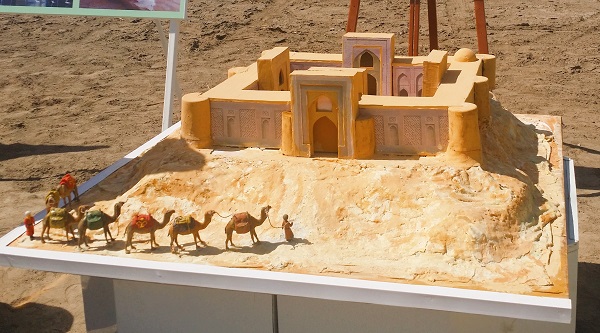
Centuries before modern borders mapped the Eurasian landmass, merchant caravans dictated the flow of global civilization. At the heart of this ancient web lay Amul, a fortress city positioned on the left bank of the Amu Darya river—the very fortress that gave the great river its name. Located on the eastern edge of present-day Turkmenabat, Amul served as the vital starting point and transit hub for several major strands of the Great Silk Road.
Today, Turkmenistan is actively resurrecting these historical arteries. The rapid expansion of state-of-the-art transit corridors across the country represents far more than an economic initiative—it is the rebirth of the Great Silk Road, bridging an ancient trade legacy with a modern nation forging ahead.
Amul: The Historical Heart of Regional Strands
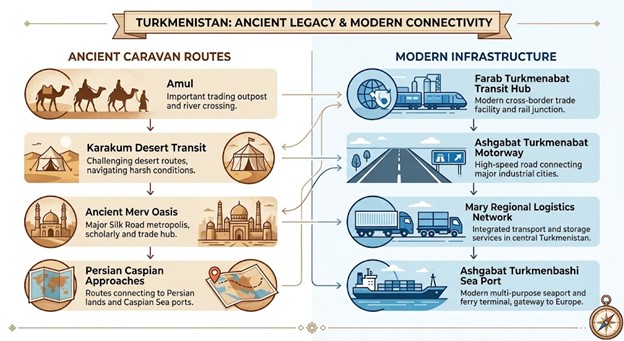
In ancient and medieval geography, Amul was not merely a stop along the road; it was a multi-directional nexus. Caravans departing Amul embarked on distinct strands that defined trans-Eurasian trade:
- The Westward Desert Route: The dangerous journey across the Karakum Desert from Amul to Merv (Mary), leading onward to Iran, the Middle East, and the Mediterranean basin.
- The Northern River Route: The trade corridor moving downstream from Amul toward Khorezm, connecting to the Ural region and Eastern Europe.
- The Southern Maritime and Overland Routes: Upstream and overland links extending south towards Afghanistan, the Pamir mountains, and northern India.
Links to our in-depth series on Amul
Journalists feel the Heart of the Great Silk Road – Part 1
Tariq Saeedi, Raviliya Kadyrova, Elvira Kadyrova
Journalists feel the Heart of the Great Silk Road – Part 2
Tariq Saeedi, Raviliya Kadyrova, Elvira Kadyrova
Journalists feel the Heart of the Great Silk Road – Part 3
Tariq Saeedi, Raviliya Kadyrova, Elvira Kadyrova
Recognized globally for its historical weight, the Amul fortress stands as a cornerstone of the UNESCO World Heritage listing for the Silk Roads: Zarafshan-Karakum Corridor.
The Farab–Turkmenbashi Route: The Rebirth of a Transcontinental Highway
In a remarkable convergence of geography and destiny, the ancient caravan trails from Amul to the Caspian Sea are being mirrored by modern concrete and asphalt. The vision of a unified high-speed transport corridor stretching across the entirety of Turkmenistan—from Farab on the eastern border (adjacent to Turkmenabat and ancient Amul) all the way to the seaport of Turkmenbashi on the Caspian coast—is fast becoming a reality.
The completion of major milestones along the Ashgabat–Turkmenabat Motorway—including the opening of the initial Ashgabat–Tejen segment (2021), the Tejen–Mary section (2024), and the completion of the Mary–Turkmenabat section in April 2026—marks a historic leap forward.
This 600-kilometer high-speed artery connects seamlessly with the Ashgabat–Turkmenbashi highway system, essentially recreating the ancient Amul–Merv–Caspian trade strand into a world-class transit corridor capable of moving thousands of modern freight trucks and transit vehicles daily.
Connecting Nations: Modern Arteries Along Ancient Strands
The revival extends far beyond a single east-west highway. Turkmenistan’s expanding transport network accurately aligns with every historical branch of the Silk Road passing through its territory:
- Southward to Iran: Modern border crossings and road routes connecting Turkmenistan with Iran (such as Howdan/Bajgiran, Sarahs, and Artyk) mirror the ancient mountain pass trails through the Kopetdag that connected northern Parthia to the Iranian plateau.
- Southeastward to Afghanistan: Road and rail connections via Serhetabat (toward Herat) and Kerki/Imamnazar (toward Aqina) revive the historic trade routes that linked the Merv and Amul oases directly to Southern Asia.
- Westward to the Caspian Gateway: The modern Turkmenbashi International Seaport serves as the modern counterpart to ancient Caspian embarkation points, linking Central Asia across the sea to the Caucasus, Turkey, and Europe.
The Merger of the Ancient and the Modern
Where camel caravans once took weeks to navigate the burning sands of the Karakum between Amul and Merv, modern freight trucks now cross high-speed autobahns in a matter of hours.
By merging its rich historical legacy as the crossroads of Eurasia with forward-looking transport diplomacy and infrastructure development, Turkmenistan is proving that the Silk Road was never merely a chapter in history books. It is a living, breathing blueprint for a nation forging ahead into a connected global future. /// nCa, 19 October 2026