


Tariq Saeedi and Elvira Kadyrova
The first generation of discussions about the Middle Corridor focused largely on geography. Maps were drawn, routes were compared, and countries were identified according to their position along the emerging Eurasian transport corridor.
The next generation of discussion must move beyond maps.
Transport corridors do not compete because of their geography alone. They compete because they deliver faster transit, lower costs, greater reliability, higher capacity, and better service to the businesses that use them. — As a matter of fact, when we say ‘competition’, it doesn’t mean the corridors try to defeat each other. It only means they try to be more attractive than others.
Every day, thousands of decisions are made by freight forwarders, shipping companies, logistics operators and cargo owners. Their questions are remarkably practical. Where can cargo move faster? Where are border delays shorter? Where is capacity available? Where are operating costs lower? Where is the least uncertainty?
The answers to these questions—not political narratives or promotional campaigns—determine which transport corridors prosper.
Viewed from this perspective, Turkmenistan is steadily strengthening one of the most compelling competitive positions anywhere along the Middle Corridor.
Capacity Begins with Geography
One of the most important yet least discussed aspects of the Middle Corridor lies beneath the surface of the Caspian Sea.
Ports do not operate in isolation from geography. Water depth determines the commercial efficiency of maritime transport. Every centimetre of draft affects how much cargo a vessel can carry.
If ships cannot sail fully loaded, the economics of transport change immediately. The northern Caspian has experienced a persistent decline in water levels in recent years. This has created operational challenges for ports located in its shallower waters, requiring extensive dredging programmes simply to maintain existing capacity.
Kazakhstan has publicly acknowledged this challenge through major dredging projects designed to restore and expand the operational capabilities of Aktau Port.
Industry assessments have noted that draft restrictions have prevented larger vessels from operating at their full commercial loading until these works are completed. This is not a question of port management but of physical geography.
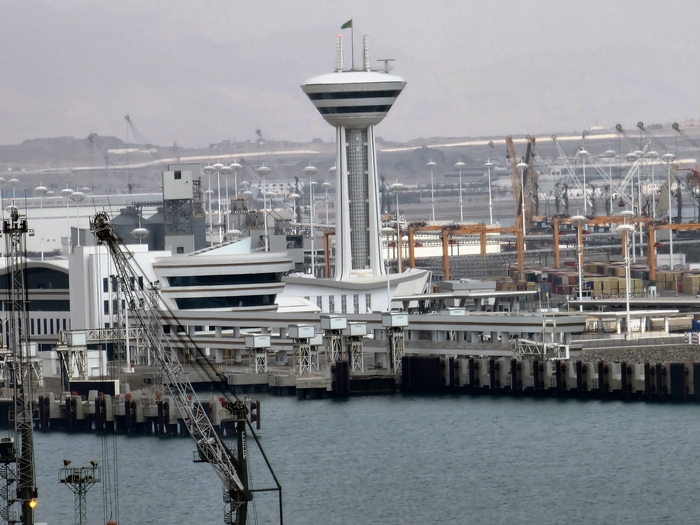
Turkmenbashi occupies a different position. Located on deeper waters of the eastern Caspian, the Turkmenbashi International Seaport enjoys a natural operational advantage. It is capable of accommodating the full range of vessels currently operating on the Caspian without the same degree of draft-related constraints affecting navigation farther north.
An interesting illustration came recently when Azerbaijan transferred an approximately 8,000-deadweight-ton tanker to Turkmenistan’s fleet. Such investments reflect confidence not only in the vessel itself but also in the operational environment in which it is expected to serve.
For shipping companies, capacity is not measured by the size of a ship. It is measured by how much cargo that ship can actually carry.
Every Connection Multiplies Value
In our previous analysis, we argued that connectivity is the defining strength of Turkmenistan’s transport system. That proposition deserves further consideration.
Transport economists increasingly view infrastructure not as isolated projects but as interconnected networks. Every additional railway, highway, logistics centre or border crossing increases the value of every other element within the system.
A new railway does not merely create another line on a map. It creates additional routing options. It reduces vulnerability. It increases resilience. It expands commercial opportunities.
This is precisely the direction in which Turkmenistan has been developing its transport infrastructure. Multiple rail and road connections with every neighbouring country provide an unusually dense web of international access. Railways connect Turkmenistan with Iran, Afghanistan, Uzbekistan and Kazakhstan.
Highways mirror this multidirectional connectivity, creating alternatives that are increasingly valuable in a world where supply chains must remain resilient under changing economic and geopolitical conditions.
The value of this network is likely to increase further in the years ahead.
Afghanistan has gradually extended road infrastructure toward the Wakhjir Pass on its border with China. Although a direct international road connection will depend on continued infrastructure development and the management of legitimate security concerns, the strategic implications are evident. If realised, such a route would create the shortest overland connection between western China and the Caspian Sea through Afghanistan and Turkmenistan.
Infrastructure projects should be evaluated not only by what they achieve today but also by the possibilities they create tomorrow.
Speed Has Become the New Geography
Distance no longer determines competitiveness. Time does. Every hour spent waiting at a border crossing represents lost productivity. Every unnecessary document increases transaction costs. Every customs delay weakens the attractiveness of an entire corridor.
Modern logistics increasingly rewards predictability rather than simply speed. This understanding is reflected in Turkmenistan’s ongoing efforts to modernise customs administration and digitise transport procedures. The Turkmenbashi International Seaport has already demonstrated what streamlined processing can achieve. Customs clearance times measured in minutes rather than hours have shown that administrative efficiency can become as valuable as physical infrastructure.
The same philosophy is gradually being extended across other border crossings and transport facilities. Digital documentation, integrated information systems and harmonised procedures are becoming central elements of Turkmenistan’s transport strategy.
In contemporary logistics, every hour saved is equivalent to building new infrastructure.
Competitiveness Is Built on Cost
Transport operators evaluate corridors in terms of total logistics cost rather than individual expenses. Fuel prices, transit fees, waiting times, customs procedures, vehicle utilisation and administrative requirements all contribute to the final calculation. This broader perspective helps explain why Turkmenistan’s current policy direction is significant.
The country is examining ways to optimise transit fees while continuing to simplify administrative procedures. Together with comparatively low fuel costs and continuing investments in transport infrastructure, these measures point toward a coherent strategy: reducing the overall cost of moving goods across the country.
The objective is not simply to attract more traffic. It is to become a corridor that logistics operators actively prefer. That distinction matters.
Preparing for the Next Generation of Freight
Transport planning must anticipate future trends rather than merely respond to present demand.
China is rapidly accelerating the adoption of electric heavy-duty trucks for freight transport. Similar developments are underway in other major markets. Recognising these changes, Turkmenistan is studying the practicalities of establishing charging infrastructure along its principal highways and motorways.
Although still at the planning stage, such initiatives demonstrate a willingness to prepare for the next generation of freight transport rather than waiting for change to become unavoidable.
Infrastructure built today will shape competitiveness for decades to come.
The Emerging Logic of the Middle Corridor
The Middle Corridor is often described as a transport route. It is becoming something much larger. It is evolving into an integrated logistics network whose success will depend on operational performance rather than geographical description. In such a network, the decisive advantages belong to countries that combine connectivity with efficiency, capacity with resilience, and infrastructure with intelligent management.
Turkmenistan’s expanding network of railways, highways, ports, logistics centres and digital transport systems points consistently in that direction.
Each investment strengthens the value of those that came before it. Each new connection increases the flexibility of the network as a whole. Each improvement in operational efficiency enhances the competitiveness of the entire corridor.
History has always rewarded places that connect markets. The twenty-first century will reward those that connect them better. That is the direction in which Turkmenistan is steadily moving. /// nCa, 30 June 2026