


Tariq Saeedi
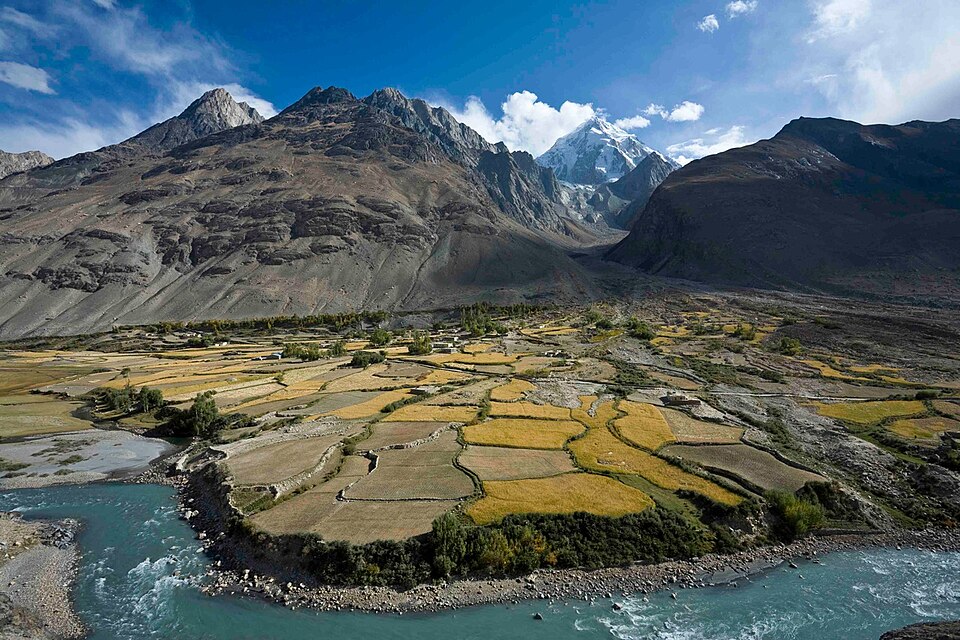
The Wakhan Corridor is one of the strangest lines ever drawn on a map. — A narrow finger of Afghan territory some 350 kilometres long and, in places, barely 13 kilometres wide, it reaches out from Badakhshan Province to touch China’s Xinjiang region, separating Tajikistan to its north from Pakistan’s Gilgit-Baltistan to its south.
It was not born of trade, migration, or the natural contours of a people’s history. It was drawn by the Pamir Boundary Commission of 1895 for a single, narrow purpose: to ensure that Czarist Russia and British India would never share a common frontier.
Afghanistan’s Emir Abdur Rahman Khan accepted custodianship of the strip — reluctantly, and with a British subsidy to help police it — as part of a settlement between two empires that no longer exist.
That is where most polemics about Wakhan begin and, unfortunately, where the more reckless ones end — leaping from “the empires are gone” to the conclusion that the territory itself should therefore change hands. It should not, and no serious regional proposal needs it to.
Afghanistan’s sovereignty over the Wakhan is not in question; it has been consistently affirmed since the 1919 Treaty of Rawalpindi and the 1921 Anglo-Afghan Treaty, and it sits comfortably within the international law principle that successor states inherit the boundaries they held at independence.
Pakistan’s own government has been explicit on this point, repeatedly denying any territorial ambition over the corridor. Any credible analysis has to start from that ground, not tiptoe around it.
But sovereignty over a territory and the use to which that territory is put are two different questions — and it is the second one, not the first, where there is real room for a regional conversation. — The purpose the Wakhan was built to serve is dead. The question worth asking today is not who owns the corridor, but what it is for.
A corridor already being reopened — just not the way most people assume
That question is no longer hypothetical. Kabul is already building an answer to it. Afghan road crews have spent the past two years pushing a route through the Wakhan toward the Wakhjir Pass, the only realistic crossing point into China, sitting at nearly 4,900 metres and snowbound for much of the year. Progress reports from Kabul this year put the westward stretch from Bazhai Gonbad to the Badakhshan border crossing at roughly three-quarters complete, with the final approach to the Chinese frontier further along.
This is an Afghan-driven initiative, not an imposed one — Kabul’s motive is straightforward: reduce dependence on Pakistani border crossings that Islamabad has, at various points, closed during disputes, and open an alternative route north and east that answers to no third country’s leverage.
China’s response so far has been measured rather than enthusiastic. Beijing has repeatedly signalled that its interest in Wakhjir Pass is driven by security more than commerce — chiefly concern that militants could use an open corridor to move between Afghanistan and Xinjiang. That caution shaped Foreign Minister Wang Yi’s most recent visit to Kabul, where joint patrols along the corridor, not trade facilitation, were the headline outcome.
There are, as yet, no customs facilities on the Chinese side of Wakhjir Pass at all. The terrain itself is formidable: a gravel track through some of the highest inhabited country on earth cannot carry the tonnage a seaport or a lowland highway can. Nobody seriously argues the Wakhan will rival the Karakoram Highway as a freight artery. What it can plausibly become is something narrower and, in some ways, more valuable: a controlled, multilaterally managed transit and cooperation zone that turns a dead-end buffer into a shared asset.
The case for a free-transit arrangement, not a change of flag
A jointly administered transit regime for the Wakhan — negotiated by Afghanistan with its neighbours, and remaining unambiguously under Afghan sovereignty — would answer to interests on every side of the corridor, which is precisely what gives the idea staying power over a unilateral claim.
For Afghanistan, formalising and internationalising transit rights through the Wakhan converts a chronically underdeveloped, food-insecure district — home to barely 12,000 to 15,000 people, mostly Wakhi farmers and Kyrgyz herders — into a revenue-generating gateway to Central Asia and China that reduces Kabul’s dependence on any single neighbour’s goodwill. It also gives Afghanistan a diplomatic asset: the ability to offer transit rights as a point of leverage and cooperation with Pakistan, China, and Tajikistan simultaneously, rather than being squeezed by any one of them.
For Pakistan, a cooperative transit framework offers a shorter path north into Tajikistan and the wider Central Asian republics than the existing route through the Karakoram Highway and Kulma Pass, without requiring Islamabad to make any claim on Afghan territory that would immediately complicate its own long-running border tensions with Kabul over the Durand Line. Pakistan has an obvious interest in the corridor’s stability given that Gilgit-Baltistan and Chitral sit directly on its southern edge, and given that Wakhi communities live on both sides of that boundary — but that interest is best served by a functioning transit agreement, not by a claim that would harden Afghan opposition and invite exactly the sovereignty dispute Islamabad has spent decades trying to avoid.
For China, a transparently managed, jointly patrolled transit zone — rather than an unregulated opening — is arguably more attractive than the status quo, because it gives Beijing what it has said it actually wants: security cooperation and monitored movement, not an open frontier it cannot control. A multilateral framework with agreed customs and security protocols addresses China’s stated concerns more directly than either an unmanaged Afghan road or a Pakistani annexation ever could.
For Tajikistan, largely absent from most Wakhan commentary, a transit arrangement offers a second route to South Asian and Chinese markets that does not run through Uzbekistan or the more congested crossings further west — relevant for a landlocked economy that has long looked for alternatives to routes it does not control.
The human argument, made honestly
The corridor’s creation did split a people. Wakhi communities — an Eastern Iranian, Ismaili Muslim ethnic group of some 50,000 to 80,000 — now live divided across four states: in Afghanistan’s Wakhan district, in Pakistan’s Gojal valley of upper Hunza and in Chitral, in Tajikistan’s Gorno-Badakhshan, and in a small corner of China’s Xinjiang. Successive border closures through the twentieth century — the Soviet Union sealing the Pamir frontier in 1935, China closing its side in 1953 — cut off contact between communities that had shared language, religion, and pastoral migration routes for centuries. Where those borders have loosened even slightly, as with the Kulma Pass link between Tajikistan and Pakistan, family and cultural ties have visibly reasserted themselves.
That is a genuine argument for eased movement, family reunification visas, and cross-border cultural and religious exchange for Wakhi communities — and it is a far more honest way to make the “reunification” case than folding it into a territorial claim. Reconnecting a divided people does not require redrawing a map; it requires the kind of visa and transit facilitation that a genuine free-movement framework could deliver on its own terms, for Wakhis on both sides of every border that currently divides them — including the Afghan side, which by most accounts remains the most isolated and least developed of the four.
What a workable proposal would actually contain
A credible version of this idea would need to specify, at minimum: a negotiated transit and customs protocol agreed by Afghanistan, Pakistan, China, and Tajikistan; a security and patrol arrangement — building on the joint-patrol precedent already discussed between Kabul and Beijing — that addresses China’s stated counter-terrorism concerns; an infrastructure investment plan realistic about the corridor’s altitude and climate, rather than promising it can substitute for CPEC’s lowland capacity; and explicit, written confirmation that no party’s existing border agreements — including the 1963 Sino-Pakistan boundary settlement and its tri-junction point — are reopened or altered by the arrangement.
None of that requires touching sovereignty. All of it requires Kabul’s agreement as the sovereign party, since a transit regime imposed without Afghan consent would be no more workable, and no more legitimate, than the reversion claims it is meant to improve upon.
The Wakhan Corridor was built to keep two empires apart. The more interesting, and more defensible, argument today is not about who it should belong to, but about what it could connect — provided the region approaches it as a shared problem to be negotiated, not a prize to be claimed. /// nCa, 17 August 2026