


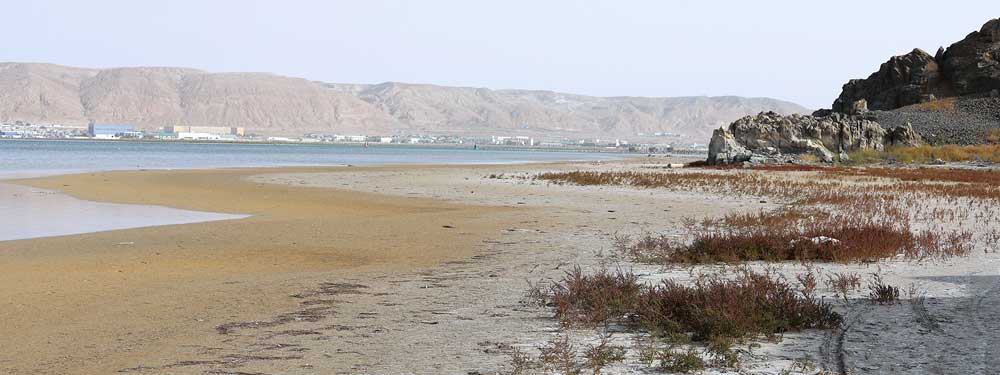
The level of the Caspian Sea continues to drop rapidly — over the past 15–20 years, the water has receded dozens of meters, exposing vast areas of former seabed. The coastline of the Turkmenbashi Bay and the Garabogazgol Bay has changed dramatically: where the sea was present quite recently, today there are salt flats, sandy plains, and gradually forming new ecosystems.
In his article published in the newspaper «Neutral Turkmenistan» (10 January 2026), Pirli Kepbanov, Director of the National Institute of Deserts, Flora and Fauna of Turkmenistan, Candidate of Biological Sciences, shares the results of observations and expeditionary research on the natural colonization processes of these newly emerged territories.
Nature step by step is settling the “empty” land: from the first pioneers — annual euhalophytes (Salicornia europaea, Suaeda maritima, Atriplex) — to the formation of a fully “desert-like” appearance with psammophytes, Nitraria komarovii, and the famous “desert birches” — Conolly’s sand acacia (Ammodendron conollyi).
These observations and research results can be applied to the phytomelioration of saline lands, creation of fodder areas, and development of adaptation strategies to the ongoing decline of the Caspian Sea level.
Here is the full English translation of the article:
The New Face of the Caspian Shores
Pirli Kepbanov, Director of the National Institute of Deserts, Flora and Fauna of the Ministry of Environmental Protection of Turkmenistan, Candidate of Biological Sciences
The Caspian Sea — the largest inland body of water on the continent and in the world — is subject to significant and difficult-to-predict fluctuations in water level. With the increasing consequences of global climate change, understanding the causes and mitigating the impacts of these fluctuations has become an urgent scientific and political priority for the expert community of the five Caspian coastal states.
Scientists emphasize the need for a comprehensive and interdisciplinary approach to assess historical patterns of the phenomenon, refine predictive models, evaluate impacts on marine ecosystems and biodiversity, and develop strategies for mitigation and adaptation.
Over the past 15–20 years, the water has retreated dozens of meters deeper into the Caspian. The shoreline of the Garabogazgol Bay has moved significantly inland, although Caspian water continues to flow into the bay. In the case of Turkmenbashi Bay, we are already talking about a retreat of a couple of kilometers. A telling example: on an electronic map, a researcher standing on dry land was identified by the satellite app as being in the water far from the shore. Once upon a time, the Turkmenbashi Bay washed the small Garadag ridge, which is still visible from the city of Turkmenbashi. Now there is a saltwort plain with thickets of halophytes — plants adapted to saline soils. As is well known, nature abhors a vacuum, and the land does not remain “ownerless” for long. With the deposition of washed sands, plant residues, wind-blown and organic particles, evaporation of moisture, and the influence of precipitation, the soil began to change its degree of mineralization.
Gradually, over time, the territory freed from water was first colonized by individual plants, and then full plant communities established themselves. The first to appear were the “strong, true” halophytes or euhalophytes — salt-accumulating plants. Participants of the recent expedition — specialists from the National Institute of Deserts, Flora and Fauna and the Khazar State Nature Reserve of the Ministry of Environmental Protection of Turkmenistan — recorded these plants on dried sea bottom.
They should be called pioneers of saline hydromorphic soils, including the Caspian coastal zone.
Plants were assessed according to their position relative to the shoreline, density, condition, and seasonal vegetation. Within such territories, annual species were found: Salicornia europaea (European glasswort), Suaeda maritima (seablite), and Atriplex hortensis (ornamental orache). A bit farther from the shoreline shrubs grow — Halocnemum strobilaceum (Caspian saltwort), a plant that adapt to harsh ecological conditions, serves as good forage, and is tolerant to high salinity. On saline clays covered with a thin layer of wind-blown sand, scattered Tamarix (saltcedar) appear. Their branches and small leaves are covered with salty dust — this is how the plant gets rid of excess absorbed salts.

Separately from the shore, on nearby salt flats, the subshrub Halocnemum strobilaceum (sarsazan) settles — it does not tolerate flooding. Growing at distances of about 35 meters from each other, they accumulate sandy substrate around themselves, forming small elevations, on which spring ephemerals can settle, and in autumn — various red-orange colored saltworts.
The farther one moves from the sea, the more the surveyed territories exhibit the characteristic vegetation of the pre-Caspian deserts. On hummocky substrates with low salinity, psammophytes—plants adapted to sandy environments—become established. Here, on sand hummocks rising up to two meters high, shrubs of Nitraria komarovii grow. These hummocks form beneath the shrubs as wind-blown sand accumulates and is stabilized by their root systems.
Among the larger psammophytes, one frequently encounters the region’s only endemic tree: Conolly’s sand acacia (Ammodendron conollyi). With its light-reflecting foliage, this species is a true ornament of the Karakum Desert. It is typically found in excellent condition, readily producing daughter shoots from dormant buds on drooping branches as well as from root suckers. From a distance, these acacias resemble weeping willows or even small birches—hence the long-standing nickname “desert birches” used by desert researchers. Owing to the thorns on their shoots, the plants are avoided by livestock.
In the pre-Caspian deserts, one can see a large number of dried-up subshrubs by autumn — tree-like astragalus (singren) with long, dry, leafless stems. Shepherds and experienced field workers often use them to quickly start a fire, as they ignite brightly and easily. On dry plants — wormwoods, cherkez, and others — symbiotic organisms settle: lichens consisting of fungi and algae, capable of living for a long time without water and waiting for the favorable moment — rain — to revive and continue developing.

In general, the assessment of the condition and species composition of vegetation in the pre-Caspian deserts—areas that represent promising pasturelands—is conducted seasonally, almost every year, and constitutes one of the principal research directions of the National Institute of Deserts, Flora and Fauna. However, the analysis of processes occurring in a new type of ecosystem—areas newly exposed after the retreat of saline waters—represents a distinct field of natural science research and has significant applied importance.
It should be emphasized that even a visual survey of such territories enables ecologists to trace the pathways by which nature, step by step, transforms landscapes abandoned by the sea. Understanding the sequence of stages through which the shores of saline water bodies evolve into unique ecosystems can inform the development of phytomelioration strategies, including the use of these lands as pastures and for the cultivation of fodder and medicinal halophytes. Moreover, such knowledge may help identify effective approaches to land reclamation, the preparation of territories for alternative forms of use, and their sustainable development and adaptation to meet the needs of both natural ecosystems and human society.
Here, highly saline lands represent a poorly studied type of ecological system which, as a kind of reference model, may be included among the diverse landscape formations of Turkmenistan. Today, scientists are investigating the rate at which vegetation cover appears and spreads, the resilience of living organisms and ecosystems, and their ability to fill abandoned пространства with diverse life forms and prepare them for further transformation.
As a result, groups of camels now move freely among tall, lush shrubs of a robust halophyte—the plant known as salt cedar or tamarisk—and this no longer comes as a surprise. Wild horses also enter such areas to feed on juicy, slightly saline halophytes, and reptiles penetrate these habitats as well; a young saw-scaled viper (Echis) has been recorded. During the autumn–winter period and with the arrival of rains, salt-marsh vegetation loses much of its salt saturation and becomes a succulent, nutritionally valuable forage.
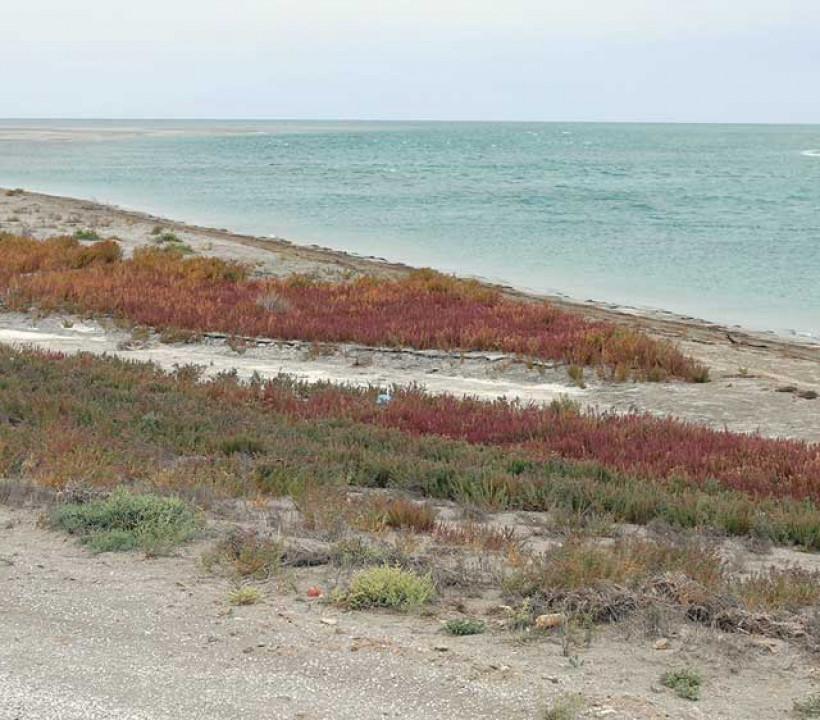
The natural process of colonization of newly formed land areas is reminiscent of the history of the artificial island “Emeli ada,” which emerged during the construction of the International Seaport of Turkmenbashi. At that time, soil excavated for the construction of berths was deposited in designated areas, eventually giving rise to a distinctive ecosystem with its own natural phytostructure. In this context, the experience of studying the emergence and natural spread of vegetation on clayey saline soils and heavily washed marine sands containing shell fragments on this artificial island is particularly illustrative.
The environmental conditions there were initially harsh, owing to the island’s limited size and isolation from the mainland. Over several consecutive years, ecologists conducted systematic research and compiled a comprehensive database. As a result, stable perennial communities of halophytic and xerophytic plants have formed, and the area now more closely resembles a peninsula, as a land connection has since developed. Bird colonies have settled here, nesting among thickets of Artemisia kelleri (reaching up to one meter in height) and A. kemrudica, as well as tamarisk shrubs, various species of southern and Paulsen’s saltwort, glasswort, orache, and seablite.
Although this land area was originally created by human hands, it has ultimately become a space shaped and sustained by nature.
Observation of the transformation of hydromorphic and halomorphic territories (during the spread of halophytes) is necessary to determine the time frames of nature’s transformation. ///nCa, 11 January 2026