


Elvira Kadyrova, Ankara
Binali Yıldırım says the route’s development should go hand in hand with joint production facilities, logistics hubs and the removal of barriers to trade among Turkic states.
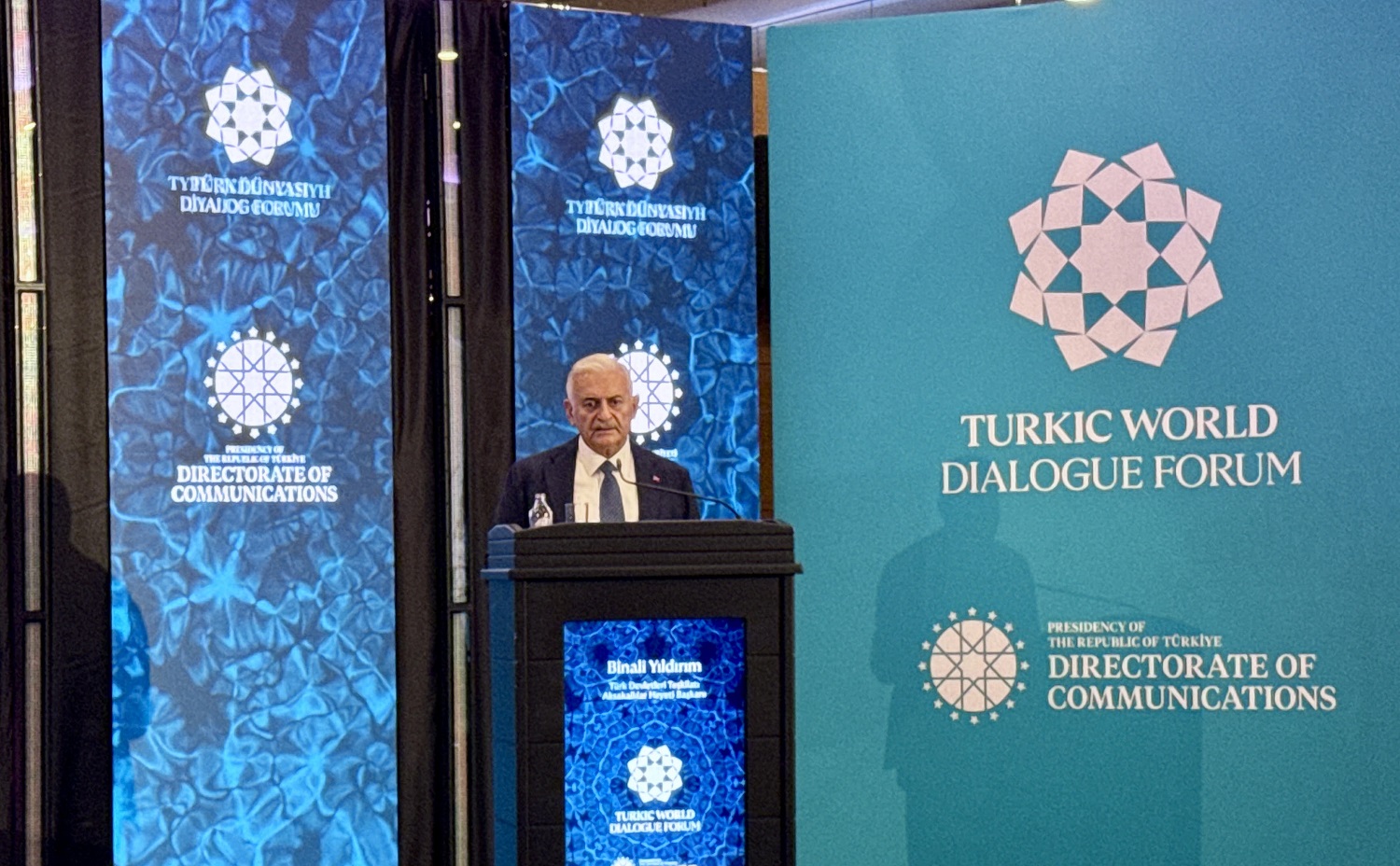
The Middle Corridor should become more than a transport route linking East and West. It should also serve as a platform for economic cooperation, joint production and rising prosperity across the Turkic states. This was stated by Binali Yıldırım, Chairman of the Council of Elders of the Organization of Turkic States (OTS) and former Prime Minister of Türkiye, in his opening remarks at the panel “From the Middle Corridor to a Shared Production Ecosystem: An Economic Model in the Turkic World” at the Turkic World Dialogue Forum in Ankara.
According to Yıldırım, the potential of the Turkic world is determined not only by its geographical position but also by its combined demographic and economic resources. Its territory covers approximately 5 million square kilometres and stretches 8,500 kilometres from east to west, from the Balkans to Lake Baikal. The independent Turkic states have a combined population of 180 million, while their aggregate gross national product is estimated at $2.5 trillion. Their total external trade amounts to around $1.3 trillion. Including Turkic communities and peoples living in other countries, the population of the wider Turkic world could reach 300 million.
Addressing the global economic outlook, Yıldırım said the world economy was developing amid uncertainty, with growth remaining at 2.5–3%. More than 130 countries, he noted, had recorded a decline in GDP compared with the previous year. The world is also home to around 120 million displaced people and 800 million people living in extreme poverty, on less than $3 a day.
He also drew attention to the stark imbalance in the distribution of global wealth: the wealthiest 10% of the population account for three-quarters of the world’s wealth, while the poorest half receive just 2%. In these circumstances, Yıldırım stressed, Turkic states need to work together to reduce economic disparities and expand development opportunities across the region.
The Middle Corridor and its untapped potential
Yıldırım recalled that trade between East and West has historically followed three main routes: the Northern, Middle and Southern corridors. The Northern route connects China with Western Europe through Russia. The Middle Corridor runs from China through Kazakhstan, Turkmenistan, Azerbaijan, Uzbekistan and Türkiye to Europe. The Southern route links the Indian Ocean with Europe via Iran and Türkiye.
In Yıldırım’s assessment, the Middle Corridor offers the greatest added value of the three routes, although actual freight volumes remain far below its potential. According to the figures he cited, around 180 million tonnes of cargo are transported annually along the Northern route, compared with 4.5 million tonnes along the Middle Corridor and 3 million tonnes along the Southern route.
Yıldırım questioned why such a gap persists. He identified multiple administrative procedures and fees along the route as one of the main obstacles. Carriers, he said, are required to repeat similar procedures and pay charges in each transit country. As a result, a journey that could take 11–12 days can stretch to almost a month.
“Transportation in itself is not trade. It is a tool for increasing trade,” he stressed, arguing that transport should not become an end in itself or a source of additional obstacles for businesses.
Yıldırım believes freight volumes along the Middle Corridor could be increased to 30 million tonnes. Achieving this would require wider use of electronic permits, electronic consignment notes and digital customs procedures, simpler transit rules, shorter border-crossing times and better coordination between different modes of transport.
The Caspian Sea also remains a major bottleneck. To increase the corridor’s capacity, Yıldırım said, the number of vessels needs to grow, transport management should be improved and port capacity expanded. Developing individual sections will not ensure the efficient operation of the entire route if constraints remain elsewhere along the corridor.
In this context, Yıldırım called on the OTS to continue systematically assessing the strengths and weaknesses of its member states. Such work, he said, is already being carried out under the strategic document Turkic World Vision 2040 and its four-year action plans. He emphasised that implementing the objectives requires consistent efforts by heads of state, ministers and relevant government agencies.
From a transport route to a shared economic system
Yıldırım identified the development of joint production and logistics infrastructure along the entire route as the key to turning the Middle Corridor into a fully fledged driver of economic growth.
“The Middle Corridor is a corridor of prosperity, an economic corridor, a corridor of history and culture,” he said.
In his view, Turkic states should establish joint manufacturing facilities and logistics centres all along the route, from its starting point to its destination.
As one possible model of cooperation, he suggested building production and distribution chains linking several countries: goods could be manufactured in one country, stored in another and sold in the markets of a third, taking into account their geographical position and proximity to consumers.
Yıldırım also highlighted the imbalance between the scale of the Turkic states’ external trade and the volume of trade within the group. While their combined external trade stands at around $1.3 trillion, mutual trade among them, he said, has yet to reach even $50 billion.
He urged the countries to focus on expanding trade within the Turkic world so that economic growth and rising prosperity would increasingly be driven by cooperation among the countries of the region themselves.
One of the long-term objectives, he said, should be to create conditions for the virtually uninterrupted movement of goods from Hungary through Türkiye, the Caucasus and Central Asia to East Asia.
Once the necessary documents — identification, a consignment note and a permit — have been presented at the point of departure, Yıldırım argued, cargo should be able to proceed to its destination without having to undergo the same procedures repeatedly at every stage of the journey.
Shared identity and people-to-people ties
In his remarks, Yıldırım also addressed institutional and humanitarian integration. He said the OTS Council of Elders was intended to bring to the attention of government authorities the problems faced by citizens of member states and help find solutions in areas ranging from transport and culture to education and everyday life.
He identified work on a common Turkic alphabet as an important step towards closer ties. Yıldırım linked the idea of linguistic unity to Ismail Gasprinsky and his principle of “Unity in language, thought and action”. Some countries, he said, have already adopted the common alphabet, while others are preparing their plans for its introduction.
He placed particular emphasis on youth exchanges. The Orhun exchange programme, which he compared with Europe’s Erasmus programme while stressing that it was not a copy of it, should be significantly expanded. The goal, he said, should be for at least 10% of university students to take part in educational exchanges or study in another Turkic country.
Yıldırım said that around 30,000 students in Türkiye currently participate in such exchange programmes, describing this figure as insufficient. In the longer term, he believes annual exchanges between universities across the Turkic states should involve 1.5 million students.
Concluding his remarks, Yıldırım said the geographical position of the Turkic world would retain its strategic importance regardless of the direction in which the centres of global economic development shift. The region linking Anatolia, the Balkans, the Caucasus and Turkestan, he said, would remain a vital route for the movement of goods and wealth between East and West.
“This 8,500-kilometre route will continue to be indispensable for the movement of economic flows from East to West and in the opposite direction,” Yıldırım concluded.
///nCa, 31 October 2026