


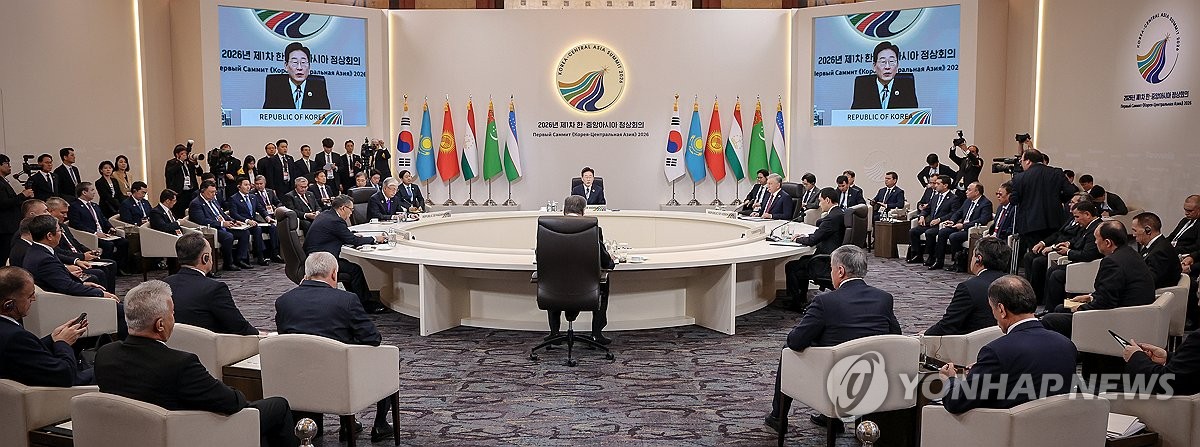
The presidents of the Republic of Korea and the five Central Asian countries — Turkmenistan, Kazakhstan, Kyrgyzstan, Tajikistan and Uzbekistan — adopted the Seoul Declaration, outlining long-term areas of cooperation and a new institutional framework for engagement between the sides. The document was adopted in Seoul on September 16 following the first Korea–Central Asia Summit.
The full text of the Declaration was published by the Korean online media outlet Joseilbo.
One of the key decisions set out in the Declaration is to hold the summit of heads of state every two years on a regular basis. In years when the summit is not held, the Korea–Central Asia Cooperation Forum at the foreign ministerial level will be used to review the implementation of agreements reached at the previous summit, prepare the agenda for the next summit and coordinate positions.
Kazakhstan expressed its desire to host the second summit in Astana in 2028, and the other countries supported this initiative.
From Dialogue to an Institutionalized Partnership
The Seoul Declaration formalizes the transition of Korea–Central Asia relations to a new level. The document identifies four main areas:
- Institutionalization of the partnership between the Republic of Korea and Central Asia;
- Moving together toward peace and stability;
- A future oriented toward innovation and prosperity;
- Building connections through people and trust.
In addition to regular summits, the Declaration provides for the development of consultation mechanisms at various levels.
In particular, the leaders welcomed the establishment of the Korea–Central Asia Senior Officials’ Meeting at the vice-ministerial level and highlighted the importance of parliamentary, think tank and local government forums in further expanding cooperation.
Trade, Investment and New Value Chains
A substantial part of the Declaration is devoted to economic cooperation. The heads of state supported the establishment of a consultation mechanism between the industry ministers of the Republic of Korea and the Central Asian countries, as well as the signing of a memorandum of understanding on industrial and supply chain cooperation.
The sides intend to expand trade and diversify its structure, strengthen manufacturing capabilities and hold consultations on removing non-tariff barriers.
In this regard, the leaders noted that the establishment of dedicated Korean Desks within government agencies in Central Asian countries would contribute to facilitating trade, promoting investment and improving the business environment, within the framework of each country’s international obligations.
Particular attention is given to the textile and light industries, including investment, technological cooperation and the development of value chains.
The Declaration also addresses cooperation in urban development, the construction of production facilities and infrastructure, including new-city projects and the development of national park infrastructure.
Critical Minerals and Energy
One of the central areas of the economic section of the Declaration is critical minerals. The leaders recognized their importance for economic security and supply-chain diversification and expressed interest in combining Central Asia’s natural-resource potential with South Korea’s technological capabilities.
The focus spans beyond raw-material supplies to the creation of joint value-added production chains, including processing, industrial localization, scientific and technological cooperation, and human-resource development. This approach reflects a broader shift from resource-based cooperation toward cooperation further along production chains.
The energy section covers cooperation in the oil and gas and petrochemical sectors, natural gas processing and the modernization of energy infrastructure using Korean technologies. Potential cooperation was also identified in hydropower, renewable energy, energy efficiency and the development of clean-energy technologies.
Transport, Digitalization and New Technologies
The Declaration places significant emphasis on improving transport and logistics connectivity. The sides agreed to promote the modernization of transport systems, the development of multimodal transport, transport corridors and logistics hubs, including dry ports and customs infrastructure.
The economic agenda is complemented by digital transformation and the development of new technologies. The Declaration provides for expanded cooperation in artificial intelligence, digital technologies, science and innovation, as well as the digitalization of public administration, manufacturing, agriculture, statistics, public procurement and government services.
Particular attention is given to supporting small and medium-sized enterprises and startups, including those working in AI, information technology and the green economy.
Peace, Climate and People-to-People Ties
Beyond the economic agenda, the leaders addressed international and regional security issues. They reaffirmed their commitment to the complete denuclearization of the Korean Peninsula and the establishment of lasting peace, and highlighted the importance of the Central Asian Nuclear-Weapon-Free Zone. The Declaration also calls for cooperation in addressing terrorism, illicit drug trafficking, cyber threats, transnational crime and irregular migration.
The environmental section of the document covers climate change, emissions reduction, low-carbon technologies, ecosystem conservation, efficient use of water resources, renewable energy, sustainable transport, forestry, and efforts to combat desertification and land degradation.
Separate sections address healthcare, education, culture, air connectivity, vocational training and exchanges among government officials.
A special place is given to cooperation concerning Koreans in Central Asia. The leaders highlighted their role as a historical bridge between Korea and Central Asia and supported expanding academic exchanges and joint research.
The Seoul Declaration thus establishes a broad framework for cooperation extending beyond trade and natural resources. Alongside investment, industry, critical minerals, energy and infrastructure, it covers artificial intelligence, digitalization, science, climate, water resources, education, culture and people-to-people ties. ///nCa, 16 September 2026 (photo credit: Yonhap)