


The economic cooperation between Turkmenistan and the Republic of Korea is gradually expanding beyond individual large-scale industrial projects. Alongside the construction of industrial facilities, technology transfer, training for local specialists, modernization of production facilities, and localization are gaining increasing importance.
A prime example of this new phase is the development of shipbuilding on Turkmenistan’s Caspian coast.
Balkan Shipyard: Joint Production and Technology Transfer
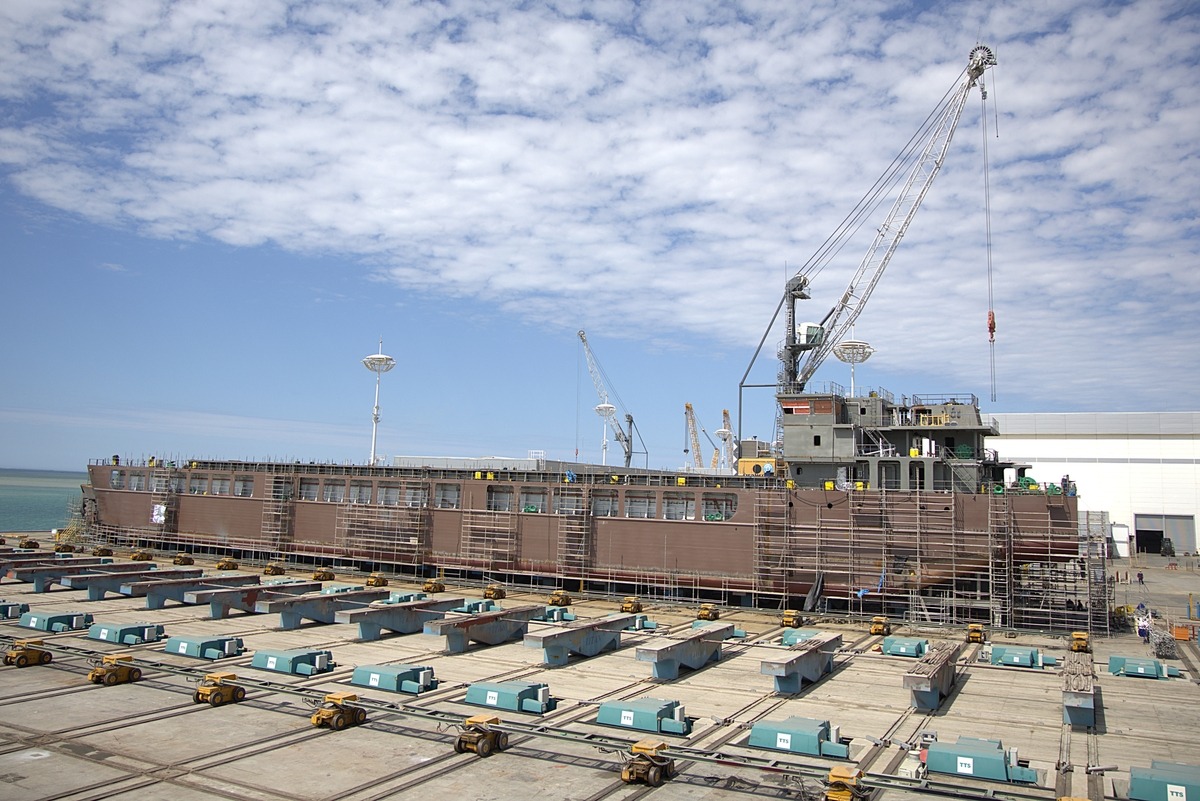
According to a report by the South Korean news agency Yonhap published on 2 September, construction of a 6,100-ton multipurpose cargo vessel continues at the Balkan Shipyard in Turkmenistan. The project is being carried out in partnership with the South Korean company Korea Shipbuilding Industry Technology (KSIT).
The first vessel in the series was delivered in May 2026, and construction of the second is underway. At the time of a visit by Korean journalists in late June, equipment installation on the second vessel had reached approximately 77% completion. Around 700 people are working on site, including more than 50 KSIT specialists.
Sung Gwang-mok, Executive Vice President of KSIT, expressed readiness to participate in building subsequent vessels, including multipurpose cargo ships and combined cargo-passenger vessels.
However, the collaboration extends far beyond building a few ships.
Korean experts are involved in modernizing the shipyard itself, introducing robotic welding systems, and implementing automated production methods. In parallel, training for Turkmen personnel is underway: local workers receive instruction from Korean specialists and apply their new skills directly on the production floor. This approach helps build native engineering and manufacturing expertise over time.
The Next Phase: Localization
Production localization is taking on particular significance in this partnership.
Currently, a substantial portion of the components required for shipbuilding—including piping systems—is manufactured in South Korea and delivered to Turkmenistan. However, KSIT and the Balkan Shipyard are exploring the possibility of establishing local facilities for pipe fabrication and galvanization processes.
In the long term, this could create a foundation not only to support Turkmenistan’s domestic shipbuilding industry, but also to enter the broader market of the Caspian region. The expansion of shipbuilding cooperation creates opportunities to build a regional supply chain that could potentially encompass Kazakhstan, Azerbaijan, and other Caspian littoral states.
Thus, the partnership has evolved beyond equipment delivery or single facility construction. A manufacturing ecosystem is taking shape, simultaneously developing technology, human resources, and a local industrial base.
Turkmen Gas: Processing Potential Over Direct Exports
Another key area for potential cooperation remains the gas chemical industry.
Turkmenistan holds some of the world’s largest natural gas reserves; however, its geographical location presents objective challenges for direct supplies to distant markets, including South Korea. Transporting Turkmen gas to Korea would require navigating existing pipeline networks, transit through third countries, potential Caspian Sea routes, and overall economic feasibility.
Under these conditions, a more promising model for South Korean business involves participating in projects that process Turkmen gas locally into high-value-added products. This includes gas chemical facilities, fertilizer production, and other industrial projects where natural gas serves as a feedstock for processing rather than a final export commodity.
In this context, the fertilizer plant project being undertaken in Turkmenistan by Daewoo Engineering & Construction is of particular interest. Producing fertilizers from natural gas generates added value directly within the country, allowing Turkmenistan to expand its processing capacity instead of exporting raw resources.
A New Model of Cooperation
Economic relations between South Korea and Turkmenistan hold the potential to advance to a higher level—transitioning from single contracts to long-term industrial partnerships.
The experience at the Balkan Shipyard demonstrates that such a model can integrate construction, modernization, technology transfer, workforce training, and localization into a single framework.
For Turkmenistan, this presents an opportunity to strengthen its domestic industrial base and systematically increase the share of high-value-added goods.
For the Republic of Korea, it offers a pathway to anchor its presence in Central Asia’s emerging supply chains by delivering not just equipment and engineering solutions, but also proven technological expertise. /// nCa, 9 September 2026