


nCa Commentary
The strategic collaboration between Turkmenistan and Korea maintains an unwavering trajectory of focused execution. Built on mutual respect, long-term economic synergies, and a high degree of technical synergy, this partnership continues to be a driving engine behind Turkmenistan’s industrial modernization and economic diversification.
Rather than relying merely on general declarations, the Turkmen-Korean relationship is distinguished by direct industrial implementation. With a solid portfolio of joint achievements and newly signed strategic agreements, both nations are setting the stage for an expanded, technology-driven partnership.
1. What Is Already There: Anchors of Technological and Industrial Success
Korean industrial giants—including Hyundai Engineering, LG International (LX), Daewoo Engineering & Construction, and SK—have long established themselves as key contributors to Turkmenistan’s high-tech downstream capacity. The concrete foundation of this partnership is reflected across several cornerstone projects:
- Gas Desulfurization & Processing Infrastructure: Korean technology played a key role in developing processing facilities at Galkynysh, one of the world’s largest gas fields, laying the bedrock for national export capacity.
- Petrochemical and Gas-Chemical Leadership: The Kiyanly Polymer Complex in Balkan velayat stands as a landmark project constructed by Korean and international consortiums, processing natural gas into high-value polyethylene and polypropylene.
- Modernization of Refineries: Korean expertise has contributed significantly to modernizing the Turkmenbashi Complex of Oil Refineries (TKOR), upgrading processing standards and environmental efficiency.
- Urban Transit and Public Fleet Integration: Korean automotive engineering has become an integral part of Turkmen urban life, with thousands of modern Hyundai buses and vehicles operating seamlessly across Ashgabat and the provinces.
- Solid Investment Footprint: Over 17 major investment projects involving Korean enterprises have been registered in Turkmenistan, totaling over $12 billion in value.
2. Emerging Horizons: Where Scope for Collaboration Expands
Building on this existing foundation, recent high-level business forums and bilateral summits—supported by the trade-investment framework agreements (TIFA) and investment protection agreements—have opened promising avenues for deeper collaboration:
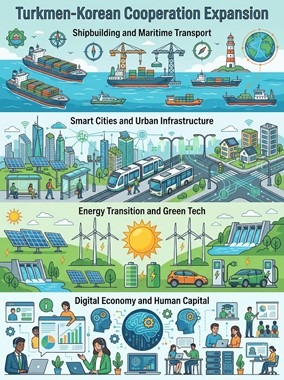
A. Maritime Logistics and Shipbuilding at Turkmenbashi Seaport
As Turkmenistan expands its presence along the Trans-Caspian International Transport Route, maritime logistics has emerged as a high-priority front.
- Cooperation agreements with Korean shipbuilders are paving the way for joint ship construction, vessel repair, and technological transfer at the Balkan Shipbuilding and Shiprepair Plant in Turkmenbashi.
- Modernizing maritime logistics using Korean port-management technology will streamline cargo flows across Eurasian transit corridors.
B. Smart Cities, Arkadag, and Urban Infrastructure
Korea’s global leadership in urban technologies aligns directly with Turkmenistan’s mega-projects, notably Arkadag City—the country’s flagship “smart city.”
- Collaboration opportunities span intelligent transport management, AI-driven municipal services, energy-efficient building systems, and digital civic administration.
- Joint urban development models provide Korean tech firms an ideal platform to co-design sustainable urban centers in Turkmenistan.
C. Green Energy Transition and Climate Action
As global industrial standards pivot toward decarbonization, Turkmenistan and Korea are building clean energy frameworks:
- Memorandum of Understanding (MoU) frameworks between environmental agencies cover digital forest restoration, land management, and joint action on climate change.
- Potential projects include methane reduction technologies, capture and utilization of industrial emissions, and joint feasibility studies on green and blue hydrogen production.
D. Digital Innovation, Cultural Exchange, and Academic Links
Beyond heavy infrastructure, the human and technological link continues to widen:
- IT Joint Ventures: Emerging Turkmen-Korean IT partnerships are creating solutions for enterprise digitalization and software localization.
- Education & Scientific R&D: Academic exchanges between universities, vocational engineering training, and scientific research in material science ensure local technical leadership for future plants.
- Cultural Synergies: Agreements between national cultural centers foster language training, arts exchanges, and educational programs, reinforcing deep social ties between the two nations.
3. Sustaining Momentum: A Future Built on Trust
The steady rhythm of bilateral exchanges, parliamentary dialogues, and economic committee meetings underlines a simple reality: the Turkmen-Korean economic and technological alliance operates on long-term vision rather than temporary political cycles.
By integrating Korean high-tech innovation with Turkmenistan’s rich resource base, strategic position, and modern logistics infrastructure, both nations are uniquely positioned to shape the economic landscape of Central Asia for years to come. /// nCa, 27 October 2026