


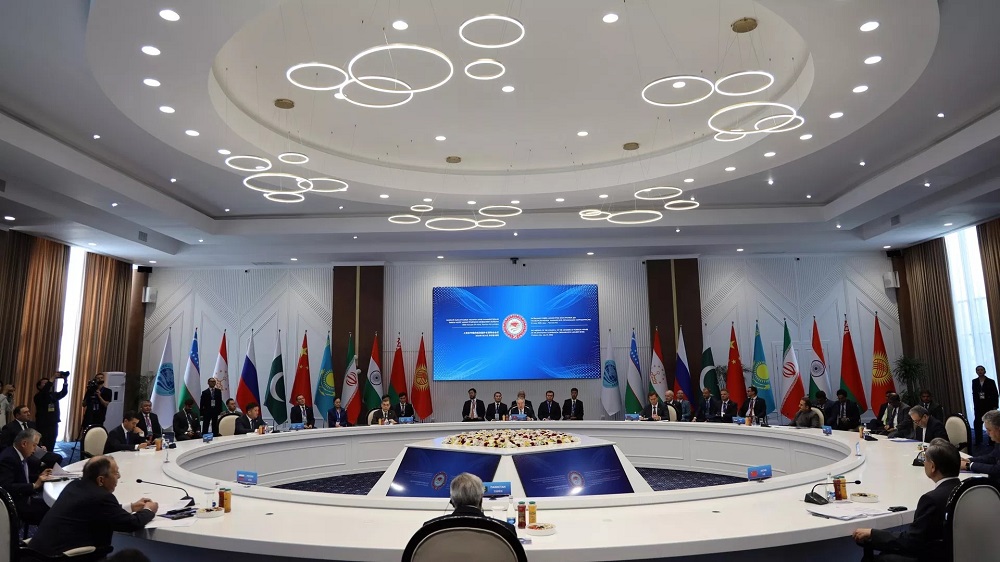
1. Participants and Related Events
The Council of Ministers of Foreign Affairs (CMFA) of the Shanghai Cooperation Organization (SCO) met on 24 July 2026 in Cholpon-Ata, Kyrgyz Republic, under the Kyrgyz chairmanship. The meeting constituted the principal ministerial preparation for the Council of Heads of State Summit, scheduled for 1 September 2026 in Bishkek, which will also coincide with the 25th anniversary of the SCO.
The meeting brought together the foreign ministers or official representatives of all ten SCO member states:
- Belarus
- China
- India
- Iran
- Kazakhstan
- Kyrgyz Republic
- Pakistan
- Russia
- Tajikistan
- Uzbekistan
The meeting was attended by SCO Secretary-General Nurlan Yermekbayev and representatives of the organization’s permanent bodies. Delegations also held numerous bilateral meetings on the margins of the conference, reflecting the increasingly important role of SCO ministerial gatherings as venues for parallel diplomatic engagement.
The Foreign Ministers’ Meeting concluded a series of SCO events held in Cholpon-Ata during the preceding week:
- 19–22 July: Meeting of the Council of National Coordinators, which finalized draft documents for both the Foreign Ministers’ Meeting and the September summit.
- 21 July: Meeting of SCO Ministers of Culture.
- Meetings of the SCO Youth Council and several expert-level consultations held under the Kyrgyz chairmanship.
These preparatory activities demonstrate that the organization continues to rely on extensive technical coordination before decisions are elevated to the level of heads of state.
2. Main Outcomes of the Meeting
Although the meeting did not announce major new initiatives, it successfully completed its principal task of preparing the agenda and documentation for the September summit.
Preparation of summit documents
The ministers completed consideration of draft documents that will be submitted to the heads of state. These reportedly include:
- the Bishkek Declaration commemorating the 25th anniversary of the SCO;
- several thematic statements by the heads of state;
- institutional decisions concerning the future work of the organization;
- the Secretary-General’s annual report.
The National Coordinators had already substantially prepared these documents during their earlier meeting, allowing ministers to focus primarily on political approval rather than extensive negotiations.
Exchange of views on regional and international issues
The ministers reviewed developments affecting Eurasia, including regional security, political stability and economic cooperation.
While public communiqués remain deliberately general, discussions reportedly covered:
- regional security;
- economic and transport connectivity;
- strengthening multilateral cooperation;
- preparations for future SCO initiatives under the Kyrgyz chairmanship.
As is customary within the SCO, no attempt was made to issue detailed positions on every international issue. Instead, the meeting emphasized consensus-building and preserving unity among members with increasingly diverse foreign policy priorities.
Emphasis on the 25th anniversary
The anniversary provides an opportunity for the organization to present itself as a mature Eurasian institution rather than simply a regional security grouping.
Official statements repeatedly highlighted:
- the “Shanghai Spirit”;
- sovereign equality;
- non-interference;
- consensus-based decision-making;
- expansion of cooperation in security, economy, culture and people-to-people exchanges.
These themes are expected to feature prominently during the September summit.
Bilateral diplomacy
As in previous SCO ministerial meetings, much practical diplomacy occurred on the sidelines.
Foreign ministers held bilateral meetings covering:
- political relations;
- trade;
- transport connectivity;
- regional security;
- preparations for future chairmanships and upcoming high-level visits.
For many participating countries, these bilateral consultations remain one of the principal practical benefits of SCO gatherings.
3. Assessment: What to Expect from the September Summit
The Foreign Ministers’ Meeting suggests that the Bishkek Summit is likely to emphasize continuity rather than institutional transformation.
Greater focus on implementation
The organization has gradually accumulated a substantial number of declarations, action plans and cooperation mechanisms. The September summit is therefore likely to place greater emphasis on implementation of existing initiatives rather than announcing ambitious new institutional structures.
Connectivity will remain important
Transport, logistics and trade facilitation are expected to remain prominent themes, reflecting growing interest in Eurasian connectivity.
However, the summit is unlikely to endorse any single transport corridor as the organization’s preferred route. Instead, it is expected to continue supporting broader regional connectivity while allowing member states to pursue their respective infrastructure priorities.
Security cooperation will continue incrementally
Security remains the SCO’s traditional core function.
The summit is likely to reaffirm cooperation against:
- terrorism;
- separatism;
- extremism;
- transnational organized crime;
- narcotics trafficking;
- cyber threats.
No major restructuring of the SCO’s security mechanisms appears likely at this stage.
Afghanistan will remain on the agenda
Afghanistan continues to influence regional security calculations, particularly for Central Asian members.
The summit is expected to reiterate support for a peaceful, stable and economically integrated Afghanistan while encouraging greater regional engagement. Nevertheless, significant policy changes toward the current Afghan authorities appear unlikely because member states continue to maintain differing bilateral approaches.
Consensus will continue to shape outcomes
The most important structural characteristic of the SCO remains its consensus-based decision-making.
With the organization now including countries that have differing strategic interests—including China, Russia, India, Pakistan and Iran—the scope for highly ambitious collective decisions is naturally limited.
This does not necessarily reduce the SCO’s value. Rather, it reinforces its primary function as a platform for dialogue, confidence-building and gradual cooperation among states that may disagree on important geopolitical questions but still share an interest in maintaining regional stability.
Overall Assessment
The July 2026 Foreign Ministers’ Meeting indicates that the SCO remains institutionally stable and politically active. The organization continues to expand practical cooperation while carefully avoiding issues that could undermine internal consensus.
The September 2026 Bishkek Summit is therefore likely to produce a substantial package of political declarations and cooperation documents marking the SCO’s 25th anniversary. However, expectations of major institutional reform or far-reaching strategic shifts should remain measured. The organization’s strength continues to lie in incremental consensus-building rather than rapid policy innovation, and the forthcoming summit is expected to reinforce that established pattern. /// nCa, 27 July 2026