


nCa Report
The Commonwealth’s 35th anniversary summit adopted 15 documents, designated 2029 as the Year of CIS Transport Connectivity and outlined priorities for economic cooperation. Iran’s participation added a new regional dimension, while Uzbekistan prepared to assume the CIS chairmanship in 2027.
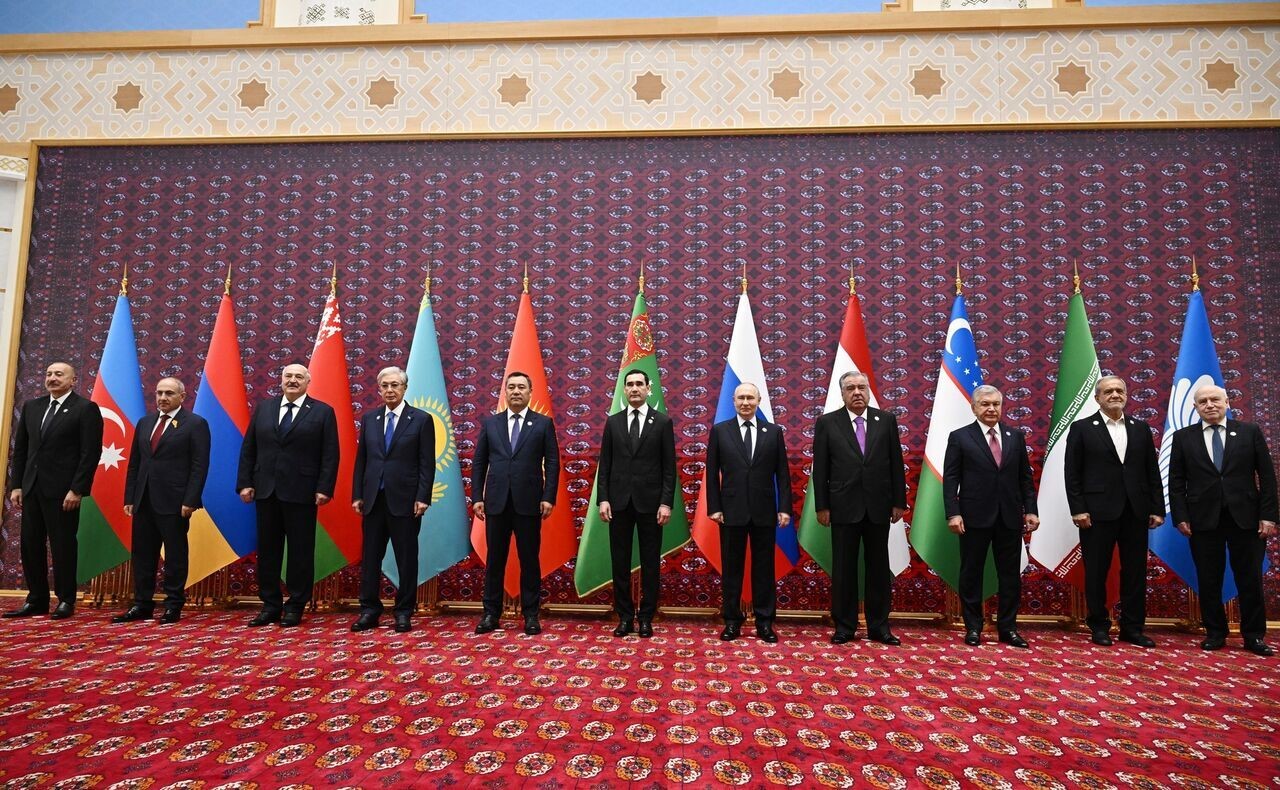
A summit focused on continuity and practical cooperation
The 35th anniversary meeting of the Council of Heads of State of the Commonwealth of Independent States (CIS), held on 9 October in Turkmenistan’s Awaza National Tourist Zone, combined an assessment of the organisation’s achievements with decisions intended to guide its future work.
Chaired by President Serdar Berdimuhamedov, the meeting brought together the leaders of Azerbaijan, Belarus, Kazakhstan, Kyrgyzstan, Russia, Tajikistan and Uzbekistan, as well as Armenian Prime Minister Nikol Pashinyan. CIS Secretary-General Sergey Lebedev also participated. Iranian President Masoud Pezeshkian attended as a special guest, marking the first participation of an Iranian head of state in a CIS Council of Heads of State meeting, according to Turkmenistan’s official account.
The summit adopted 15 documents covering institutional arrangements, transport connectivity, social development, population censuses, historical memory, information policy and cooperation against information-technology-related crime. The decisions included the transfer of the CIS chairmanship to Uzbekistan in 2027, the designation of 2028 as the Year of Social Development and Quality of Life, and the designation of 2029 as the Year of CIS Transport Connectivity.
The meeting took place against a background of changing international trade routes, economic uncertainty and renewed attention to regional transport infrastructure. Its agenda reflected an effort to preserve established relationships while identifying areas in which cooperation can produce practical benefits.
For Turkmenistan, the summit was also an opportunity to advance priorities developed during its 2026 chairmanship: transport and transit, economic diplomacy, humanitarian cooperation, environmental concerns and respect for international law.
The significance of Awaza will ultimately depend on whether the decisions made there translate into coordinated programmes, investment and measurable results.
President Berdimuhamedov’s message: connectivity, neutrality and international law
In his opening address, President Serdar Berdimuhamedov described the Council of Heads of State meeting as the Commonwealth’s key event of the year. Its purpose, he said, was to review work already undertaken and establish priorities for the period ahead.
Assessing the CIS’s 35-year history, he argued that the organisation had preserved the foundations of cooperation despite objective difficulties.
“Despite objective difficulties, we have managed to preserve the foundations of cooperation and ensure its equal, respectful and mutually beneficial nature,” the president said, according to the published Russian transcript.
He pointed to the development of trade and economic relations, political and diplomatic consultations, cultural and humanitarian exchanges, and interparliamentary cooperation. He also reviewed the meetings held during Turkmenistan’s chairmanship, including sessions of the Council of Heads of Government, the Council of Foreign Ministers and the Economic Council, as well as meetings of sectoral bodies.
Berdimuhamedov thanked participating delegations for their cooperation and CIS Secretary-General Sergey Lebedev for his contribution to coordinating the organisation’s work.
The address was notable for connecting the immediate CIS agenda with Turkmenistan’s wider foreign-policy priorities. The president highlighted the importance of international law and the UN Charter, while presenting transport connectivity as an area in which the Commonwealth could make a tangible contribution to economic development.
He also informed the participating leaders about decisions taken at Turkmenistan’s recent Halk Maslahaty meeting. These included the National Strategy for Industrial Development for 2030–2045, the State Programme on Youth Policy through 2031, the national concept “International Law and Neutrality of Turkmenistan”, and legislation on state protection of Akhal-Teke horses.
The references served to place Turkmenistan’s domestic development agenda alongside its priorities for international cooperation.
Transport connectivity as a strategic priority
Berdimuhamedov placed particular emphasis on transport infrastructure and the need to unlock the Commonwealth’s collective logistical potential.
Turkmenistan proposed declaring 2029 the Year of CIS Transport Connectivity. The president described the initiative as a basis for active, targeted and systematic joint work.
He also called on CIS countries to contribute to international cooperation on sustainable transport, referring to the UN Decade of Sustainable Transport for 2026–2035, an initiative promoted by Turkmenistan and proclaimed by the UN General Assembly.
Ashgabat, he said, was ready to consult with its partners and develop practical proposals for implementing the decade’s objectives both within the CIS and at the United Nations.
The president linked this agenda to the UN General Assembly resolution on cooperation between the United Nations and the CIS, adopted on 26 August 2025, and to the Awaza Political Declaration adopted at the Third UN Conference on Landlocked Developing Countries in Turkmenbashi in August 2025.
A central concern was ensuring that transport and transit corridors remained accessible to all countries, including those without direct access to the sea.
“The Caspian region is an important link in transport connectivity,” Berdimuhamedov said in substance, identifying the eastern and western Caspian routes of the North–South corridor as particularly important.
He also stressed the growing role of industrial and technological cooperation and the creation of production chains across participating countries.
The message was consistent with Turkmenistan’s broader approach to connectivity: infrastructure should facilitate trade and transit, while international cooperation should help ensure that landlocked economies are not disadvantaged by geography.
For the region, the next challenge is to turn these principles into operational arrangements. New infrastructure must be supported by efficient border procedures, compatible transport systems, predictable transit conditions and reliable information exchange.
The designation of 2029 provides a timetable for pursuing this agenda, but the summit announcement alone does not establish a new integrated transport system. That will require further agreements and practical implementation.
International law as a common foundation
The other major theme in Berdimuhamedov’s address was the defence of international law and the UN Charter.
He recalled that, on Turkmenistan’s initiative, the UN General Assembly had proclaimed 2028 the International Year of International Law. He thanked CIS countries that supported the resolution and contributed to its adoption.
Berdimuhamedov said Turkmenistan’s initiative reflected a firm political and moral conviction that the legal foundations of international relations and the UN Charter should remain central to global security.
This position is consistent with Turkmenistan’s policy of permanent neutrality and its emphasis on peaceful diplomacy, sovereign equality and cooperation through multilateral institutions.
It also provides a wider context for the transport agenda. In Turkmenistan’s approach, connectivity is not solely a commercial or infrastructural matter; it is part of a broader effort to create conditions for cooperation among countries with different national interests and international relationships.
Uzbekistan’s economic proposals: moving from trade to joint production
President Shavkat Mirziyoyev used his address to argue that the CIS should make better use of the combined economic potential of its participating countries.
“We need to move gradually from the simple exchange of goods to the joint creation of full-fledged value chains,” he said.
The Uzbek president explained that this would involve producing together, investing, developing technologies and entering international markets with jointly developed products. Such cooperation, he argued, could create enterprises, employment and higher incomes.
The proposal points to an important distinction between conventional trade and deeper industrial cooperation. Trading finished products can sustain commercial relationships, but cross-border value chains can create additional opportunities through shared processing, technology, investment and distribution.
Mirziyoyev identified several areas requiring attention.
He called for the full functioning of the CIS Free Trade Area without restrictions, the removal of technical barriers, mutual recognition of conformity certificates and broader access to public procurement.
He also proposed connecting special economic zones and industrial parks across CIS countries into a single network, supported by a roadmap for cooperation.
Food security was another priority. Uzbekistan called for progress on an agreement expanding mutual access to public procurement of agricultural products and a CIS food-security cooperation programme. Mirziyoyev also proposed advance notification and consultations before restrictions are introduced on exports of food and fertilisers.
Such a mechanism could help governments anticipate disruptions and reduce the risk that unilateral measures unexpectedly affect neighbouring markets. Its effectiveness would depend on the procedures ultimately agreed and the willingness of governments to consult.
Energy cooperation formed another part of the programme. Mirziyoyev called for a long-term assessment of regional energy connectivity to identify seasonal surpluses and shortages, infrastructure needs and opportunities to combine hydropower, thermal generation and renewable energy.
He said Uzbekistan had developed a programme for innovative development of the CIS energy sector and an accompanying action plan.
On climate policy, he proposed a CIS concept for cooperation in resource efficiency and the circular economy, including the accelerated introduction of low-carbon technologies.
These were proposals for further work, rather than evidence that the proposed mechanisms had already been established.
Cybercrime and cross-border security
Mirziyoyev also highlighted the growing threat of cybercrime and online fraud.
“Fraud by using information technologies is already causing serious damage to citizens and businesses and creates risks for the stable operation of the financial systems of our countries,” he said.
He proposed instructing the CIS Council of Ministers of Internal Affairs to develop measures for establishing a joint contact centre to respond rapidly to transnational cybercrime and fraudulent schemes.
The proposal addresses a problem that increasingly crosses national jurisdictions. Effective responses can require rapid communication between law-enforcement agencies, financial institutions and other competent authorities.
A joint contact centre could facilitate such cooperation, although its practical value would depend on agreed operating procedures, legal safeguards and the ability to exchange information promptly.
Mirziyoyev also proposed expanding cultural and humanitarian cooperation, including through the development of creative industries and a proposed forum on cultural policy and creative industries.
His address thus combined economic integration with a wider agenda covering food security, energy, digital security and human development.
Iran proposes a “CIS+1” framework
Iranian President Masoud Pezeshkian’s participation added a significant dimension to the summit. Iran was invited as a special guest, and its president used the occasion to propose a more structured framework for cooperation with CIS countries.
According to Iran’s official IRNA news agency, Pezeshkian presented the proposal as an opportunity to strengthen existing ties and expand cooperation in transport, energy, trade, investment, technology, environmental protection, tourism, and scientific and cultural exchanges.
The proposed “CIS+1” format would bring Iran and CIS member states together in a flexible mechanism for dialogue and cooperation. It was an Iranian proposal; the summit’s published list of adopted documents does not identify the creation of such a framework as an agreed CIS decision.
Pezeshkian emphasised the strategic importance of connecting transport routes and avoiding unnecessary competition between them.
“Our shared interests lie not in competition between routes, but in connecting routes,” he said, as reported by IRNA.
He highlighted Iran’s geographical position between Central Asia, Eurasia and the open waters of the Persian Gulf and Sea of Oman. He also pointed to the potential of Iran’s southern ports, particularly Chabahar, to connect regional economies with South Asia, Africa and Europe.
The Iranian president argued that the North–South and East–West corridors should be understood as parts of a wider regional network rather than competing projects.
He also called for greater cooperation in energy production, transmission and exchange, including oil, gas, electricity and renewable energy. Practical financial and barter arrangements, he suggested, could help sustain trade and economic cooperation despite external restrictions.
Pezeshkian’s wider argument was that regional countries should develop greater resilience through connectivity, cooperation and interdependence.
“Connectivity instead of fragmentation, cooperation instead of exhausting competition, interdependence instead of one-sided dependence,” was the principle he articulated in his address, according to Iranian reporting.
The proposal is relevant to Turkmenistan because it brings together several of the country’s established priorities: Caspian transport, north–south connections, access to international markets and stronger links between Central Asia and neighbouring regions.
However, the commercial prospects of any such arrangement would depend on infrastructure, transit conditions, financing, market demand and the policies of participating governments. The proposal should therefore be understood as an opening for further discussion rather than an established regional mechanism. It would also depend on the political inclination to fully use the available infrastructure options.
Russia stresses economic relations and the Russian language
President Vladimir Putin presented the CIS as an important platform for preserving economic, social, cultural and humanitarian ties among its participating countries.
He described the organisation as an authoritative regional integration structure and emphasised the continuing role of the Russian language in communication across the Commonwealth.
Putin also highlighted trade and financial cooperation. According to his remarks, trade between Russia and CIS countries exceeded $110 billion in 2025, while approximately 90 percent of transactions were conducted in national currencies.
He argued that stronger financial arrangements could support economic resilience and reduce exposure to external pressure.
The figures underline the continuing importance of Russia as an economic partner for many CIS countries. At the same time, participating states maintain their own trade diversification strategies and relationships with markets outside the Commonwealth.
The future of CIS economic cooperation will depend on whether the organisation can accommodate these different priorities while identifying areas where joint action offers clear advantages.
The summit did not establish a uniform economic or foreign-policy approach among its participants. Its more immediate purpose was to maintain dialogue and advance cooperation in selected areas of common interest.
Azerbaijan highlights transport and logistics
President Ilham Aliyev emphasised Azerbaijan’s role as a transport hub linking the North–South and East–West international corridors.
According to his address, transit cargo through Azerbaijan increased by 10 percent in the first half of 2026, reaching nearly eight million tonnes. He set a medium-term objective of increasing the volume of cargo transported along each corridor to 15 million tonnes.
The figures reflect Azerbaijan’s ambition to expand its position in regional logistics and underline the potential for closer connections between the South Caucasus and Central Asia.
For Turkmenistan, this agenda has direct relevance. Caspian shipping, railway links and coordinated freight operations can contribute to wider transport networks, provided that infrastructure investments are matched by efficient operating arrangements.
Aliyev also welcomed the decision concerning Azerbaijan’s co-chairmanship of the CIS in 2027 and confirmed readiness to assume the chairmanship in 2028.
He highlighted humanitarian cooperation, including the Third CIS Games hosted in Azerbaijan, which brought athletes and visitors from participating countries together across seven cities.
The combination of transport and humanitarian priorities illustrates the range of activities through which CIS countries seek to maintain their relationships.
The next phase: Uzbekistan’s chairmanship
Uzbekistan will assume the CIS chairmanship on 1 January 2027.
Mirziyoyev said that his country’s chairmanship concept and associated programme had been completed, with a plan covering more than 100 events. He indicated that Uzbekistan would focus on initiatives capable of producing clear and tangible results.
The next meeting of the Council of Heads of State is planned for Bukhara in October 2027.
The incoming chairmanship will inherit the priorities established at Awaza, including the preparation for the 2028 Year of Social Development and Quality of Life and the 2029 Year of CIS Transport Connectivity.
The challenge will be to turn broad objectives into programmes with clear responsibilities, deadlines and measurable outcomes.
For example, progress on transport connectivity could be assessed through reductions in transit time and administrative costs, improved freight-information exchange and greater predictability at borders. Industrial cooperation could be assessed through actual joint investments, production projects and trade in processed goods.
Such measures would provide a more meaningful assessment of progress than the number of meetings or declarations alone.
What was adopted: the 15 documents
The official summit reporting and the published list of adopted documents identify 15 instruments. They cover institutional continuity, social development, transport, information policy, legal cooperation and security.
The following list reproduces the reported titles in English. Where the available material does not provide the full text of a document, its precise legal obligations or implementation arrangements should not be inferred from the title alone.
Institutional and commemorative decisions
- Decision on the Chairmanship of the Commonwealth of Independent States in 2027. Establishes the chairmanship arrangement for the following year, with Uzbekistan taking over from Turkmenistan.
- Protocol decision on holding the next meeting of the Council of Heads of State of the CIS. The next meeting is planned for Bukhara in October 2027.
- Decision on the Statement by the Heads of State in connection with the 35th anniversary of the formation of the CIS. Marks the organisation’s anniversary and provides a collective statement on its development and future cooperation.
- Decision declaring 2028 the Year of Social Development and Quality of Life in the CIS. Establishes the thematic priority for the Commonwealth’s activities in that year.
- Decision declaring 2029 the Year of CIS Transport Connectivity. Establishes the thematic year for advancing cooperation on transport and logistics.
- Decision on measures to shape a positive image of the CIS and its member states in the information space. Addresses the Commonwealth’s public and international information profile.
- Decision on conducting population censuses of the 2030 round in CIS member states. Provides for cooperation around the forthcoming round of national population censuses.
Legal, information and security cooperation
- Protocol on amendments to the Agreement on Cooperation among CIS Member States in Combating Crimes in the Sphere of Information Technologies of 28 September 2018. Updates the existing framework for cooperation against information-technology-related crime.
- Second Optional Protocol to the Convention on the Transfer of Sentenced Persons for Further Service of Sentence of 6 March 1998. Concerns the legal framework governing the transfer of sentenced persons between participating states.
- Decision amending the Regulation on the Coordinating Council of Prosecutors General of CIS Member States. Revises the rules governing this intergovernmental prosecutorial coordination body.
- Decision on the Fundamentals of the Information Policy of CIS Member States in the Border Sphere. Establishes a framework concerning information policy in the border sphere.
- Protocol decision on awarding the Certificate of Honour of the CIS. Concerns formal recognition for contributions to the Commonwealth.
- Decision on the Statement by the Heads of State of the CIS on Preserving Historical Memory. Sets out a collective position on the importance of historical memory.
- Decision on the Chairman of the Coordination Committee on Air Defence Issues under the Council of Defence Ministers of CIS Member States. Concerns the leadership of the Commonwealth’s air-defence coordination body.
- Decision on the Concept for the Development of Information Exchange among CIS Member States in Combating Crimes Committed Using Information and Communication Technologies. Establishes a conceptual framework for developing information exchange in combating information and communication technology-related crime.
The list indicates that the summit’s outcomes extended beyond political declarations. They included decisions on demographic statistics, legal cooperation, institutional coordination, information exchange and security.
Nevertheless, the practical significance of these documents varies. Some establish thematic years or institutional arrangements; others concern amendments to existing agreements or the development of future cooperation. Their precise implications will become clearer through publication of the full texts and subsequent implementation.
Assessment: a practical agenda, but implementation remains the test
The Awaza summit demonstrated the continuing usefulness of the CIS as a forum for political dialogue and cooperation among countries with substantial historical, economic and social connections.
Three themes stand out.
First, transport connectivity is emerging as a practical area in which regional cooperation can produce benefits without requiring a common foreign policy or a fully integrated economic system. Turkmenistan’s proposal for 2029 gives the Commonwealth a defined horizon for developing this agenda.
Second, the summit’s economic discussions point towards a broader understanding of resilience. Joint production, more predictable trade rules, food security, energy coordination and cooperation against cybercrime all address vulnerabilities that individual countries may find difficult to manage alone.
Third, Iran’s participation widened the diplomatic conversation. Pezeshkian’s proposal for a “CIS+1” format offers a possible avenue for dialogue on transport, energy and trade, but it remains a proposal rather than an adopted institutional arrangement.
For Turkmenistan, the summit reinforced the relationship between its neutrality-based diplomacy, its advocacy of international law and its practical interest in regional connectivity. The emphasis on the Caspian and north–south transport links is particularly relevant to the country’s geographical position.
For Uzbekistan, the 2027 chairmanship provides an opportunity to advance proposals on value chains, industrial cooperation and logistics. The subsequent chairmanship arrangements also offer continuity for the Commonwealth’s work.
The ultimate test will be delivery. Transport initiatives must produce more efficient freight movement. Trade proposals must reduce barriers and uncertainty. Security cooperation must improve the exchange of information. Thematic years must generate programmes that go beyond symbolic designation.
At 35, the CIS is not a uniform economic bloc, and the summit did not resolve the differences among its participating states. It did, however, identify a series of practical areas in which cooperation can continue.
Awaza has established priorities and a timetable. The measure of its success will be whether governments turn those priorities into working arrangements that businesses, public institutions and citizens can actually use. /// nCa, 10 October 2026