


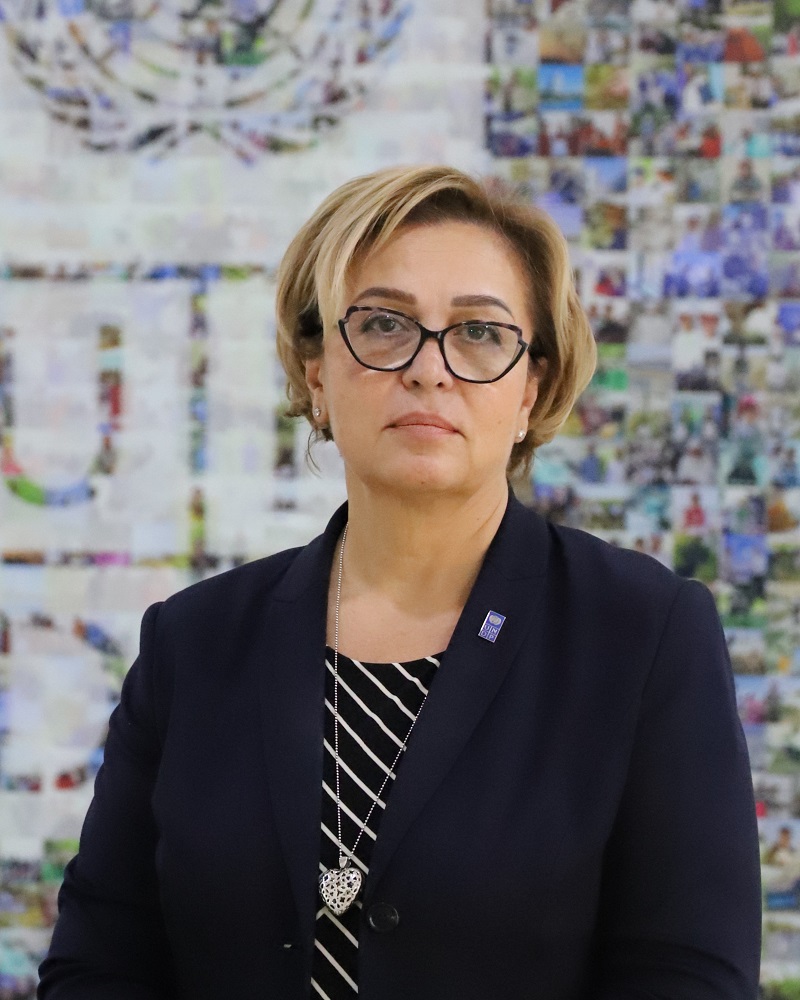
Op-Ed by Narine Sahakyan, UNDP Resident Representative in Turkmenistan, on the occasion of Healthcare and Medical Industry Workers’ Day, 10 October
Health is one of humanity’s most fundamental shared priorities. Across the world, health systems are being called upon to do more – to reach people earlier, respond faster, withstand shocks and deliver quality care to everyone. At the same time, digital technologies are opening new possibilities to make healthcare more accessible, efficient and people centered.
In Turkmenistan, this transformation is already taking shape. Digital tools, artificial intelligence, better access to knowledge and clean energy solutions are helping strengthen health services – while supporting the doctors, nurses and laboratory specialists who are at the heart of them. The goal is simple: a health system that is more accessible, resilient and sustainable.
On Healthcare and Medical Industry Workers’ Day in Turkmenistan, we honor the dedication of every doctor, nurse and laboratory specialist who works tirelessly for their communities. Technology can support their work, but it is their expertise, compassion and commitment that remain at the heart of healthcare.
For more than 25 years, UNDP has supported Turkmenistan in making public services more efficient, accessible and responsive to people’s needs. Today, we are bringing this experience into healthcare, where digital innovation can make a direct and tangible difference in people’s lives.
Take tuberculosis treatment. With UNDP support, patients use Video-Supported Treatment and Smart Pill Boxes, simple digital tools that let them take medication at home, without daily clinic visits. “It was a relief not to travel an hour just to take my pills,” one mother said. “Now I can take my children to school, have breakfast, and take my medicine calmly.” A young student credited the Smart Pillbox with helping her stay private and confident, free from stigma. These are simple technologies, but their impact is deeply human: they give patients greater flexibility, privacy and dignity.
The same principle applies to how we detect and treat the disease. We’re using artificial intelligence to fight TB. The CAD4TB system quickly and accurately reads chest X-rays, flagging people with TB symptoms who need further examination. Already showing promising results in Lebap velayat, the system is helping health workers to detect TB at an early stage.
Beyond TB, we’ve created mobile apps for healthcare workers: treatment protocols for TB and non-communicable diseases, laboratory procedures and medicine guides — all available in Turkmen language. We’ve introduced QR-code tracking for medical equipment, so hospitals can monitor the assets through a simple mobile app. We’re training doctors, nurses and laboratory specialists in computer literacy – starting with infectious disease centers and soon expanding into all regions.
For me, these innovations are most meaningful when they make a health worker’s job easier and a patient’s journey through the health system simpler. A protocol available on a phone, equipment that can be tracked with a QR code, or digital tools that reduce unnecessary travel may seem like small changes. Together, however, they are helping build a health system that is more connected, responsive and prepared for the future.
We’re powering healthcare with green energy, installing solar systems at Yoloten Etrap Hospital to ensure uninterrupted electricity for neonatal intensive care, maternity wards and laboratories, while reducing carbon emissions. Because resilient healthcare also depends on reliable and sustainable infrastructure.
Between 2021 and 2025, UNDP’s global health portfolio, co-financed by the Government of Turkmenistan, reached $195 million – delivering access to over 120 essential medicines and upgrading 121 health facilities across the country. These investments remind us that digital innovation is most powerful when it is part of a broader effort to strengthen health systems, expand access and build resilience.
Of course, none of this could have been done without strong cooperation with our partners – Government of Turkmenistan, Global Fund to fight AIDS, Tuberculosis and Malaria, Stop TB Partnership’s Global Drug Facility. Looking forward, we aim to scale up what works: more patients able to receive appropriate treatment closer to home, healthcare workers equipped with instant access to the latest knowledge, and health facilities operating on clean and reliable energy. But our ambition goes beyond introducing new technologies. It is to ensure that these solutions become part of the health system itself – embedded in national institutions, supported by local expertise and sustained for years to come.
On this special day, I thank every health worker in Turkmenistan for the care you provide every day, for your openness to new approaches, and for your willingness to embrace change while keeping people at the center. Your compassion, dedication and willingness to innovate are helping build a healthier, stronger and more inclusive future.
Digital transformation can provide new tools. But it is people – the health workers – who use them and the patients whose lives they touch – who give those tools their meaning. UNDP is proud to be your committed partner on this journey. ///nCa, 9 October 2026 (in cooperation with UNDP Turkmenistan)