


nCa Report
The first Caspian Environmental Summit concluded with an agreement to establish a five-country commission on declining water levels. Presidential proposals ranged from coordinated scientific research and artificial-intelligence-based monitoring to a long-term regional action plan. The challenge now is to turn political agreement into a sustained programme of environmental cooperation.
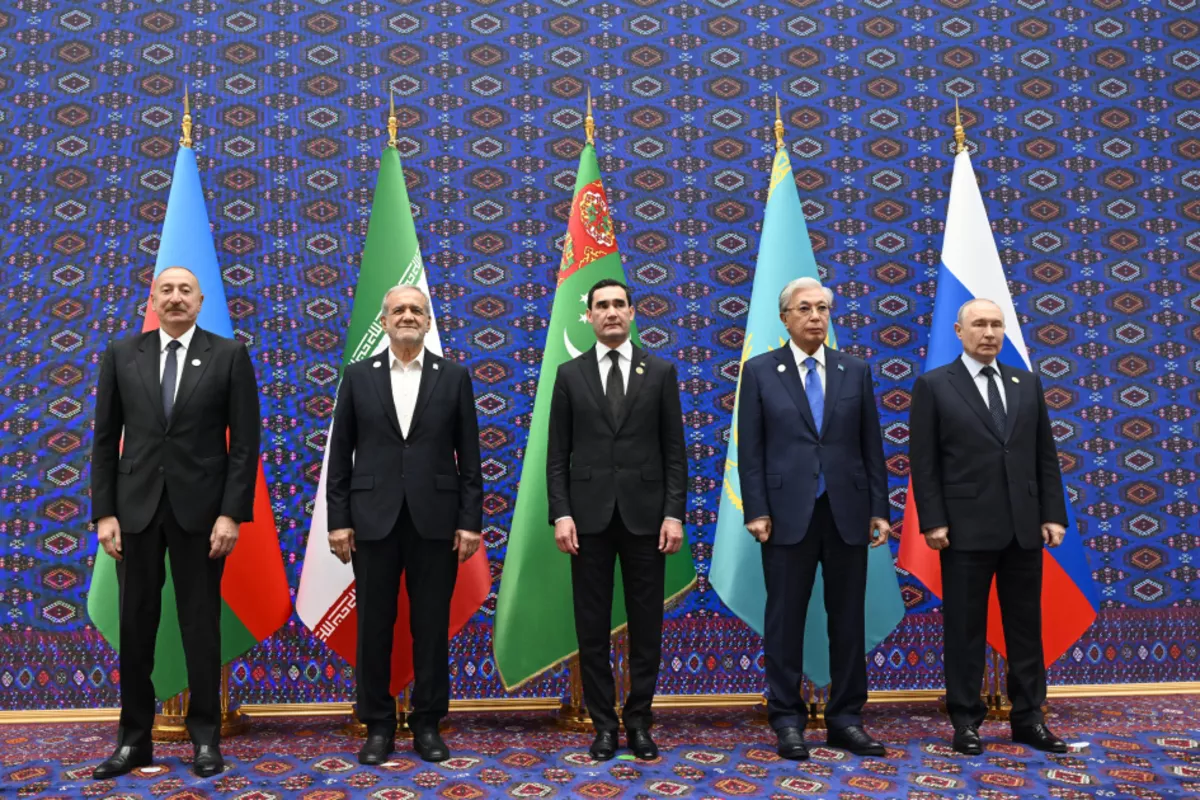
A new chapter in Caspian cooperation
The presidents of Turkmenistan, Azerbaijan, Iran, Kazakhstan and Russia met in the Awaza National Tourist Zone on 9 October for the First Caspian Environmental Summit, convened on the initiative of Turkmenistan’s President Serdar Berdimuhamedov.
The summit addressed an increasingly pressing regional concern: the declining water level of the Caspian Sea and its consequences for coastal ecosystems, biodiversity, shipping, ports, fisheries and the economic life of communities along its shores.
The meeting concluded with the signing of a Decision of the Heads of the Caspian Littoral States on the Outcomes of the Caspian Environmental Summit. The participants also adopted a statement by the chair of the summit.
The most concrete institutional outcome was the decision to establish a commission to investigate the causes of the Caspian’s falling water level and develop coordinated measures to address its consequences. The first meeting is scheduled to take place in Azerbaijan in the first half of 2027, when the commission’s regulations are to be approved. Governments are to designate their authorised representatives within three months of the decision.
The initiative gives the five littoral states a new mechanism for addressing a problem that cannot be understood or managed solely within individual national boundaries. The Caspian is a connected body of water, and changes in its water balance, shoreline and ecosystems affect all five countries, although the nature and scale of the consequences differ from one coast to another.
The significance of the summit lies not simply in the recognition that the sea is changing, but in the decision to organise a continuing intergovernmental response. Whether that response becomes effective will depend on the commission’s scientific capabilities, access to comparable data, its ability to coordinate national policies and the resources made available for implementation.
Why the first Caspian Environmental Summit was convened
The meeting represented a new emphasis within an established framework of Caspian diplomacy.
Turkmenistan initiated the first summit of the heads of Caspian littoral states, held in Ashgabat in 2002. That meeting began a series of high-level consultations among the five countries on the legal, political and economic arrangements governing the sea.
The process subsequently produced important agreements, including the Convention on the Legal Status of the Caspian Sea, signed in Aktau in August 2018. The convention established a legal framework for the use of the sea and cooperation among its littoral states.
Another important instrument is the Framework Convention for the Protection of the Marine Environment of the Caspian Sea, generally known as the Tehran Convention. Signed in 2003 and entering into force in 2006, it provides the principal regional legal framework for environmental protection.
Turkmenistan also initiated the first Caspian Economic Forum, held in Awaza on 12 August 2019. That event concentrated on expanding trade and economic cooperation among the littoral countries.
The First Caspian Environmental Summit differed in its principal focus. Rather than concentrating primarily on the legal status of the sea or the expansion of economic cooperation, it placed environmental deterioration—especially the declining water level—at the centre of discussions among the five presidents.
The initiative emerged from Turkmenistan’s Caspian Environmental Initiative, presented at the 78th session of the United Nations General Assembly in 2023. The initiative was intended to consolidate the scientific, technological and institutional capacities of the littoral states to protect the marine environment, monitor its condition and prevent pollution.
In his opening address, President Berdimuhamedov described the elevation of Caspian environmental issues to the level of heads of state as evidence of a shared recognition that the problem requires systematic and sustained action.
He expressed confidence that the countries could make progress through open, constructive dialogue and a common commitment to preserving the sea.
The president also proposed turning the Caspian Environmental Summit into a permanently functioning platform for cooperation. This was a proposal for the future of the summit format, distinct from the decision establishing the commission on declining water levels.
The distinction matters. — The commission is a specific institutional measure agreed by the five states; a permanent summit platform would provide a broader mechanism for political consultation on the Caspian’s environmental agenda.
The Caspian’s declining water level: an environmental and economic problem
The Caspian Sea is the world’s largest enclosed inland body of water. Its environmental condition is closely connected with the river systems that feed it, regional climate, evaporation, precipitation and human activities affecting water flows.
Its water level has fluctuated over long periods. The present decline has nevertheless raised concern because of its implications for coastal habitats, biodiversity, ports, shipping and industries that depend on access to the sea.
President Kassym-Jomart Tokayev of Kazakhstan cited estimates indicating that the Caspian’s surface area shrank by more than 16,000 square kilometres between 2000 and 2025. He also said that some sections of the shoreline had retreated by tens of kilometres.
President Ilham Aliyev of Azerbaijan referred to estimates that the sea’s surface area had declined by more than 20,000 square kilometres, while approximately 30,000 hectares of land had emerged in Azerbaijan’s sector of the Caspian.
These figures were cited by the respective presidents and should be read with attention to their geographical scope, reference periods and methods of measurement. They nevertheless illustrate the scale of the changes that have prompted the five countries to elevate the issue to the highest political level.
The consequences extend well beyond the physical movement of the shoreline.
Shallowing can affect access channels to ports, increase the need for dredging, change navigation routes and create additional costs for shipping. Changes in coastal habitats can affect spawning grounds, wetlands, fish populations and the survival of species adapted to the Caspian’s particular conditions.
Coastal settlements and industries may also face higher costs as infrastructure designed around historical water levels becomes less suited to changing conditions.
For Kazakhstan, Azerbaijan and Turkmenistan, which have developed significant port and transport infrastructure along the Caspian, the implications for regional connectivity are especially relevant. The sea is an important link in east–west and north–south transport networks, and declining water levels can affect the economics of maritime transport.
The environmental issue is therefore inseparable from regional development. The challenge is to understand the causes of the decline, identify which impacts can be mitigated and determine how infrastructure, ecosystems and coastal economies can adapt.
President Berdimuhamedov: a common problem requires common action
Turkmenistan’s president placed the summit within the country’s wider policy of promoting dialogue and cooperation among the five littoral states.
In his address, Berdimuhamedov stressed that the Caspian’s environmental problems cannot be addressed effectively by individual countries acting in isolation.
“Unity of the Caspian states is our main resource,” he said, referring to the historical ties and traditions of good-neighbourliness connecting the peoples of the region.
The president recalled Turkmenistan’s Caspian Environmental Initiative and thanked the other littoral countries for supporting the initiative and participating in its implementation.
A central element of his address was support for establishing a commission on the declining water level at the level of deputy heads of government. He proposed that the commission work on the basis of objective scientific data to identify causes and develop coordinated measures.
Berdimuhamedov also advocated the creation of specialist working groups involving scientists, experts, technical specialists and representatives of government institutions.
Turkmenistan, he said, would participate actively in the commission’s work and supported holding its first meeting in Azerbaijan in the first half of 2027.
The president further endorsed the development of an interstate programme for conserving the Caspian’s water resources. He emphasised the importance of responsible use of the sea’s biological resources and the protection of its ecosystems.
He also argued that new mechanisms should build on existing legal arrangements, particularly the Convention on the Legal Status of the Caspian Sea and the Tehran Convention, rather than create disconnected structures.
“Today we are moving to a new level of five-party dialogue,” Berdimuhamedov said, expressing the hope that the meeting would mark the beginning of systematic practical work on the most pressing issue: the Caspian’s shallowing.
His proposal to establish a permanent summit platform reflected the same objective: to ensure that environmental cooperation continues beyond a single meeting.
For Turkmenistan, this approach is consistent with its emphasis on multilateral dialogue, international law and cooperation through the United Nations and its specialised agencies. It also connects environmental protection with the country’s broader interests in Caspian transport, energy, logistics, trade and sustainable development.
Azerbaijan: understanding the causes of the decline
President Ilham Aliyev welcomed Turkmenistan’s initiative and emphasised the strategic importance of preserving the Caspian’s ecosystem.
He referred to the Convention on the Legal Status of the Caspian Sea, signed in 2018, as an important foundation for cooperation among the littoral states. He also highlighted the consequences of declining water levels for coastal communities, transport infrastructure and the economic use of the sea.
The question of causation was particularly important in Azerbaijan’s contribution.
The Caspian’s water balance is influenced by multiple factors, including precipitation, evaporation, climate change and river inflows. The Volga River supplies a substantial share of the freshwater entering the sea, making conditions within its basin particularly relevant.
Understanding changes in river flows, reservoir operations, water abstraction and seasonal patterns will therefore be important to a comprehensive scientific assessment.
These questions should be investigated through shared data and transparent research rather than assumptions about the responsibility of individual countries. The five states need a common evidence base if they are to identify measures that are technically sound and politically acceptable.
Aliyev’s support for a commission on declining water levels was consistent with Azerbaijan’s earlier advocacy of joint expert work. At the Sixth Caspian Summit in Ashgabat in June 2022, he had proposed establishing expert groups to investigate the causes of the decline and address its consequences.
The 2026 decision gives that earlier initiative a more defined institutional direction.
Azerbaijan’s agreement to host the commission’s first meeting in the first half of 2027 is therefore an important immediate commitment. The meeting will need to establish working arrangements, identify the questions requiring urgent investigation and determine how the five countries will contribute scientific information and expertise.
Iran: a long-term regional action plan
President Masoud Pezeshkian argued that the Caspian’s environmental problems require a coordinated response based on the shared interests of the littoral countries.
In his address, he identified declining water levels, climate change, pollution, rising air and water temperatures, habitat destruction and threats to biodiversity as interconnected challenges.
He emphasised that no single country could preserve the Caspian ecosystem independently of the others. Because the sea is a connected environmental system, deterioration in one area can have consequences elsewhere.
Iran’s official IRNA news agency reported that Pezeshkian proposed formulating and implementing a long-term regional programme to address the falling water level within the framework of the Tehran Convention.
He also welcomed the decision to establish a high-level commission involving representatives of the five governments.
The Iranian president called for the littoral states to rely on their own scientific, technical, financial and human resources while cooperating through established regional mechanisms.
He argued that environmental cooperation could help build trust among the countries even when wider political and economic circumstances were difficult.
Pezeshkian’s contribution placed particular emphasis on the need for sustained action rather than short-term measures. A long-term programme would need to connect scientific findings with practical decisions on water resources, pollution control, biodiversity, coastal infrastructure and adaptation.
The precise scope of such a programme, its financing and its relationship to the new commission remain matters for further negotiation. The summit did not, on the evidence available, adopt a fully specified Iranian programme.
Nevertheless, the proposal reinforces a central theme of the meeting: the need to move from recognising a shared problem to organising a continuous process of research, planning and implementation.
Kazakhstan: science, artificial intelligence and ecosystem protection
President Kassym-Jomart Tokayev described the Caspian as a unique natural resource and a major transport and energy hub for Eurasia.
He argued that the decline in water levels was no longer merely an environmental concern but had become an economic problem with potentially serious consequences.
Tokayev cited the retreat of the shoreline, the effects of changing water levels on ports and shipping, and the threats to fisheries, industry and coastal communities.
He also raised concern about the Caspian seal, whose population he said had fallen from approximately one million to 270,000 over the past century.
The president stressed the importance of coordinated scientific research. Kazakhstan established a Research Institute for the Caspian Sea in 2024, and he proposed making use of its capabilities in cooperation with research institutions across the other littoral states.
Tokayev also proposed exploring a shared digital platform to collect and analyse information on water resources, shoreline changes, biodiversity, pollution and river flows.
He suggested that satellite technologies, artificial intelligence and advanced forecasting systems could help monitor environmental risks and support timely responses.
The proposal is potentially important because one of the principal challenges in managing the Caspian is the need to bring together observations collected by different countries and institutions. A shared system could make it easier to compare measurements, assess trends and develop scenarios, provided that the participating states agree on data standards, access arrangements and scientific methods.
Tokayev also highlighted the need to protect biodiversity, restore spawning grounds and delta ecosystems, combat illegal fishing and improve cooperation between environmental authorities and law-enforcement agencies.
He referred to Kazakhstan’s experience with the Northern Aral Sea, where restoration measures had helped increase water area and improve conditions for fisheries and surrounding communities. The Caspian is a different and much larger ecosystem, so the experience cannot simply be replicated. However, it offers lessons about the value of combining engineering, scientific monitoring and ecosystem management.
The president further called for the development of an interstate programme to conserve Caspian water resources and emphasised the need to strengthen existing regional institutions.
He supported completing the establishment of a permanent secretariat for the Tehran Convention and called for more effective coordination of decisions and implementation.
His proposals illustrate how the summit’s environmental agenda could develop beyond the immediate issue of water levels to include biodiversity, digital monitoring, scientific cooperation and institutional capacity.
Russia: a digital twin and research through 2030
President Vladimir Putin welcomed Turkmenistan’s initiative to convene the first Caspian Environmental Summit and emphasised the sea’s natural, economic, transport and historical significance.
He called for coordinated action to understand the causes of the declining water level and reduce its negative consequences. He also stressed the importance of making full use of existing international institutions and scientific expertise.
A notable element of Russia’s contribution was a proposal to develop a digital twin of the Caspian Sea.
According to reporting by Turkmenportal, Putin described a high-precision virtual model that would use artificial-intelligence algorithms to analyse evaporation, precipitation and river runoff and calculate possible future changes in water levels.
The model could also help assess navigation routes and maritime safety as the sea’s conditions change.
Putin invited partners to participate in the initiative. He also said Russia was preparing a comprehensive programme to study Caspian water-level fluctuations through 2030 and intended to share the results with neighbouring countries.
The proposal complements Kazakhstan’s call for a shared digital monitoring platform, although the two ideas should not automatically be treated as a single agreed project. A digital twin would involve a model of the sea’s physical system and its changing conditions; a shared monitoring platform could provide a wider infrastructure for exchanging observations and environmental data.
Combining such capabilities could eventually support more accurate assessments of water-level trends, identify risks to infrastructure and improve the basis for adaptation planning.
The practical challenge will be to ensure that the systems use compatible data, disclose their methods and allow participating countries to compare and validate results.
The Russian proposals were presented at the summit, but the published decision on its outcomes does not establish that the five countries formally adopted a common digital-twin project. Further technical discussions would be required to determine whether and how the proposals could be integrated.
The signed decision: what the five countries agreed to do
The most important formal outcome was the Decision of the Heads of the Caspian Littoral States on the Outcomes of the Caspian Environmental Summit.
According to the published text, the five presidents agreed on the following measures:
- Establish a commission on the declining water level of the Caspian Sea. The commission is to operate at the level of deputy heads of government from Azerbaijan, Kazakhstan and Turkmenistan, together with high-ranking representatives of Iran and Russia.
- Identify the causes of the decline. The commission’s principal task is to establish the causes of the falling water level and develop and implement coordinated, comprehensive measures to address the negative processes associated with the sea’s shallowing.
- Create specialised working groups. The commission may establish working groups involving representatives of government institutions, scientists, experts and technical specialists from the five littoral states.
- Designate national representatives within three months. The governments are to appoint authorised representatives to the commission within the stipulated period.
- Hold the first meeting in Azerbaijan in the first half of 2027. The commission is to meet in Azerbaijan, where its regulations are to be approved.
- Rotate subsequent meetings among the five countries. Later meetings are to take place in the territories of the littoral states in alphabetical order according to their English names.
These measures give the new commission a defined starting point, membership structure and initial timetable.
The decision does not, however, provide all the details needed for implementation. The commission’s regulations, working methods, reporting arrangements and practical research programme are to be developed through subsequent work.
The agreement also does not, by itself, establish a binding regional water-allocation system or a single environmental monitoring authority. Its immediate purpose is to create an intergovernmental mechanism for investigating the problem and coordinating measures.
The distinction is important. — The commission can help establish a common scientific and policy basis for action, but the effectiveness of its work will depend on the quality of the evidence, the cooperation of national agencies and the willingness of governments to implement its recommendations.
Existing legal arrangements and the Tehran Convention
The summit’s decisions were presented as building on existing agreements rather than replacing them.
The 2018 Convention on the Legal Status of the Caspian Sea provides the central framework for relations among the littoral states concerning the sea’s legal status and use.
The Tehran Convention, signed in 2003 and in force since 2006, provides the principal regional framework for protecting the Caspian’s marine environment. Its work involves the five littoral states and addresses environmental protection and cooperation.
At the summit, Berdimuhamedov stressed that new mechanisms should operate in accordance with these existing instruments and decisions reached at earlier Caspian summits.
Tokayev likewise emphasised the importance of the Tehran Convention and called for stronger institutional capacity, including a permanent secretariat.
The value of the new commission will therefore depend partly on how its work relates to the existing environmental framework. Clear coordination could help avoid duplication, connect scientific findings with established procedures and improve the implementation of decisions already agreed by the five countries.
The seventh session of the Conference of the Parties to the Tehran Convention, held on 23 September 2026, had already addressed environmental cooperation, including work on the declining water level. The summit’s decision can be understood as an additional high-level mechanism intended to give the issue sustained political attention.
The wider regional implications
The Caspian is both an ecosystem and an economic space. Its coastal infrastructure supports energy production, maritime transport, fisheries, industrial activity and communities whose livelihoods are connected with the sea.
Environmental deterioration can therefore affect several policy areas simultaneously.
For transport operators, declining water levels can change port access and increase the costs of maintaining navigable channels. For coastal communities, changes in habitats and shorelines can affect livelihoods and local infrastructure. For governments, the need to protect biodiversity and manage environmental risks can require additional expenditure and coordination across agencies.
The effects are not uniform across the region. The exposure of a port, fishery or coastal settlement depends on local geography, infrastructure, economic activity and the pace of environmental change.
This makes shared scientific work particularly important. A regional commission should help distinguish common trends from local variations and establish where coordinated action would have the greatest practical value.
The proposals made by Kazakhstan, Russia and Iran point to complementary areas of possible cooperation: common data, scientific modelling, long-term planning and the development of adaptation measures.
For Turkmenistan, the summit also connects environmental diplomacy with the country’s wider interest in Caspian connectivity. A sea that remains ecologically viable and navigable is important to the region’s transport and trade networks. Conversely, infrastructure development must account for changing environmental conditions and avoid adding unnecessary pressure to fragile ecosystems.
The summit did not resolve these challenges. It established a mechanism through which the countries can begin to address them more systematically.
What happens next?
The immediate next step is the designation of national representatives to the commission within three months of the decision.
The first meeting, planned for Azerbaijan in the first half of 2027, is expected to approve the commission’s regulations. That meeting will be an important opportunity to establish a clear programme of work.
Several issues will require attention.
First, the countries need a shared scientific assessment of the Caspian’s water balance. This should draw on comparable observations of river inflows, precipitation, evaporation, temperature and changes in water levels. It should also examine the effects of human activities where evidence indicates they are relevant.
Second, the commission will need to establish how scientific data are collected, validated and exchanged. Existing national research institutions could contribute to a coordinated regional assessment, while satellite observations and modelling could help fill gaps in ground-based measurements.
Third, the five states will need to identify practical adaptation measures. Depending on the findings, these could include improvements in coastal monitoring, protection of vulnerable habitats, changes in port and navigation planning, restoration of wetlands and measures to reduce pollution.
Fourth, the work will need continuity and resources. A commission that meets periodically but lacks a defined programme, technical support or funding will have limited capacity to produce results. Its regulations and subsequent work programme will therefore be important indicators of whether the agreement can translate into sustained cooperation.
Finally, the new mechanism should complement the Tehran Convention and other existing arrangements. Clear division of responsibilities will help ensure that the commission adds practical value rather than creating parallel processes.
These are implementation priorities, not commitments that can already be attributed to the summit’s decision. Their status will depend on the commission’s subsequent work and the decisions of the five governments.
Conclusion: from shared concern to coordinated action
The First Caspian Environmental Summit placed the changing condition of the Caspian Sea at the centre of high-level regional diplomacy.
The five presidents agreed to establish a commission on declining water levels, with a defined membership structure, a timetable for national appointments and a first meeting planned for Azerbaijan in the first half of 2027. They also adopted a statement by the chair of the summit.
The speeches presented a wider set of ideas: Iran’s proposal for a long-term regional action plan, Kazakhstan’s proposals for shared scientific research and digital monitoring, Russia’s digital-twin initiative and Turkmenistan’s call for a permanent summit platform.
These proposals are not all formal commitments, and their implementation will require further decisions. Nevertheless, they indicate the range of practical work that could follow the summit.
The central challenge is scientific as well as political. The five countries need to understand the causes and consequences of the declining water level, establish a common evidence base and agree on measures that can protect ecosystems while helping coastal economies adapt.
The Caspian’s environmental condition cannot be managed effectively through isolated national efforts. The summit has created a mechanism for cooperation, but its success will be measured by the quality of the work that follows.
The first meeting of the commission in 2027 will provide an early indication of whether Awaza has marked the beginning of a sustained regional process or remains principally a statement of shared concern.
For the Caspian states, the objective is clear: to preserve the sea’s ecological wealth while safeguarding its role in the lives, economies and future development. /// nCa, 10 October 2026