


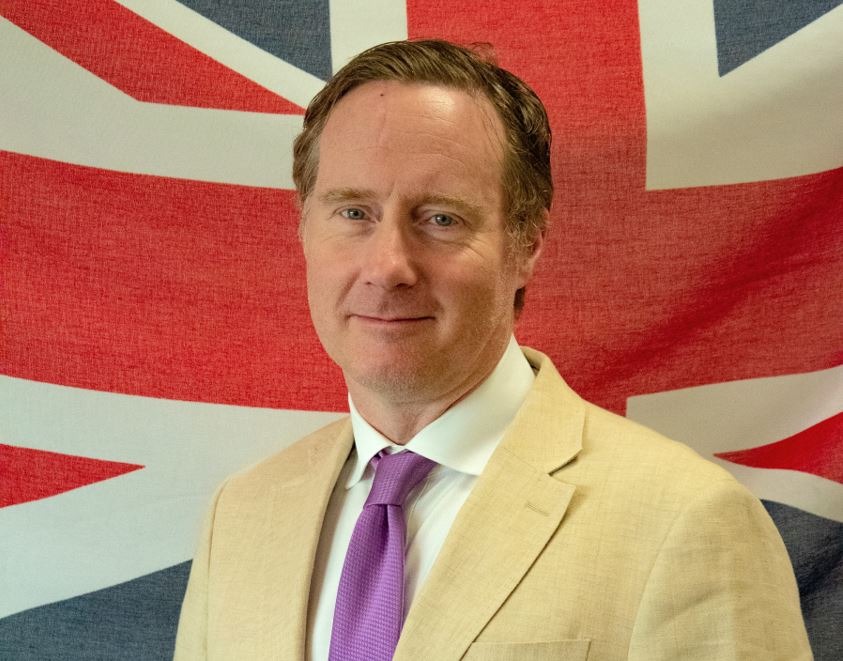
Stephen Conlon is His Majesty’s Ambassador to Turkmenistan since May 2023.
With a BSc and an MBA, fluency in Russian, French, Finnish, and Lithuanian, and a rich portfolio of accomplishments that would be the envy of any diplomat, Ambassador Conlon is widely recognized as a pragmatic leader who delivers tangible results on the global stage.
He has a proven ability to turn complex diplomatic strategies into real results.
Here is the complete text of our interview with him.
nCa: You had at least one year, while going through the Russian language degree programme, to think and plan your priorities and roadmap for your work as His Majesty’s Ambassador in Turkmenistan. What were your expectations and plans back then? Now that you are approaching the three-year mark, what has changed, particularly about your perceptions and insight about Turkmenistan? Have you been able to stick to your initial roadmap, or did you readjust and refine your goals and objectives as you went along?
SC: Thank you for the opportunity to be interviewed by News Central Asia. I read it daily and find it a valuable source of information.
I should clarify that I already had a degree in Russian and had spent some time studying at MGIMO in Moscow. However, after many years working elsewhere and learning other languages, including Finnish, Lithuanian and French, my Russian had become rather rusty. My pre-posting language training gave me the opportunity to refresh it, rebuild my confidence and immerse myself once again in the language.
It also gave me the unusual luxury of time to study Turkmenistan and think carefully about what I wanted to achieve as Ambassador. My initial objective was simple: to move our relationship from traditional diplomacy towards practical partnership.
Shortly before taking up my post, I had the honour of meeting President Serdar Berdimuhamedov when he visited the United Kingdom for the Coronation of His Majesty King Charles III in May 2023. That provided an important personal starting point for my work.
When I later presented my credentials, the President recalled His Majesty’s visit to Turkmenistan in November 1996 with particular warmth. My responsibility has been to help translate that history and goodwill into practical and lasting results.
I arrived with priorities covering climate action, education, trade and stronger connections between our people. Those priorities remain, but the agenda has broadened considerably. Our climate work now includes methane reduction, renewable energy, water resilience and climate finance. Economic engagement has expanded beyond hydrocarbons into finance, engineering, construction, agriculture, transport and professional services.
My understanding of Turkmenistan has also been transformed by travelling beyond Ashgabat. I have visited different velayats and towns, including Turkmenabat, Mary and the ancient city of Merv, Awaza, Turkmenbashy, Tejen, Arkadag and Nokhur.
Each place has shown me a different aspect of the country. Merv brought home the extraordinary depth of Turkmenistan’s history and its historic place on the Silk Road. Turkmenbashy and Awaza highlighted the importance and potential of the Caspian. Arkadag demonstrated Turkmenistan’s ambitions for modern urban development, while Nokhur offered a particularly distinctive expression of Turkmen culture and community.
These visits have reinforced an important lesson: Turkmenistan cannot be understood only through the lens of its capital. Its regions have different identities, strengths and opportunities. If we want to build a genuine partnership, we must understand the country as a whole and listen to people outside official meeting rooms.
On a personal level, I was immensely pleased that, after the UK Government gave permission, my wife, Ruta, and our two children were able to join me from the second year of my posting. Their presence has enriched my experience of Turkmenistan enormously. Seeing the country not only as an ambassador, but also as a husband and father, has given me another perspective on its warmth, hospitality and strong sense of family.
So I have kept the destination but adjusted the route. Diplomacy requires a plan, but it also requires curiosity, patience and the humility to listen and learn.
nCa: Having interacted not only with the Government of Turkmenistan but with society more generally, what do you see as the principal areas of common interest between the UK and Turkmenistan? Where could more be done for the benefit of both countries?
SC: The United Kingdom and Turkmenistan have more in common than may be immediately obvious. Both countries value sovereignty, stability, education and constructive international engagement. We share important interests in climate resilience, energy security, sustainable economic growth and stronger regional connectivity.
The depth of the UK’s interest was demonstrated by the visit of then Foreign Secretary Lord Cameron in April 2024. It was the first visit to Turkmenistan by a serving British Foreign Secretary. The visit produced a bilateral Cooperation Programme and agreements covering environmental protection in the Caspian and cooperation in transport and communications.
Lord Cameron put the case for engagement very clearly:
“Central Asia is at the epicentre of some of the biggest challenges we face and it’s vital for the UK and the region that we drive forward its future prosperity.”
His visit gave our relationship greater visibility and momentum. It showed that the United Kingdom regards Turkmenistan not as a remote or peripheral country, but as an important partner in a strategically significant region.
We also share something more personal: a deep love of horses.
The Akhal-Teke is a national treasure of Turkmenistan, while horses are deeply embedded in British sporting, rural and Royal traditions. This shared passion came vividly to life when His Excellency the National Leader of the Turkmen People, Gurbanguly Berdimuhamedov, visited the Royal Windsor Horse Show in May 2026.
During his visit, the National Leader met His Majesty King Charles III and Their Royal Highnesses The Duke and Duchess of Edinburgh. He also visited the Turkmenistan stand, which showcased the country’s equestrian heritage and its profound connection with the Akhal-Teke breed.
The National Leader has described the commonality of our interests in horse breeding and equestrian sport as providing a firm basis for fruitful cooperation and an exchange of experience. That is also a useful description of the wider relationship: we begin with something we genuinely share and build practical cooperation around it.
As His Majesty The King has said:
“There is far, far more that unites us than divides us.”
Successful relationships respect difference while concentrating on the interests and values that bring people together.
Education is among our most promising areas of cooperation. We are supporting partnerships between British universities and higher education institutions in Turkmenistan through the Accelerating English Language Learning in Central Asia programme. Turkmen officials have participated in the Education World Forum, while representatives of the country’s developing private English-language sector have attended BETT, the major educational technology event in the UK. Chevening scholars also create lasting personal and professional connections between our countries.
Climate action and the protection of nature are also strong common interests. Turkmenistan faces challenges involving water scarcity, rising temperatures and emissions, but it also has considerable potential in renewable energy, methane reduction, climate finance and more resilient agriculture.
Climate and nature are inseparable. Turkmenistan has remarkable landscapes and wildlife, including the endangered Persian leopard. The British Embassy was therefore delighted to support the BBC Studios Natural History Unit and its Turkmen conservation partners in securing permission to film the Persian leopard and the people working to protect it.
Successful filming took place at Dushak Erekdag in the Kopetdag Mountains in 2024, and the team subsequently received permission to film at Uly Balkan. The British Embassy was pleased to help facilitate this cooperation.
The resulting sequence is intended for HOME Asia, a BBC Studios Natural History Unit production for National Geographic. I am very much looking forward to its release. It should introduce an international audience not only to the Persian leopard, but also to Turkmenistan’s extraordinary natural beauty and the dedicated people working to conserve it.
This is an excellent example of partnership in practice. The Turkmen authorities provided access and permission, local conservationists contributed their knowledge and experience, and British natural-history filmmakers can help bring the story to a global audience.
This subject has particular resonance in the United Kingdom. His Majesty The King has a profound and longstanding commitment to nature. For more than five decades, His Majesty has championed environmental action, including the protection of wildlife and biodiversity and the responsible stewardship of soil, water, forests and oceans.
I hope the documentary will increase international appreciation of Turkmenistan’s wildlife. More importantly, I hope it will reinforce the case for continued monitoring, stronger habitats and practical cooperation to ensure that species such as the Persian leopard survive and thrive.
There is still much more that we can do together. I would particularly highlight improving the environment for trade and investment, supporting Turkmenistan’s stated ambition to join the World Trade Organization, developing renewable-energy and methane-reduction projects, strengthening water and agricultural resilience, deepening educational partnerships, supporting women’s economic participation and improving transport links across the Caspian.
The key is not to cooperate everywhere at once. It is to identify areas where both countries have a genuine shared interest and where cooperation can produce visible, lasting results.
Whether we are protecting Persian leopards, improving water resilience, developing university partnerships or bringing Akhal-Teke horses to Windsor, the principle is the same: begin with a shared interest, bring together the right people and turn goodwill into action.
nCa: What are your goals and expectations for the medium term, over the next three to five years?
SC: My hope is that, in three to five years, the relationship will be broader, deeper and increasingly self-sustaining.
The inaugural CA5+UK Foreign Ministers’ meeting in London in February 2026 was an important step in that direction. It brought together the Foreign Ministers of all five Central Asian countries with the UK Foreign Secretary in a single forum for the first time. Foreign Minister Rashid Meredov represented Turkmenistan.
This was much more than a ceremonial gathering. The discussions covered education, security, culture, finance and economic development. The programme included bilateral meetings, engagement with Parliament and British businesses, and a reception hosted by His Royal Highness The Duke of Edinburgh. A manuscript of the great Turkmen poet Magtymguly Pyragy was also displayed at Lancaster House, providing a fitting cultural dimension.
The CA5+UK meeting was complemented by the UK–Turkmenistan Structured Dialogue, which resulted in a new Programme of Cooperation for 2026–27. Educational agreements were also signed during the wider visit, strengthening institutional links between our countries.
That matters because many of the issues we face are both bilateral and regional. Transport corridors cross borders. Water, climate and energy security cannot be addressed by one country alone. Regional engagement does not replace our bilateral relationship with Turkmenistan. It strengthens it and gives it wider reach.
First, I would like to see more British and Turkmen companies doing business together, supported by clearer processes, transparent procurement and a more predictable investment environment.
We are already seeing encouraging signs. In March 2026, TheCityUK, which represents Britain’s financial and professional services industry, made its first visit to Turkmenistan. A delegation from the internationally renowned Zaha Hadid Architects has also visited. At the same time, Turkmen private-sector companies are increasingly looking towards the United Kingdom for partnerships and export opportunities. I was delighted to meet a Turkmen business delegation during its visit to London in May 2026.
Second, I hope we will move from discussing green energy to delivering real projects. These could include renewable energy, methane reduction, efficient water use and climate-smart agriculture. I would particularly like to see British expertise contributing to a substantial pilot project that demonstrates what is possible.
Third, I want the educational links already established to mature into long-term institutional relationships. We are already seeing encouraging results. I was particularly pleased by the establishment of a Pearson Certiport authorised testing centre in Turkmenistan, giving students access to internationally recognised digital-skills certification. The original framework agreement concerned the establishment and operation of a Certiport authorised test centre in the country.
The opening of Jahan Bilimli Çagalar Dünýäsi is another important milestone. It follows the Cambridge University Press & Assessment schools curriculum and is being supported through the Cambridge Pathway Preparatory Programme, including by British teachers. This shows how cooperation can move quickly from discussion and agreements to something tangible in the classroom.
These are precisely the kinds of practical achievements we want to build upon. Success over the next three to five years would mean more recognised qualifications, regular exchanges, joint programmes and sustained professional cooperation. Above all, I want British and Turkmen educational institutions to develop relationships that continue to grow under their own momentum.
Fourth, I would like Turkmenistan to become more closely connected to European and international markets through stronger transport, digital and financial links. Practical improvements to the Trans-Caspian Transport Corridor, alongside business reforms connected with Turkmenistan’s WTO ambitions, would be important steps.
Finally, I hope our partnership will remain honest as well as friendly. Good partners celebrate progress, but they must also be able to discuss difficult questions respectfully.
We have built momentum. The next three to five years must be about converting it into substantial projects and relationships that can endure.
nCa: In mega-projects such as the TAPI gas pipeline, TAP power transmission network, railway and road construction, regional connectivity, ports and shipping, and processing in the food, chemical and other industries, do you see potential for public-private or business-to-business partnerships?
SC: Yes, there is considerable potential. But major projects require more than sound technical ideas. They need commercially viable structures, transparent procurement, dependable payment arrangements and a clear allocation of risk.
When I met President Serdar Berdimuhamedov, he asked me to focus on developing the economic relationship between our countries. I have taken that request seriously.
The United Kingdom’s strength is not necessarily to build every kilometre of a road, railway or pipeline. It is often to provide the specialist expertise that makes a major project investable, efficient and sustainable.
British companies can contribute through engineering design, project management, environmental assessment, specialist machinery, legal and financial services, insurance, technical standards, digital systems and professional training.
This is not simply theoretical. British companies already provide high-quality goods and services in Turkmenistan. Intertek has operated here for almost 30 years. Colvir has worked here since 2008 and provides services to commercial banks. JCB machinery can be seen on construction sites, while companies such as Score Group and EthosEnergy offer specialist engineering and energy expertise. De La Rue has links with security printing, and Skyloom Cargo supports air-cargo connections between our markets.
These examples show that strong foundations already exist. Our next objective should be to progress from the supply of individual goods and services towards larger, longer-term partnerships.
For projects such as TAPI, power networks or the Trans-Caspian corridor, the most effective approach may combine government-to-government engagement, private investment and specialist business-to-business cooperation.
The strongest starting point will not always be an entire mega-project. It may be a clearly defined component in which a British company offers distinctive expertise and can demonstrate real value. A successful smaller partnership can build the confidence needed for something more ambitious.
The potential is considerable, but projects must be transparent, financeable and beneficial to both sides.
Government can open the door, but business must walk through it.
nCa: While the UK has enormous potential for partnership in almost every sector, could business entities from Turkmenistan establish themselves successfully in British markets? If so, in which areas?
SC: Yes, although success in the British market requires quality, consistency, competitive pricing and compliance with demanding regulatory standards.
Turkmenistan has potential in textiles, specialist agricultural products, processed foods, chemicals and petrochemicals, logistics services, and distinctive cultural and design products. Turkmen carpets and cotton products, for example, have a strong national identity. The challenge is to turn that identity into an internationally recognised and trusted brand.
British consumers value quality, provenance and a compelling story. Turkmen businesses have all three available to them, but they must translate those advantages into attractive presentation, effective marketing, consistent standards and reliable delivery.
Turkmen companies should not think only about exporting finished goods. They could also form partnerships with British distributors, designers, universities, technology companies and financial advisers. A joint venture or commercial partnership may offer a more effective first step than attempting to enter a complex new market alone.
There is potential in services too. Turkmen businesses with knowledge of transport, logistics and trade across Central Asia and the Caspian could become valuable partners for British companies seeking to understand and enter the region.
The recent Turkmen business delegation to London showed that this should not be a one-way relationship. Turkmen businesses are increasingly interested in British partnerships and export opportunities. The next step is to convert that interest into lasting commercial relationships.
The opportunity is real, but ambition must be matched by preparation and a readiness to compete. The businesses most likely to succeed will be those that understand the British market, meet its standards and identify the right local partners.
nCa: Is there anything else you would like to add?
SC: Firstly, I am looking forward to seeing Akhal-Teke horses and their riders perform at the Royal Windsor Horse Show next year. I am convinced they will attract enormous interest and introduce even more people to these beautiful and majestic horses.
Turkmenistan has made me a better diplomat. It has taught me that diplomacy is ultimately about people and the things that connect them.
Formal dialogue between governments provides the framework, but teachers, students, entrepreneurs, engineers, conservationists, artists and young people turn agreements into a genuine relationship.
Some of my most memorable experiences have come outside formal meeting rooms: speaking with young people learning English, meeting teachers and entrepreneurs, visiting projects and listening to communities across the country.
Modern diplomacy should not be measured simply by the number of meetings held or documents signed. It should be judged by whether it creates opportunities, brings people and institutions together, and produces results that endure.
The United Kingdom does not come to Turkmenistan claiming to have all the answers. We come as a partner, with experience and ideas to share, but also with a willingness to listen and learn.
Turkmenistan, in turn, has much to offer the United Kingdom: a strategic location, significant natural resources, a remarkable cultural and natural inheritance, and a young population with considerable ambition.
The next stage of our relationship must be about delivery: fewer abstract declarations and more practical partnerships; fewer isolated activities and more lasting connections between our institutions, businesses and people.
My hope is that these connections will eventually become so numerous and well established that the relationship no longer depends principally on ambassadors or official visits. It will be sustained by universities working together, companies trading and investing, experts tackling shared challenges, conservationists protecting wildlife and friendships growing between our peoples.
That, for me, is the best measure of successful diplomacy and a genuine partnership between our countries. /// nCa, 11 September 2026