


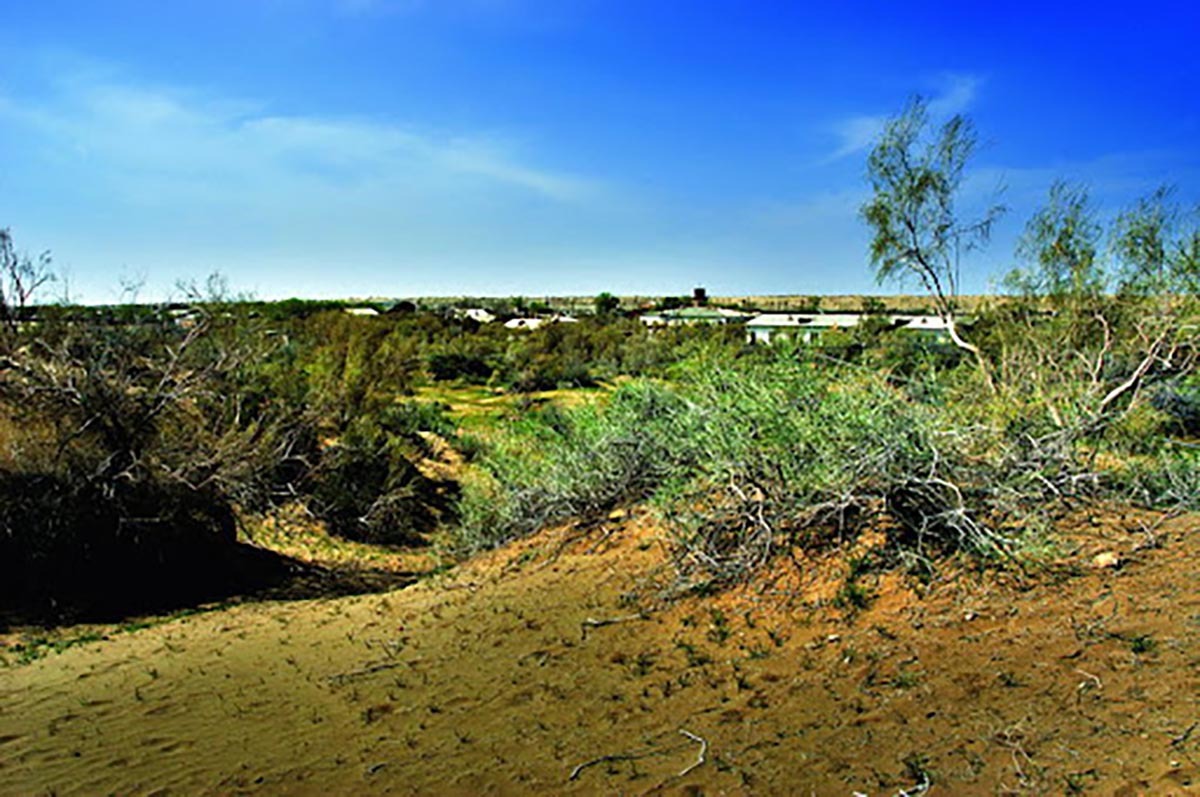
Turkmenistan has launched a five-year project to promote nature-based approaches in agriculture, restore degraded land and strengthen the resilience of agricultural landscapes to climate change. The Lebap province’s Charjew district will serve as the pilot area, where ecosystem restoration will be combined with modern technologies for managing land and water resources.
The project, titled “Catalysing Nature-Based Transformations in Turkmenistan’s Agricultural Sector to Enhance Climate Resilience,” is being implemented jointly by Turkmenistan’s Ministry of Environmental Protection, the Food and Agriculture Organization of the United Nations (FAO), the Green Climate Fund and the Regional Environmental Centre for Central Asia (RECCA). Its launch was reported by the newspaper ‘Neutral Turkmenistan’ in its 28 October 2026 edition.
The initiative aims to help agriculture adapt to climate risks through more sustainable use of natural resources, the restoration of degraded land and closer integration of agricultural production with environmental protection.
For Turkmenistan, where an arid climate, water scarcity, rising temperatures and desertification pose growing challenges to the agricultural sector, these measures are particularly important. The objective is not only to maintain agricultural productivity but also to ensure the long-term sustainability of production and strengthen food security.
Pilot Area to Combine Farmland and Protected Natural Areas
At the project’s launch event, Ivetta Zenina, a technical specialist at FAO’s Subregional Office for Central Asia, presented its main components and implementation framework.
She explained that the project takes an integrated approach, addressing the links between crop production, livestock farming and aquaculture and the climate agenda across the entire value chain, from production to consumption. This approach is intended to make agri-food systems more resilient while improving the relationship between ecosystems and rural communities.
The main pilot area will be Charjew district in Lebap province, where agricultural land borders protected natural areas. According to information presented at the event, the district accounts for approximately one-quarter of the region’s agricultural output, while forested areas remain relatively limited.
The project plans to establish protective belts of perennial fruit trees around fields. These plantings are expected to improve pollination of agricultural crops while supporting beekeeping. Another measure will involve expanding vegetation along waterways to create natural barriers against saline winds and dust carried from the Aral Sea region.
A tree nursery is scheduled to be established on the premises of the local forestry enterprise during the first year of implementation.
Up to 30 landscape sites have been designated for assessment of environmental conditions and the identification of priority measures. Studies will examine both natural processes and the effects of human activity.
Land Restoration and Protection of Wetland Ecosystems
Particular attention will be given to areas important for biodiversity conservation and ecological balance. The project will include the Repetek Biosphere Reserve, which will mark its centenary in 2027.
Activities will also extend to the Yerajinsky Nature Reserve, located in the desert. The area contains an unusual wetland ecosystem whose formation is linked to the inflow of drainage water following the development of agricultural land in Lebap province in 1991.
The local lakes are replenished by drainage water from extensive agricultural areas. Over time, this system of water bodies has become a habitat for birds and a site supporting diverse vegetation. It also plays a role in carbon storage and helps limit dust transport, including dust originating from the Aral Sea region.
Protecting these wetlands requires coordinated management of agricultural and natural systems, as their continued existence depends largely on the volume of drainage water reaching the area.
On agricultural land in Charjew district, the project envisages restoration measures including land reclamation, soil desalinisation and the levelling of selected fields. Drought-resistant crops and halophytes — plants adapted to high soil salinity — will be introduced on abandoned land and salt flats.
These measures are intended to restore degraded land for potential agricultural use or improve its environmental condition while reducing the impact of adverse natural factors.
Modern Technologies and Support for Farmers
The project will introduce modern tools for environmental monitoring and resource management. These will include equipment to measure and record carbon-related indicators and air pollution, as well as laser water meters on inter-farm irrigation canals to improve the accuracy of water-use monitoring.
Alongside technological solutions, the initiative plans to revive farmer field schools. This approach will help disseminate knowledge of nature-based farming practices and provide agricultural producers with practical guidance on adapting to climate change.
Financial oversight will also be an important component of the project. According to the information presented at the launch, monitoring mechanisms will ensure that funds are used for their intended purposes and that scientific and technical activities deliver maximum results.
Over the five-year implementation period, the project will bring together land restoration, nature conservation, more efficient water management and the adoption of sustainable agricultural practices. Experience gained in Charjew district could provide a basis for expanding nature-based approaches across Turkmenistan’s agricultural sector. ///nCa, 28 October 2026