


Elvira Kadyrova
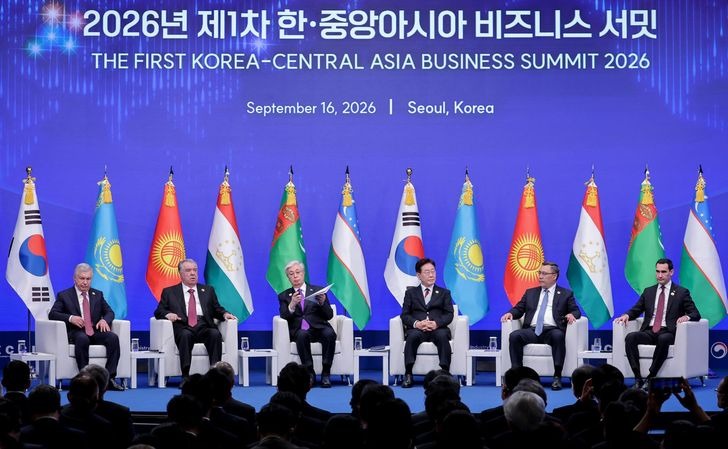
South Korea and the five Central Asian countries have agreed to expand business cooperation in trade and investment, critical minerals, energy, infrastructure and logistics. The agreements were reached at the first Korea–Central Asia Business Summit, held in Seoul on 16 September 2026.
According to the Korean Ministry of Trade, Industry and Resources, the summit was the first multilateral economic event of this scale since South Korea established diplomatic relations with the five Central Asian countries.
The business summit was attended by the Presidents of South Korea, Kazakhstan, Kyrgyzstan, Tajikistan, Turkmenistan and Uzbekistan, as well as around 520 representatives of business and government.
South Korea was represented by executives from leading companies, including Samsung Electronics Co, POSCO, LS Group, Daewoo Engineering & Construction, Shinhan Financial Group and Hyundai Motor.
Central Asian businesses included, among others, Kazakhstan’s Samruk-Kazyna and KazMunayGas, Kyrgyzstan’s Integra Engineering, Tajikistan’s Gayur Group, Turkmenistan’s Ojar Aziya, and Uzbekistan’s AKFA Group and ADM Global.
Practical Cooperation in Three Key Areas
The first session of the summit, devoted to “Future Korea–Central Asia Cooperation for Growth and Innovation,” featured panel discussions on specific areas of cooperation and opportunities for companies to enter regional markets.
The discussions focused on three main areas:
- expanding trade and investment;
- strengthening cooperation in critical minerals, energy and supply chains;
- developing projects in industrial facilities, infrastructure and logistics.
In trade and investment, participants proposed diversifying the structure of trade, which is currently largely focused on raw materials, and expanding investment cooperation, including in manufacturing.
In critical minerals, energy and supply chains, participants discussed ways to combine Central Asia’s abundant mineral and energy resources with the technological capabilities of Korean companies.
In industrial infrastructure and logistics, the participants explored opportunities to increase the involvement of Korean companies in energy and industrial construction projects, as well as transport infrastructure projects, including airports and railways.
Following the discussions, the Korea Chamber of Commerce and Industry and leading economic organizations from the five Central Asian countries adopted a Joint Declaration of the Business Summit, expressing their commitment to developing mutually beneficial cooperation between companies.
Speaking at the special session of the summit, President Lee Jae Myung stressed the need for shared prosperity between South Korea and Central Asia and reaffirmed the government’s readiness to support business cooperation.
19 Business MoUs Signed
A total of 19 business cooperation Memorandums of Understanding were signed during the summit. They cover critical minerals and energy, infrastructure, industrial construction, trade and investment.
Critical minerals. The Korea Institute of Industrial Technology signed a memorandum of understanding on cooperation in rare metals with Kazakhstan’s National Research Centre for Comprehensive Processing of Mineral Raw Materials. The two sides agreed to develop a phased cooperation model for supply chains by combining Kazakhstan’s resource and production base with the technological and investment capabilities of Korean companies.
Smart cities. Hyundai Motor signed a memorandum of understanding with Kazakhstan’s Caspian Group and Kaspi on cooperation in developing smart cities based on Physical AI. The parties will begin joint work on introducing mobility technologies and smart solutions as part of the Alatau smart city development project.
Infrastructure. The Korea Overseas Infrastructure & Urban Development Corporation (KIND) signed a framework agreement with Uzbekistan’s Agency for the Development of the Pharmaceutical Industry on the implementation and development of the Smart Bio Cluster project. The parties will cooperate on a feasibility study and the development of a pharmaceutical and biotechnology cluster.
Trade and investment. Another memorandum provides for mutual recognition of halal certification between the Korea Testing & Research Institute for Machinery, Electrical and Electronic Equipment (KTC) and Kyrgyzstan’s Halal Industry Development Centre. The agreement is intended to facilitate access to the Kyrgyz market for Korean food and cosmetics producers.
$14 Million in Contracts
Alongside the summit, the Korea–Central Asia Business Partnership event was organized by the Korea Trade-Investment Promotion Agency (KOTRA).
The event brought together 33 buyers, project owners and suppliers from Central Asia, as well as around 90 Korean companies. The participants held around 200 B2B meetings in infrastructure, energy and consumer goods.
A total of 16 export contracts worth $14 million were signed during the event, including a $3 million product supply contract between Artbox and Casia Imports.
The first Business Summit was one of the key economic events held as part of the first Korea–Central Asia Summit in Seoul. Its outcomes add a practical dimension to South Korea’s cooperation with the five countries of the region, spanning natural resources and energy to industry, infrastructure, digital solutions and trade. ///nCa, 16 September 2026 (photo credit: Yonhap)