


Tariq Saeedi
The international arena has long been dominated by a rigid, quasi-scientific obsession with classification. Foreign policy journals, academic treatises, and diplomatic summits routinely categorize the globe into a strict vertical pyramid: superpowers at the pinnacle, followed by great powers, middle powers, and an undifferentiated mass of small or minor states.
This structural philosophy operates on a single foundational premise: that global order is maintained by the supreme will of a select few commanding actors at the top, down to the rest of the world.
This conceptual framework is fundamentally flawed.
The practice of attaching arbitrary labels to sovereign states has become an obstruction to genuine international relations rather than a facilitation of them. In a deeply interconnected global system, these artificial tiers do not reflect reality; instead, they serve as a vanity trap that distorts diplomatic priorities and breeds regional friction.
Humanity is transitioning into a new global architecture. This emerging order is being shaped not by politicians cocooned in institutional echo chambers, but by unyielding ground realities. It is a system guided by a fundamental law of physics and metaphysics alike: nature abhors not only a vacuum, but also the absence of sustainable equilibrium.
The Failure of the Hierarchical Mindset
The philosophy of state labeling relies almost exclusively on material metrics—counting resource pools, demographic sizes, and military hardware. From this inventory, titles are distributed.
Yet, contemporary history demonstrates that material abundance no longer guarantees the capacity to dictate outcomes or enforce compliance.
When a state becomes fixated on achieving or maintaining an artificial tier, its foreign policy shifts from pragmatic governance to brand management. Precious national resources are frequently diverted toward high-prestige vanity projects—bloated multilateral summits, symbolic infrastructure, or international public relations campaigns—designed solely to validate a self-proclaimed rank.
More critically, this labeling system introduces an adversarial element into regional dynamics.
To claim a higher label is to implicitly demote one’s neighbors, transforming natural geographic peers into status rivals. By establishing an artificial hierarchy, the vocabulary of international relations replaces concrete problem-solving with the fragile management of diplomatic egos.
It fosters a climate where negotiations stall over structural precedence—who speaks first, who chairs the committee, who holds the veto—rather than addressing the shared structural challenges that affect the daily realities of people on the ground.
Neither Globalization Nor Localization
For decades, the debate over the future of the world order has been trapped in a binary struggle between total globalization and defensive localization. The emerging reality is breaking both molds.
The world is not consolidating into a borderless global village governed by universal, centralized rules, nor is it fracturing into isolated, autarkic enclaves. Instead, natural economic, environmental, and logistical processes are driving the formation of intersecting networks.
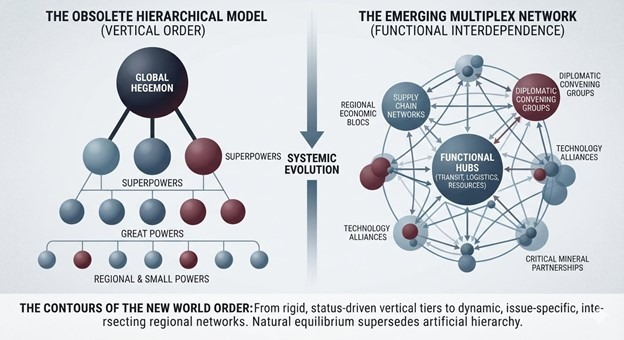
These overlapping circles of cooperation are fluid and purely functional. A state may anchor an energy corridor across one axis, participate in a localized water-management initiative across another, and link its financial infrastructure to an entirely different group of partners. These connections are determined by geographic proximity, shared practical vulnerabilities, and mutual logistical necessity—not by ideological alignment or the dictates of a distant hegemon.
This is a world of multiplexity.
Influence is no longer derived from absolute material dominance, but from connectivity and functional capacity. The vital question for a modern state is no longer “What is your rank?” but rather “What functional value do you bring to the network?”
The Search for Sustainable Equilibrium
There are those who view the decline of centralized global authority with profound alarm, predicting a descent into unbridled chaos and systemic collapse. This perspective misunderstands the self-correcting mechanisms of global interdependence.
Just as nature abhors a vacuum, it demands equilibrium. Chaos is a transitional phase, not a permanent destination. When top-down structures fail to provide security, economic predictability, or logistical continuity, the ground realities themselves force a reorganization.
The emerging order is an unscripted, self-organizing matrix of regional hubs and pragmatic coalitions. It operates beneath the radar of formal state-labeling, driven by the immediate, existential needs of trade, environmental survival, and resource allocation. This order does not rely on the supreme will of a few select nations to maintain peace, nor does it allow for unchecked lawlessness. It enforces its own discipline through the mutual vulnerability of its participants; if one link in an intersecting network breaks, the entire immediate circuit suffers, incentivizing localized self-regulation and pragmatism.
The inevitable
The contours of the new world order are already visible, whether the traditional architects of global policy approve of it or not. The era of the vertical pyramid, where power is calculated by arbitrary status and enforced by unilateral dictates, is drawing to a close.
Politicians and theorists may remain cocooned in their traditional frameworks, continuing to debate who qualifies for which semantic label. But the ground realities have moved on.
The future belongs to an equilibrium born of necessity—a decentralized web of intersecting regions and functional partnerships that prioritizes practical resilience over international vanity. /// nCa, 14 September 2026