


Elvira Kadyrova
The talks between Chinese President Xi Jinping and Kyrgyz President Sadyr Japarov in Bishkek on 31 August marked a new phase in China–Kyrgyzstan relations — from implementing individual infrastructure and investment projects to building a comprehensive system of economic connectivity spanning transport, border infrastructure, trade, standards, investment, payment mechanisms, technology and market access.
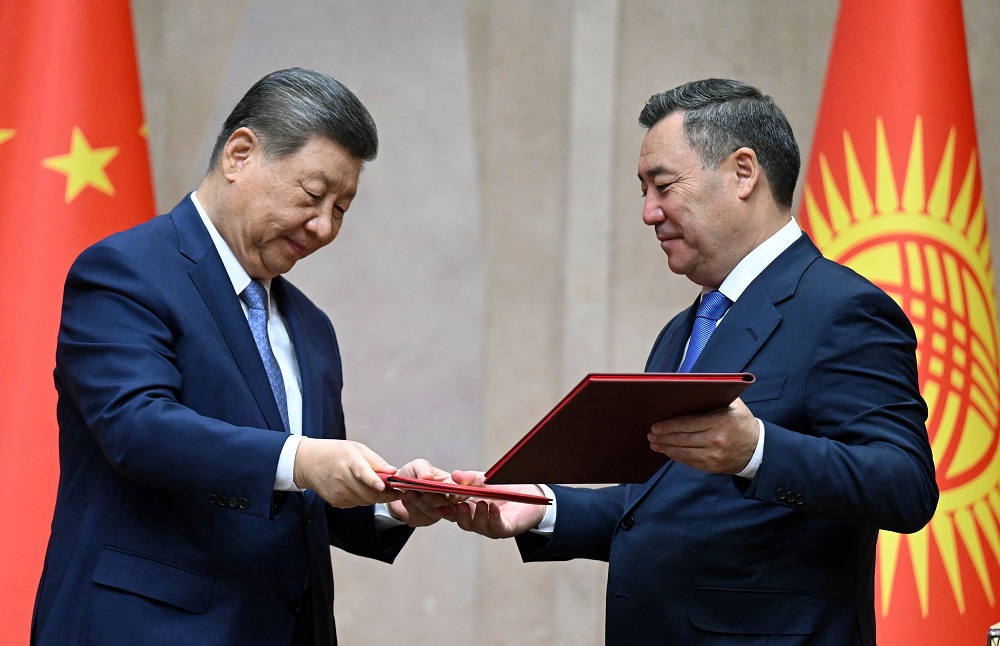
The two presidents signed two key documents: the Joint Declaration of the People’s Republic of China and the Kyrgyz Republic on the High-Quality Development of the Comprehensive Strategic Partnership in the New Era, and the Treaty of Permanent Good-Neighborliness, Friendship and Cooperation between the People’s Republic of China and the Kyrgyz Republic.
The summit agenda brought together several interconnected dimensions:
- Political — the Treaty of Permanent Good-Neighborliness, Friendship and Cooperation;
- Strategic — China’s proposal to align national development strategies, including China’s 15th Five-Year Plan and Kyrgyzstan’s National Development Programme through 2030;
- Transport — the China–Kyrgyzstan–Uzbekistan railway;
- Resources — green minerals and cooperation across the value chain;
- Technology — artificial intelligence, digital trade and joint laboratories;
- Institutional — standardization, customs cooperation and border checkpoints;
- Security — combating drug trafficking and transnational crime and maintaining regional stability;
- Multilateral — cooperation through the Shanghai Cooperation Organisation (SCO), the United Nations and the China–Central Asia framework.
In the presence of the two leaders, the sides exchanged documents covering bilateral cooperation in investment, transport, customs and sister-city relations. More than 30 additional cooperation documents were also signed during the visit, covering science and technology, education, cultural and humanitarian ties, media and other areas.
The statements made by the two presidents indicate that China and Kyrgyzstan are seeking to move their strategic partnership beyond declarations and toward a system of long-term commitments, in which transport connectivity, trade, critical minerals, the green economy and digital technologies form interconnected elements of a broader economic model.
The Treaty provides the political foundation for long-term cooperation and further economic rapprochement. Beijing and Bishkek are effectively seeking to anchor their strategic partnership in a durable political framework that can support the development of infrastructure, trade and investment.
Xi Jinping’s remarks are particularly telling in this regard. He stressed that China firmly supports Kyrgyzstan in safeguarding its sovereignty, independence and territorial integrity, as well as in pursuing a development path suited to its national circumstances. He also expressed China’s readiness to continue providing firm mutual support on issues concerning the core interests of the two countries.
Japarov, in turn, said that China remains a key priority of Kyrgyzstan’s foreign policy, as well as the country’s closest friend and most reliable partner.
On the economic front, the China–Kyrgyzstan–Uzbekistan railway featured prominently in the statements of both leaders and emerged as a central infrastructure project.
Japarov described it as a “railway Silk Road”, while Xi Jinping referred to it as a transport artery carrying the hopes of the peoples of the region for development.
The significance of the project extends beyond bilateral relations. The railway is expected to connect China’s transport system with Kyrgyzstan and, further, Uzbekistan, creating an additional route between China and Central Asia. For Kyrgyzstan, this offers an opportunity to strengthen its role in regional transit networks, while for China it provides an additional avenue for overland connectivity with Central Asian markets.
Alongside transport infrastructure development, the two sides agreed to build a border bridge at the Bedel checkpoint, modernize and equip the checkpoint, establish arrangements governing the state border, and strengthen cooperation in the management of Kyrgyz-Chinese border crossings.
At the same time, the regulatory infrastructure for trade is being developed. The sides signed documents on conformity assessment and standardization, including an action plan for 2026–2028, as well as an agreement on cooperation in e-commerce. They also noted progress in negotiations on an agreement covering trade in services and investment.
Another notable element is a set of protocols that opens opportunities for Kyrgyz products to enter the Chinese market, including equine animals, thermally processed sheep and goat meat, and fresh berries. Combined with the agricultural cooperation action plan for 2027–2030, these arrangements point to an effort to expand not only transit flows but also the actual trade base between the two countries.
Taken together, the agreements point to the formation of a comprehensive economic infrastructure — extending from roads and border crossings to standards, e-commerce, market access for goods and cross-border payment mechanisms.
Financial aspects are also becoming part of this system. The two sides signed an agreement on servicing participants in a cross-border interbank payment system. This adds a financial mechanism to the transport, customs and trade arrangements needed to support growing cross-border transactions.
Another indicator of the evolving structure of cooperation is the focus on green minerals. The agenda is no longer limited to resource extraction but also includes cooperation across the entire production chain. Xi Jinping proposed that Kyrgyzstan and China implement more landmark projects in areas such as renewable energy and resource recycling, while expanding cooperation across the value chain.
Alongside infrastructure and physical connectivity, the two countries are also seeking to take their relations to a higher technological level.
The technological dimension is likewise gaining a concrete institutional and legal framework. One memorandum provides for cooperation in science, technology, innovation and technology transfer, while another document supports joint research projects.
At the same time, security is becoming an integral part of economic connectivity. The expansion of transport and trade flows also increases the importance of securing borders and transit infrastructure. Security cooperation is therefore emerging as a complementary element of the China–Kyrgyzstan economic agenda.
Xi Jinping stressed that the two sides should expand cooperation in law enforcement and security, continue joint efforts to combat the “three forces of evil”, drug trafficking and transnational crime, and work together to ensure peace and stability in the region.
Beyond the bilateral track, Beijing and Bishkek also view their relations within a broader regional framework. China supports Kyrgyzstan’s growing role in international and regional affairs, while Kyrgyzstan has confirmed its readiness to closely coordinate with China on multilateral platforms, including the United Nations, the Shanghai Cooperation Organization and the China–Central Asia framework.
Overall, the outcome of the Bishkek talks shows that China–Kyrgyzstan relations are gradually moving beyond individual infrastructure projects and traditional trade and economic cooperation. A more complex system of connectivity is taking shape, in which transport, border infrastructure, customs procedures, e-commerce, payment mechanisms and technological cooperation reinforce one another.
For Kyrgyzstan, this creates opportunities to strengthen its role in transit links between China and Central Asia, expand exports to the Chinese market, and attract new technologies and investment. For China, deeper engagement with Kyrgyzstan strengthens one of its overland connectivity routes into Central Asia while further developing the region’s trade and production links. ///nCa, 1 September 2026