


Elvira Kadyrova
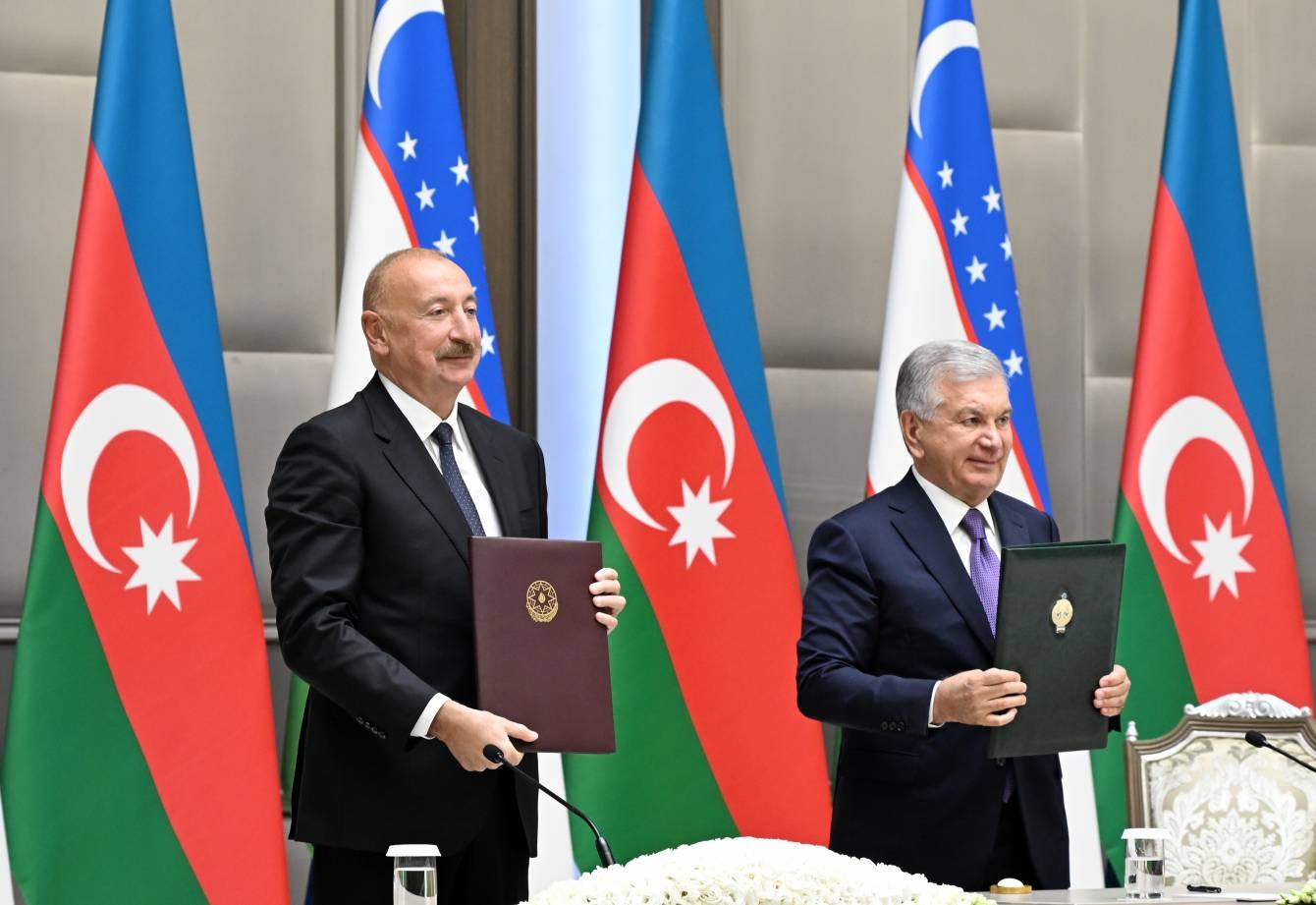
On 23–24 August 2026, President Ilham Aliyev of Azerbaijan paid a state visit to Uzbekistan. One of the key outcomes of the summit was the signing of the Treaty of Eternal Friendship with President of Uzbekistan Shavkat Mirziyoyev.
Exactly two years earlier, on 23 August 2024, the two nations had inked the Treaty on Allied Relations, which also laid the groundwork for the new agreement.
Naturally, an analytical question arises: Why, just two years after signing a comprehensive, 24-article alliance treaty, was there a need for a new 11-article document whose provisions appear quite generalized at first glance?
A comparative reading of the two documents suggests that the 2024 treaty is a strictly legal framework for developing multifaceted ties — from energy to environmental security, and from foreign policy coordination to cooperation between the Uzbek and Azerbaijani diasporas. The 2026 treaty, by contrast, is a kind of political pledge — an ideological and emotional layer added to the existing legal framework.
More than anything, it serves as a pact consolidating mutual neutrality and safeguarding the security environment needed to uphold the agreements reached two years ago.
Mutual Neutrality and the Evolution of the Security Concept
Under Article 2 of the Treaty of Eternal Friendship, “the parties shall not participate in any blocs or alliances that undermine the sovereignty, security or territorial integrity of the other party, nor shall they participate in any actions directed against the other party.” These commitments echo the provisions of Article 3 of the Treaty on Allied Relations.
What does this mean in practice? If third countries or existing military-political blocs were to pursue hostile policies toward Azerbaijan or Uzbekistan, the other party would be expected to remain neutral and refrain from joining such sanctions, alliances or resolutions.
Both treaties also stress, albeit in slightly different wording, that the parties shall not allow their territories to be used by third countries to the detriment of the state sovereignty, security or territorial integrity of the other party.
The Treaty of Eternal Friendship adds another commitment that points to an evolution in the security concept underpinning relations between Azerbaijan and Uzbekistan. Article 2 stipulates that the parties shall not allow the establishment or operation on their territory of organizations or groups that undermine the sovereignty, security or territorial integrity of the other party.
What is the substance of this provision? Neither Tashkent nor Baku will allow foreign military bases — or, potentially, intelligence facilities — to be established on its territory, nor will they permit logistical infrastructure such as airfields or railways to be used for activities directed against their partner.
Azerbaijan and Uzbekistan are effectively committing themselves to remain neutral havens where opposition, extremist, information or military formations operating against the other party cannot establish themselves or conduct activities.
In this way, by institutionalizing their alliance, Azerbaijan and Uzbekistan are reinforcing its security dimension through the adoption of a political doctrine of eternal friendship.
Why Did the 2024 Treaty on Allied Relations Require Ideological Reinforcement in 2026?
The answer lies in several parallel regional developments and the increasingly complex map of emerging risks.
From a geopolitical perspective, Azerbaijan has joined the consultative meeting format of the five Central Asian states and now officially presents itself as part of a common geopolitical space with Central Asia. Tashkent — one of the main proponents of Azerbaijan’s inclusion in the C5 format — and Baku, which serves as a bridge to Europe, are emerging as an axis linking the broader Caucasus–Central Asia macro-region.
From a security perspective, if Azerbaijan and Central Asia are increasingly positioned as a single geopolitical space, the Caspian Sea provides the physical and strategic link between the Caucasus and Central Asia. At the same time, the Caspian is a strategic component of the Middle Corridor and, in a broader sense, a key link in connectivity across the wider Turkic space, stretching from Türkiye through the South Caucasus to Central Asia.
Yet the Caspian Sea is increasingly becoming a focal point for security challenges linked to the escalation of conflicts involving Iran.
If the 2024 document lays out the roadmap for cooperation (defense, economy, environmental protection), the 2026 Treaty functions as a legal shield: it guarantees that neither Baku nor Tashkent will yield to external pressure or allow their infrastructure to be used to block or destabilize Caspian routes.
Furthermore, both parties are committed to create the necessary legal, economic, and organizational conditions for the further strengthening of an interconnected transport system.
Protecting Political Sovereignty
The 2026 Treaty introduces another important new formulation. Azerbaijan and Uzbekistan have undertaken to support each other in choosing development paths and models that reflect their respective national circumstances, as well as to back each other’s positions on key issues affecting their fundamental interests.
This provision effectively gives the two countries a framework for diplomatic support on sensitive issues at international forums, helping to counter attempts by third parties — whether individual states or political blocks — to exert pressure on the domestic or foreign policies of Baku and Tashkent.
Regional Context
The Treaty of Eternal Friendship with Uzbekistan should be viewed within the framework of Baku’s consistent efforts to form a new center of political power, one that highly likely features Turkic contours.
Azerbaijan does not limit itself to the Consultative Meetings format of Central Asia; it actively promotes a bilateral approach to relations as well. This is welcomed across the capitals of the region, as each country maintains its own unique economic models, foreign policy priorities, and national characteristics alongside the regional integration track.
In July, Azerbaijan and Kyrgyzstan elevated their relations to the level of an alliance through the signing of a treaty. Among other provisions, the treaty reconfirmed the commitment of both nations not to participate in any blocs directed against one another.
Naturally, bringing relations to an allied level with both Kyrgyzstan and Uzbekistan imposes a distinct responsibility on the parties, directly affecting the future of stability in both the Caucasus and Central Asian regions.
In June, Azerbaijan signed a broad package of documents with Turkmenistan following high-level negotiations. President Aliyev approved a portion of these last week (an agreement on the main directions for developing and deepening economic cooperation, an agreement on energy cooperation, a protocol on cooperation in mutual trade customs statistics, and an agreement on food security cooperation).
During the state visit of the President of Azerbaijan to Kazakhstan in October 2025, 15 documents were signed covering cooperation in energy, transport and logistics, digitalization and artificial intelligence, industrial safety, healthcare and statistics, as well as cultural and humanitarian ties.
The probable ultimate goal of this strategy is that amid the instability surrounding both the Caucasus and Central Asia, Azerbaijan and the Central Asian states are forming an autonomous macro-region—one that is legally safeguarded against attempts by external powers to draw it into broader geopolitical confrontation. /// nCa, 25 August 2026