


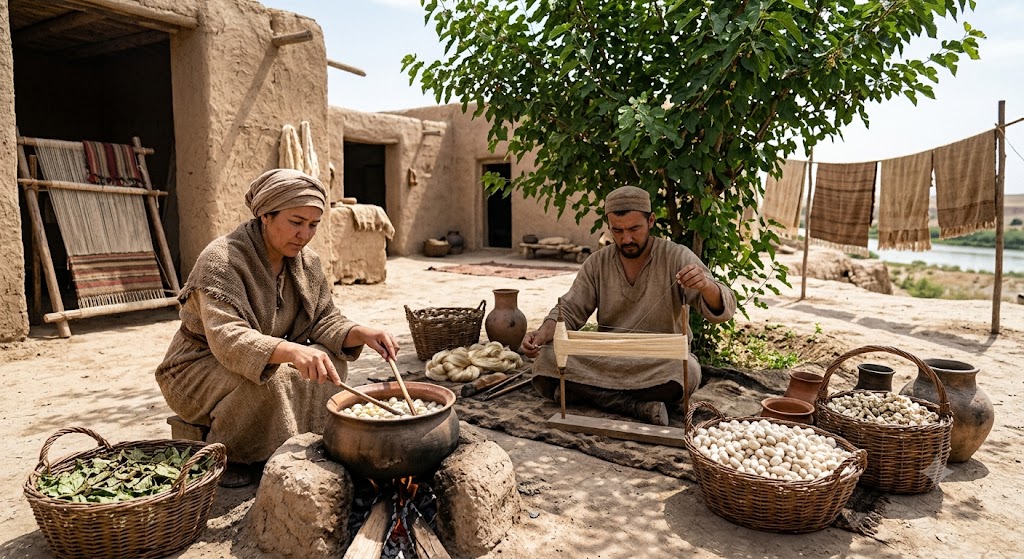
Sericulture emerged in Central Asia around 4,000 years ago—nearly 2,000 years earlier than historians long believed. Scientists reached this conclusion following the discovery of three ancient silkworm cocoons at the Bronze Age site of Sapalli Tepe in Uzbekistan, reports the online magazine Archaeology News.
For many years, researchers linked the expansion of silk production beyond China to the Silk Road, which flourished during the Han Dynasty and Ancient Roman eras. However, the new finds indicate that silk production reached Central Asia long before these famous trade routes were established.
The study, published in the journal Science Advances, focuses on three well-preserved cocoons unearthed during excavations along the Surkhandarya River. Sapalli Tepe’s arid climate helped preserve these fragile artifacts for nearly four millennia. Utilizing microscopic analysis, protein testing, and direct radiocarbon dating, scientists identified the cocoons as Bombyx mori—the domesticated mulberry silkworm still used for silk production today.
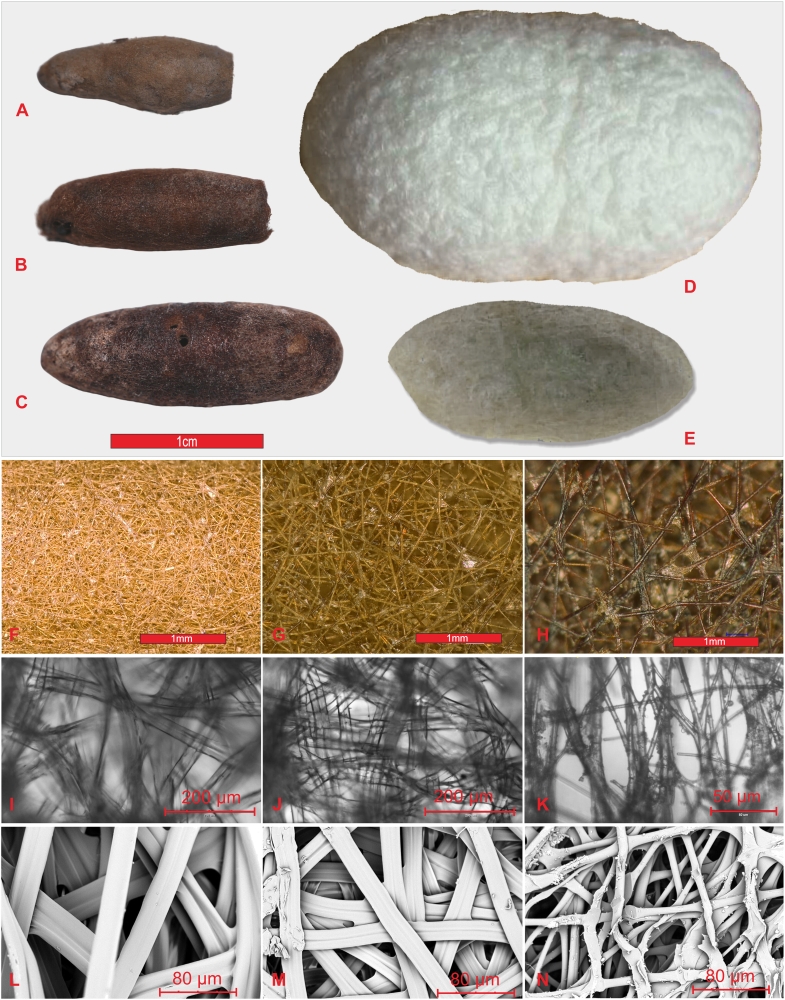
Radiocarbon analysis dates the cocoons to between 1940 and 1765 BCE. According to the research team, these are the oldest reliably dated Bombyx mori cocoons ever found by archaeologists. Even in China, where the species was first domesticated, no cocoons of comparable age have survived, as such organic remains rarely endure over time.
This discovery holds particular significance because Bombyx mori is inextricably linked to mulberry sericulture traditions originating in Ancient China. (In other Asian regions, different wild silkworm species were later utilized to produce silk varieties such as Tussar, Eri, and Muga).
Researchers uncovered another crucial piece of evidence at Sapalli Tepe: mulberry wood charcoal lying adjacent to the cocoons. Since mulberry leaves serve as the primary food source for Bombyx mori, the presence of these trees was an essential prerequisite for raising domesticated silkworms. The team notes that the discovered charcoal fragments represent the oldest known evidence of mulberry trees growing in Central Asia.
The study suggests that silkworms and mulberry trees reached the southern part of Central Asia along routes passing through the southern slopes of the Himalayas, though available data does not rule out alternative pathways. Furthermore, citrus tree charcoal was also found at the site, supporting the hypothesis of connections with regions further south.
During earlier excavations at Sapalli Tepe, a fragment of woven silk fabric had already been discovered. While modern laboratory re-analysis was not possible due to artifact conservation rules, archival records describe a simple plain-weave cloth made from spun silk thread, fully consistent with early Chinese silk-weaving techniques. Taken together, the discovered cocoons, mulberry remains, and textile fragment directly indicate that local silk production took place within the ancient settlement.
The study presents a fundamentally new chronology for the spread of sericulture. Rather than a starting point 2,000 years ago tied to the Silk Road, the introduction of the domesticated silkworm and mulberry cultivation in Central Asia began as early as the Bronze Age, pushing the history of silk production back into much deeper antiquity./// nCa, 25 July 2026