


Tariq Saeedi
As the Organization of Turkic States (OTS) prepares for its landmark 13th Summit in Ankara, debate surrounding its future expansion naturally surfaces. While the temptation exists for any regional block to widen its tent to maximize raw geographic reach, the core durability of the OTS rests on an irreplaceable strategic asset: linguistic commonality.
Preserving a tight linguistic threshold is not an exercise in romantic cultural sentimentalism. Rather, it is a pragmatic policy strategy. Anchoring the core of the OTS firmly in the Turkic language family provides five institutional advantages that money, proximity, or sheer geographical scale cannot replicate.
1. Avoiding the “Dilution Trap”: Lessons from ECO and the OIC
Multilateral organizations often suffer from a structural paradox: as membership broadens purely for political headcount, institutional efficacy drops.
- The ECO and OIC Contrast: The Economic Cooperation Organization (ECO) and the Organization of Islamic Cooperation (OIC) encompass vast populations and critical geographies. However, their sheer political, linguistic, and ideological diversity often leads to lowest-common-denominator consensus, bureaucratic inertia, and diffuse agendas.
- The OTS Structural Edge: By keeping its core bound by linguistic mutual intelligibility, the OTS avoids becoming an unwieldy talking shop. Shared language generates built-in institutional trust (“Biz Birlikte Daha Güçlüyüz”), enabling member states to ratify trade agreements, harmonize customs protocols, and execute joint initiatives faster than traditional multilateral bodies.
2. Grassroots Knowledge Transfer without English Intermediaries
In many developing regional blocs, technical collaboration, vocational training, and educational exchange are bottlenecked by English or French language proficiency—a skill often concentrated in urban elites.
- Grassroots Inclusion: Because the Turkic languages share structural grammar, core technical vocabulary, and rapid mutual learning curves (facilitated by initiatives like the 34-letter Common Turkic Alphabet adopted in late 2024), specialized technical knowledge can be transmitted directly at the shop-floor and academic level.
- Democratizing Innovation: An agricultural specialist, energy technician, or software developer from Uzbekistan, Azerbaijan, or Turkey can conduct joint training and transfer practical expertise without relying on non-native third-language translations. This democratizes skill sharing across the working population.
3. High Workforce and Professional Interchangeability
The structural closeness of the Turkic languages creates an extraordinarily fluid regional labor market for specialized human capital.
- Frictionless Mobility: Engineers, medical professionals, logistical operators, and educators can adapt quickly across national borders within the OTS space. A civil engineer trained in Ankara or Baku can integrate into infrastructure projects in Astana or Tashkent with minimal language adaptation compared to moving to a non-Turkic region.
- Collective Human Capital Pool: This interchangeability creates a self-contained ecosystem of technical talent, reducing reliance on expensive external consulting while keeping high-value skills and intellectual capital within the Turkic economic space.
4. Maximizing Collective Bargaining Power Through Cohesion
In international diplomacy and trade negotiations, a compact, culturally cohesive bloc commands far greater bargaining power than a fragmented coalition.
- Unified Geopolitical Leverage: Because member states share an intrinsic civilizational identity, they can present a unified front on key Eurasian trade, energy security, and logistics mandates.
- Strategic Autonomy: Sticking together on a shared linguistic foundation gives small and middle powers within the OTS a collective voice when dealing with neighboring global heavyweights (such as the EU, China, or Russia), ensuring their regional terms are dictated by shared consensus rather than isolated bilateral pressure.
5. Seamless Geographic Contiguity: The Trans-Caspian Backbone
Unlike dispersed linguistic communities across the globe, the Turkic language core occupies a unbroken, contiguous land and sea mass stretching from the Aegean Sea to the borders of Western China.
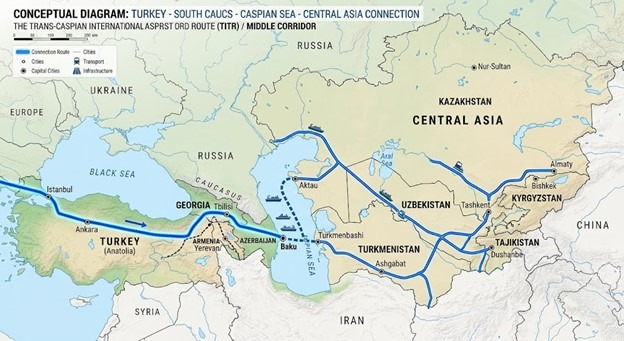
- The Middle Corridor Advantage: This unbroken spatial footprint directly frames the Trans-Caspian International Transport Route (the Middle Corridor). Language continuity across this logistics belt streamlines cross-border customs coordination, port operations at Baku, Aktau, Turkmenbashi, and Kuryk, and rail transport management.
- Geoeconomic Synergy: Contiguity transforms shared language from an abstract concept into an engine for trade transit, pipeline security, and physical infrastructure integration across Eurasia.
As discussions around partner statuses evolve at the Ankara Summit, maintaining the linguistic core as the primary criteria for full membership ensures the OTS retains its unique identity and agility. Language is not merely a medium of communication—it is the operational code that transforms raw geographic proximity into an integrated, high-trust economic bloc. /// nCa, 28 October 2026 [to be continued]