


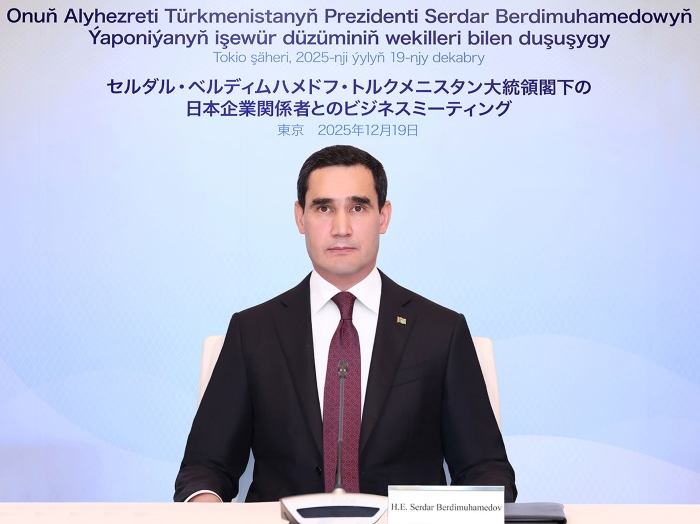
Turkmenistan is inviting Japanese businesses to partner on a series of major initiatives in water conservation, wastewater treatment, and waste management. President Serdar Berdimuhamedov detailed these proposals during a high-level meeting with executives from leading Japanese corporations on 19 December in Tokyo.
The President called on Japanese firms to consider several specific environmental and industrial initiatives, including:
- Waste Management: Construction of a modern facility for processing household and construction waste.
- Water Reclamation: Advanced wastewater treatment projects to enable water reuse in industrial and municipal sectors.
- Plastic Recycling: Construction of specialized mini-plants for recycling PET bottles.
- Electronics Recycling: A dedicated facility for processing end-of-life household appliances.
President Berdimuhamedov emphasized that Turkmenistan is prepared to offer highly favorable conditions for Japanese business circles, ensuring a supportive environment for long-term investment and mutually beneficial partnerships.
Beyond environmental projects, the President identified several other strategic areas for bilateral cooperation:
- Energy and renewable energy sources.
- Transport, logistics, and infrastructure modernization.
- High-tech and eco-oriented manufacturing.
- Professional training and human resources development.
“We are ready to actively promote Japanese technology and products in the Turkmen market, particularly in mechanical engineering, electronics, and the chemical industry,” stated President Berdimuhamedov.
The meeting was attended by senior leadership and representatives from global industry leaders, including Sumitomo Corporation, Toyo Engineering Corporation, Kawasaki Heavy Industries, Ltd., Muroosystems Corporation, ITOCHU Corporation, Tokyo Boeki Eurasia Limited, Mitsubishi Heavy Industries, Ltd., Mitsubishi Corporation, and ARGONAVT Corporation, as well as Calik Holding and Gap Inşaat ve Diş Ticaret A.Ş.
The event concluded with the signing of a comprehensive package of documents to solidify the new agreements.
Speech by President of Turkmenistan Serdar Berdimuhamedov at a meeting with the Japanese business community
Dear members of the Japan-Turkmenistan Cooperation Committee, representatives of the Japanese business community, ladies and gentlemen,
I am sincerely pleased to welcome you, the executives and representatives of leading Japanese companies—our reliable, time-tested partners, with whom Turkmenistan has enjoyed years of fruitful and mutually beneficial cooperation.
Taking this opportunity, I would like to express my gratitude to you for the initiative to organize this meeting and the opportunity to thoroughly discuss the current state and prospects for the further development of the Turkmen-Japanese economic partnership.
Turkmenistan continues to consistently deepen its established and proven forms of cooperation with Japanese companies, while simultaneously aiming to achieve new, more ambitious goals.
The interaction between Turkmenistan and Japan is long-term, sustainable and multifaceted.
It has always been built and continues to be built on the principles of mutual respect, trust and pragmatic benefit.
For Turkmenistan, Japan is a model of high-tech development, an innovative approach to the economy, and a harmonious combination of industrial growth and environmental responsibility.
The achievements of Japanese companies in science, industry, production process management, and corporate management serve as an important reference point for us in modernizing and enhancing the competitiveness of the national economy.
Recognizing the need for a comprehensive economic model update, Turkmenistan has focused its efforts on a number of priority objectives. These include the implementation of innovative development strategies, accelerated industrialization, a “green transition,” diversification of the energy sector, and the development of national and international transport and logistics connectivity. In each of these areas, we see real and mutually beneficial opportunities for the active participation of Japanese businesses.
We highly value and gratefully acknowledge the long-term successful activities of large Japanese companies in Turkmenistan.
Companies such as Itochu, Kawasaki, Mitsubishi, Sojitz, Toyo, Mitsui, Sumitomo, Komatsu, Toyota, and others have made and continue to make significant contributions to the development of the Turkmen economy. Their participation in large-scale projects in energy, mineral extraction, chemicals, transportation, and agriculture has become a clear example of effective and responsible partnership.
In recent years, major modern industrial facilities have been commissioned in Turkmenistan with the participation of Japanese companies. These include gas chemical complexes for the production of ammonia and urea in Mary and Garabogaz, a polymer plant in Kiyanly, a natural gas-to-gasoline plant in Ovadandepe, and a gas turbine power plant in Charjew district. These projects are not only economically but also strategically significant, contributing to the technological modernization and diversification of the country’s industrial potential.
The results of our joint work allow us to look to the future with even greater optimism. Turkmenistan is ready to offer Japanese business circles favorable conditions for long-term investment and mutually beneficial partnership.
Our priority areas include energy, including renewable energy sources, transport and logistics, high-tech and environmentally friendly manufacturing, water resource management, infrastructure modernization, and specialist training and development.
We are ready to actively promote Japanese technologies and products on the Turkmen market, primarily in areas such as mechanical engineering, electronics, and the chemical industry.
At the same time, Turkmenistan is interested in attracting advanced Japanese technologies and practices in the fields of water conservation, water purification, waste management, green energy, and hydrogen energy.
As you know, during our April meeting we discussed the importance of transitioning to a circular economy, an area to which Turkmenistan is now paying particular attention.
We are steadily advancing efforts to modernize our industrial infrastructure, expand waste‑recycling capacities, and implement sustainable resource‑management practices. We are also well acquainted with the advanced solutions and technologies developed by leading Japanese companies, including Mitsubishi, Toyota, Mitsui, and Sumitomo.
First, to reduce the volume of waste sent to landfills through sorting, recycling, and reuse, we propose developing a project for the construction of a modern facility for processing household and construction waste.
Second, we consider it advisable to implement a project aimed at significantly improving wastewater treatment, enabling its reuse in industrial processes and public utilities.
Third, to decrease the amount of plastic entering the environment and return polyethylene to secondary circulation, we are prepared to explore projects for establishing mini‑factories dedicated to recycling PET plastic bottles.
Fourth, to reduce the volume of hazardous and slow‑decomposing waste containing metal, plastic, and electronic components, we propose exploring the feasibility of a project to build a mini‑plant for recycling household appliances.
The experience accumulated over the years of cooperation has convincingly demonstrated the high level of trust and reliability in our relations. This is facilitated by the friendly nature of interstate ties, mutual understanding, and respect for each other’s interests.
In conclusion, I would like to reaffirm Turkmenistan’s firm and unwavering commitment to developing and expanding partnership relations with Japan, as well as its readiness to continue to provide comprehensive support to the Japanese business presence in our country on a long-term basis.
I am confident that today’s meeting will be another important step towards the implementation of new joint initiatives and projects that meet the interests of both parties.
(Tokyo City, December 19, 2025) ///nCa, 20 December 2025