


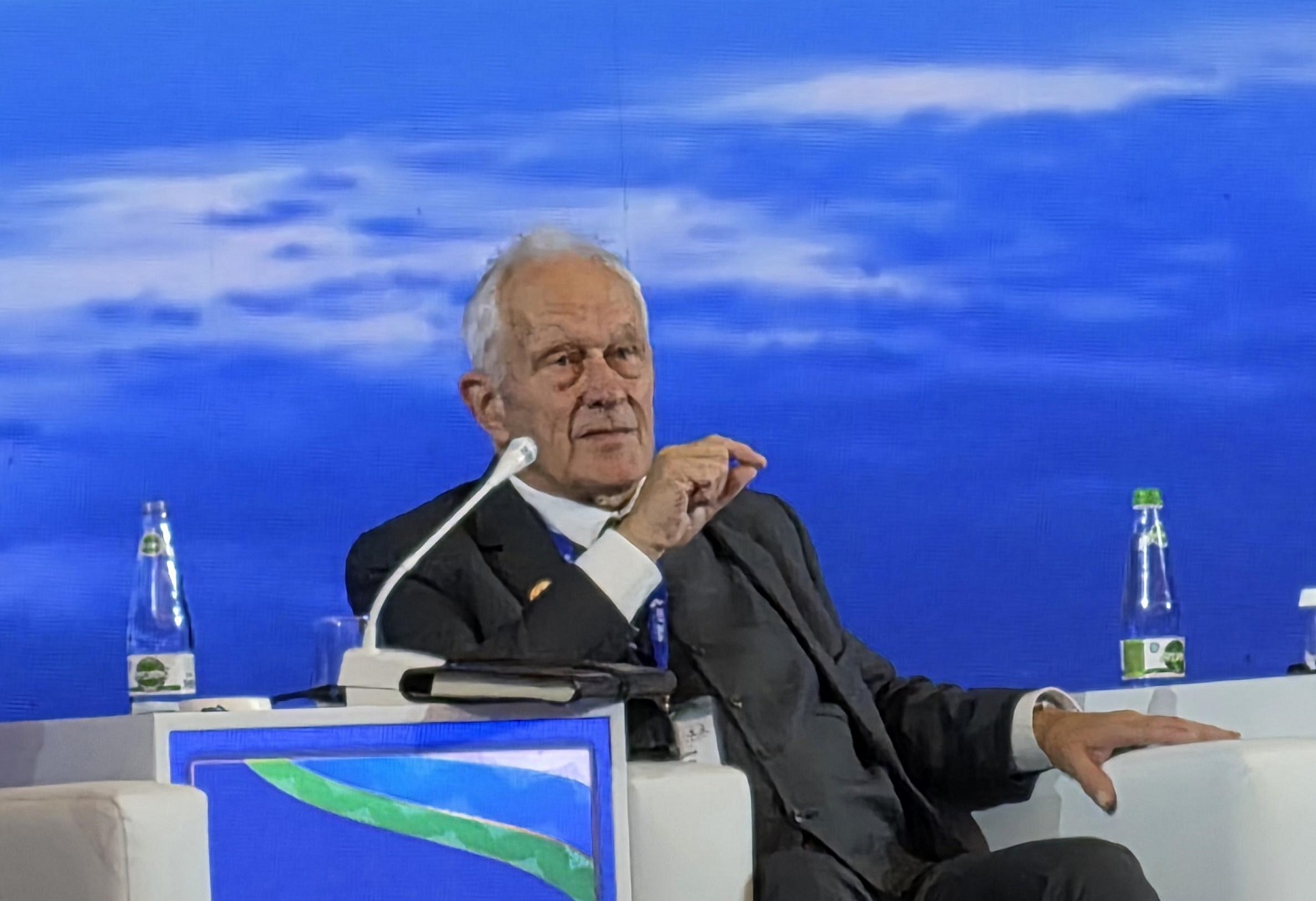
Turkmenistan is preparing to build a second gas-to-gasoline (GTG) plant, with Danish technology company Topsoe working closely with Japan’s Kawasaki Heavy Industries and Turkmenistan’s state concern Türkmenhimiýa to advance the project. Rickard Vannby, Topsoe’s Director of Licensing, said the partners hoped the new facility would be built in the very near future.
Speaking at the 31st International Conference and Exhibition “Oil and Gas of Turkmenistan” (OGT 2026) in Ashgabat, during a panel discussion on gas monetisation, petrochemicals and industrial value creation, Vannby described the first GTG plant as a major success and said Turkmenistan had become a global leader in this technology.
“This is the only plant in the world producing synthetic gasoline from natural gas, so Turkmenistan is the world leader in this technology,” he said.
The existing plant has been in continuous operation since 2019. Topsoe signed the technology licensing agreement with Kawasaki Heavy Industries in 2014, while Kawasaki Heavy Industries and Rönesans served as engineering, procurement and construction (EPC) contractors.
Vannby recalled the moment when the plant produced its first gasoline.
“I actually remember the sigh of relief on 3 May 2019 at 3:15 in the afternoon when the first drops of gasoline came,” he said.
The facility converts natural gas into synthetic gasoline using Topsoe’s technology, which was originally developed in the 1980s. According to Vannby, the project has given Turkmenistan considerable experience in operating this type of facility and demonstrated the commercial potential of converting gas into higher-value products.
A proven market for synthetic gasoline
Vannby said the success of the first plant rested on several essential conditions: access to a reliable and affordable natural gas supply, a market for the finished product, investment capacity and a dependable technology licensor and catalyst supplier.
Turkmenistan has developed both domestic and export markets for its synthetic gasoline. The product is sold within the country and exported to neighbouring states and to Balkan countries via Georgia.
“My understanding is you can export any amount you produce,” Vannby said, adding that demand for gasoline was likely to remain for decades.
“We’re not going to get rid of gasoline the next many decades, that’s for sure,” he said. “Maybe in some countries in Europe we will decrease, but we’re not getting rid of gasoline.”
Against this background, the proposed second plant would expand Turkmenistan’s capacity to convert its natural gas resources into marketable products. Vannby said Topsoe was working closely with Kawasaki Heavy Industries and Türkmenhimiýa to support the project.
“Scaling up would mean that plant number two would be built. And this is, of course, what we’re hoping,” he said. “We truly hope this will happen in the very, very near future.”
Topsoe sees potential for gas-to-liquids production
Beyond synthetic gasoline, Vannby identified another possible direction for Turkmenistan’s gas-processing industry: producing jet fuel and diesel through gas-to-liquids (GTL) technology.
“Regarding new technologies, there is not that much on the table. But one thing that could be interesting is, of course, not only producing gasoline, but producing jet fuel and diesel also by the GTL,” he said.
Topsoe would be willing to assist Turkmenistan in exploring this option, Vannby added.
Vannby noted that GTL is not a new technology, having been developed in the 1940s, but it could offer Turkmenistan another way to diversify its gas-processing output.
“That’s one alternative which we would be very much pleased to discuss with the Turkmen government also,” he said.
The proposals reflect the broader potential for Turkmenistan to build on its experience with the existing GTG plant and expand the range of higher-value products manufactured from its natural gas resources. ///nCa, 22 October 2026