


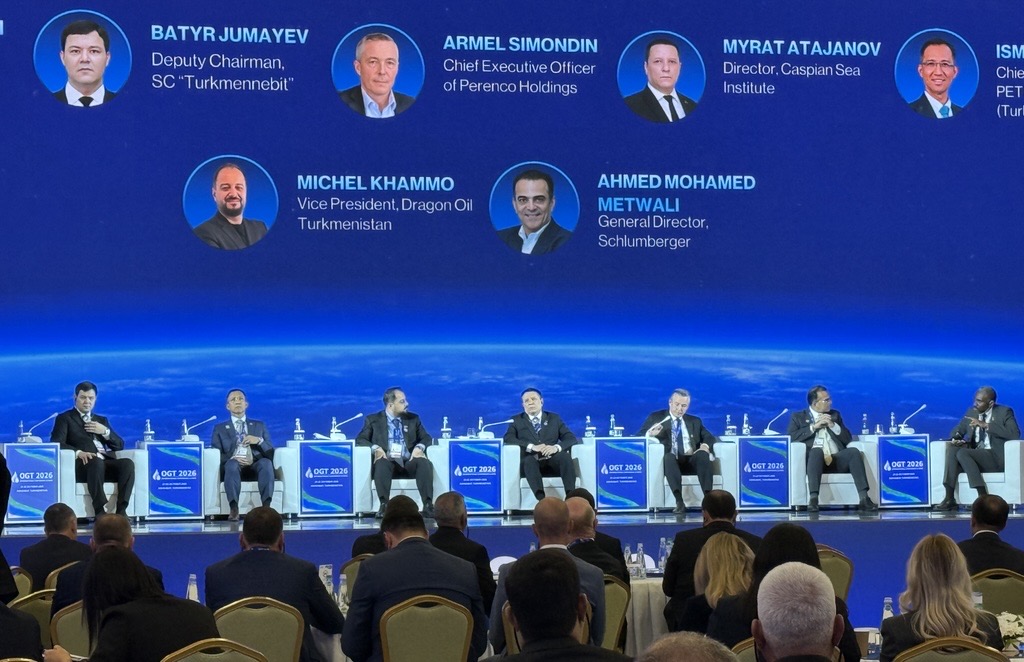
The development of oil and gas projects in the Caspian Sea requires not only investments and modern technologies, but also clear legal boundaries, as well as continuous scientific monitoring of the marine environment amid the receding sea levels. These issues took center stage in the speech by Myrat Atajanov, Director of the Caspian Sea Institute, at the “Oil and Gas of Turkmenistan” (OGT 2026) international conference in Ashgabat.
In his speech, he emphasized that scientific research and environmental assessments are not secondary or supplementary procedures when implementing large-scale oil and gas projects. On the contrary, they serve as the fundamental basis for making key technical, investment, and managerial decisions.
The head of the institute recalled that the Convention on the Legal Status of the Caspian Sea, signed on 12 August 2018, established clear principles for the rational use of marine resources while preserving the fragile ecosystem of the water body.
“The exploitation of hydrocarbon potential and the protection of the marine environment must be viewed as interconnected tasks. For the Turkmen sector of the Caspian, this means, first of all, continuous, comprehensive scientific and geological monitoring. This requires reliable data on the geological structure of the subsurface, the state of the marine environment, hydrological conditions, and coastline dynamics,” the speaker said.
Equally important is the assessment of marine ecosystems and the forecasting of potential consequences from accidental spills, the development of measures to prevent such accidents and eliminate their consequences, and the analysis of the cumulative impact of various oil and gas sector facilities on the marine environment.
Dynamics of Multilateral Cooperation and the Caspian Environmental Initiative
Speaking on the development of regional partnership, Myrat Atajanov noted an important trend: while in 2010 there were only two multilateral agreements on the Caspian, by 2018 their number had increased to 16. Such an international legal framework serves as the foundation for deepening cooperation among the Caspian states.
An important tool for uniting efforts is intended to be the Caspian Environmental Initiative, put forward by the President of Turkmenistan, Serdar Berdimuhamedov. It aims to form a unified platform for the smooth operation of existing mechanisms, such as the Tehran Convention for the Protection of the Marine Environment, the Committee on Hydrometeorology, the Commission for the Conservation and Rational Use of Aquatic Biological Resources, and the High-Level Working Group.
Since the Caspian Sea is a single natural system where hydrological, climatic, and geological processes are not limited by state borders or demarcation lines, the expansion of scientific and technical cooperation among the five countries of the region is of paramount practical importance.
In this context, a key role is played by the Agreement on Cooperation in Marine Scientific Research in the Caspian Sea, being developed on the initiative of Turkmenistan. This document will establish a systematic basis for joint research, data exchange, the improvement of observation methodologies, and the training of specialized personnel.
Challenges of Sea-Level Drop and Monitoring Tasks
Special attention in the speech was paid to the pressing challenges associated with the dropping level of the Caspian Sea, which affects the interests of all Caspian states. Myrat Atajanov noted that changes in depths and coastline configurations can create additional risks for coastal production facilities, underwater channels, port infrastructure, as well as for the operation of offshore platforms, subsea pipelines, and other offshore structures.
“Under these conditions, scientific assessments must include various scenarios of sea depth changes, vulnerability analysis of infrastructure, and the development of adaptation measures. This will allow for timely consideration of new conditions when designing facilities, selecting technical solutions, and planning operational activities,” Atajanov explained.
The Commission on the Falling Level of the Caspian Sea, established in September 2026 in the National Tourist Zone “Avaza,” must rely on agreed observation methods, unified datasets, and regular expert consultations.
“It is fundamentally important to ensure regular monitoring, the comparability of research results, and the practical application of scientific conclusions in making economic decisions. Ultimately, a scientifically grounded approach allows not only to reduce ecological and technical risks, but also to increase predictability, which is important for long-term investments,” Atajanov stressed.
Legal Certainty and Investment Attractiveness
A separate emphasis was placed on completing the process of delimiting the water areas and sectors of the Caspian Sea in strict accordance with the provisions of the 2018 Convention.
“Legal certainty regarding the sectors is necessary for planning geological exploration, determining rights to field development, placing offshore structures, and implementing long-term investment projects,” the head of the Caspian Sea Institute noted.
In conclusion, Atajanov stressed that the prospects for cooperation lie in the parallel deepening of joint scientific research and the consistent resolution of legal issues. This combination of economic efficiency, technological reliability, and legal certainty enables the Caspian states to respond more effectively to environmental challenges and create predictable conditions for the sustainable development of the entire region. ///nCa, 22 October 2026