


Tariq Saeedi
When world leaders gather for back-to-back summitry, the global news apparatus focuses naturally on the grand dining halls, the official communiqués, and the high-level handshakes.
The recent series of summits on the Caspian shore—bringing together the heads of state and government for the Consultative Meeting of Central Asia and Azerbaijan, the CIS Summit, and the Caspian Ecological Summit—produced significant consensus and crucial bilateral progress.
Yet, as someone who has observed Turkmenistan’s evolving statecraft from the ground for a long time, my eyes were simultaneously elsewhere during those four intense days in Awaza.
Diplomacy at this level is a massive kinetic operation. Pulling off three major multilateral formats simultaneously in a compact coastal zone requires an operational tempo that few smaller public service infrastructures are ever asked to endure.
Behind the polished marble facades and smoothly running bilateral talks sat a dedicated human engine—hundreds of women and men who worked around the clock, carrying out extraordinary, multi-faceted labor to ensure that the international machine did not drop a single beat.
The Art of the Multi-Role Shift
In a country with a modest population, ministerial and support agencies are intentionally lean. They do not possess the endless bureaucratic reserves of larger nations. When ten presidential delegations arrive simultaneously alongside hundreds of support staff, journalists, and technical experts, standard job descriptions dissolve.
Over those four days, operational success relied entirely on people wearing multiple hats at once. Protocol officers acted as logistics dispatchers; foreign ministry staff managed media coordination while troubleshooting regional transit movements; airport liaison crews transitioned seamlessly from welcoming state arrivals to organizing complex baggage operations and escorting technical teams.
At the regional airport and along the transit nodes, air traffic coordinators, ground crews, and logistics personnel managed the continuous cycle of incoming and outgoing presidential flights with clockwork precision.
Across the hotel cluster, housekeeping crews, kitchen staff, and maintenance technicians worked on two to three hours of sleep, ensuring every suite was immaculate, every dining facility stocked, and every technical request fulfilled instantly. Their work was quiet, tireless, and performed with remarkable composure.
Smart Design: The Invisible Flow of Traffic
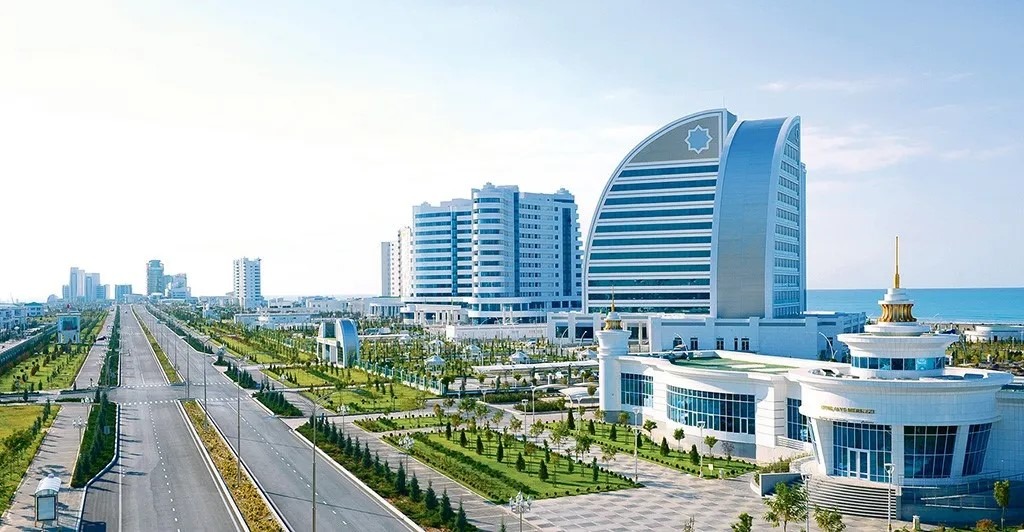
While human endurance provided the energy, the spatial engineering of Awaza provided the framework. Observing the movement of delegations across the zone revealed the quiet brilliance of Awaza’s road network and urban design.
In many international summit hosts, presidential motorcades bring surrounding cities to a complete standstill, stranding residents in hours of gridlock. In Awaza, the infrastructure functions differently. The road network was built with looping bypasses, perimeter arteries, and strategically positioned grade-separated intersections.
During the summits, as dozens of armored motorcades crisscrossed the resort moving between presidential suites, plenary halls, and bilateral meeting venues, ordinary support traffic and local transport continued to flow smoothly. The “protocol corridor” operated almost entirely on its own bypass-enabled looped layer, preventing the sudden, jarring traffic freezes that usually paralyze large-scale summits. It was a masterclass in civil planning working quietly in service of high-stakes logistics.
The Real Foundation of Success
When the final summit concluded and the delegation aircraft departed one by one into the Caspian sky, the world noted the political success of the meetings. But the foundational triumph belonged to the teams on the ground—the drivers who navigated long night shifts without losing concentration, the protocol assistants who managed foreign delegations with quiet grace, the airport crews juggling tight runway slots, and the service staff who kept the entire complex spotless and functioning smoothly throughout.
High-level political consensus is written in conference rooms, but it is made possible on the floor. The workers, technicians, support staff, and logisticians of Awaza proved that dedication, flexibility, and hard work can turn a complex multi-summit marathon into a seamless reality. They earned every bit of the pride and satisfaction that follows a job extraordinarily well done. /// nCa, 15 October 2026