


nCa Report
For years, switching to an electric vehicle (EV) felt like navigating technical jargon, high purchase prices, and constant worry about running out of charge.
However, recent battery developments have shifted focus away from laboratory science and directly toward real-world driver priorities: affordability, long-term durability, and effortless daily driving.
1. Price: Are EVs Finally Becoming Affordable?
- Closing the Purchase Price Gap: Cheaper raw material alternatives (such as sodium and iron-phosphate blends) have significantly lowered manufacturing costs. Entry-level electric cars are increasingly reaching price parity with comparable gasoline models.
- Lower Operational Costs: Charging with electricity is substantially cheaper per kilometer than buying fuel. Combined with minimal routine maintenance (no oil changes, spark plugs, or frequent brake pad wear), the total 5-year ownership cost of an EV is now lower than a gas car in most markets.
2. Battery Lifespan: Will the Battery Outlast the Car?
- Built to Last 15 to 20 Years: Today’s EV batteries are engineered to perform reliably for 300,000 to 500,000 kilometers of driving.
- Slow Wear, Not Sudden Failure: EV batteries do not abruptly stop working like a phone or flashlight. Instead, they lose roughly 1.5% to 2% of capacity per year. Even after a decade of daily use, the car retains most of its original range.
- Worry-Free Warranties: Auto manufacturers routinely include an 8-year / 160,000 km warranty guaranteeing the battery will maintain at least 70% of its initial capacity.
3. Range & Charging Speed: How Far Can You Go?
- 400 to 600+ Kilometers on a Full Charge: Standard family EVs now easily handle daily commutes and weekend highway trips without requiring frequent stops.
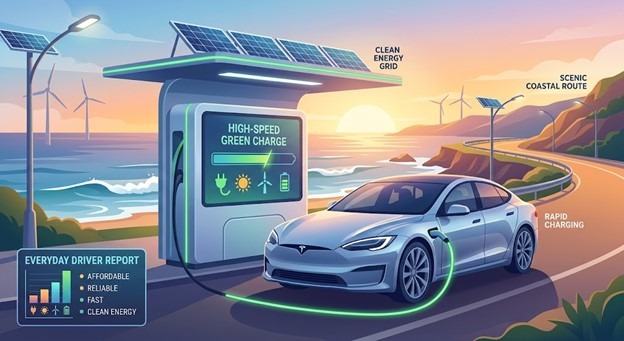
- Coffee-Break Charging: Newer high-speed charging networks enable drivers to add 200–300 km of driving range in 10 to 15 minutes—about the time it takes to grab a quick coffee on a long trip.
Quick Buyer’s Summary Checklist
| Driver Question | Everyday Expectations | Bottom Line |
| How far can I drive? | 400 – 600+ km per full charge | More than enough for daily driving and road trips |
| How fast does it charge? | 10–15 minutes for a fast highway charge | Matches a typical highway rest stop |
| How long will it last? | 15–20 years (300,000+ km) | Built to outlast the car itself |
| Is replacement risky? | Less than 0.5% failure rate | Covered by 8-year standard manufacturer warranties |
| Is it cost-effective? | Lower fuel and maintenance expenses | Saves money over 3–5 years of ownership |
Winter Performance & Cold Weather (“Will my range drop drastically in winter?”)
- The Issue: Older EV batteries historically lost up to 25–30% of their range in freezing weather because chemical reactions slow down and cabin heating drains power.
- The Latest Development: Newer battery architectures (especially incoming sodium-ion and advanced thermal management software) are solving this. Sodium-ion chemistry and smart internal heating systems maintain significantly better efficiency and charging speeds in sub-zero temperatures, meaning far less winter anxiety for drivers in colder climates.
Safety & Peace of Mind (“Are EV fires common?”)
- The Reality: Statistically, EVs are significantly less prone to fires than gasoline-powered cars (which carry hundreds of liters of highly volatile liquid fuel).
- The Latest Development: Modern battery packs use advanced fire-retardant materials, better physical crash structures, and AI-driven Battery Management Systems (BMS) that monitor individual cells 24/7. If a cell shows any irregularity, the system isolates it instantly to prevent thermal runaway.
Recycling & Second Life (“What happens to the battery when the car dies?”)
- The Reality: Drivers often worry about environmental waste or toxic disposal.
- The Latest Development: Regulations and closed-loop recycling plants are expanding rapidly. Modern EV batteries are up to 95% recyclable, meaning valuable materials like lithium, cobalt, and nickel are stripped out and reused in brand-new batteries. Furthermore, old EV batteries that have lost a bit of range often get a “second life” as stationary energy storage units for homes or solar power grids. /// nCa, 15 October 2026