


Tariq Saeedi and Elvira Kadyrova
Global supply chains were built for efficiency, not survival. For decades, the system hummed along on a fragile formula: concentrate manufacturing in East Asia and rely on a few high-traffic maritime channels like the Suez Canal or northern rail tracks cutting through Russia. But post-pandemic ripples, grinding trade friction between Washington and Beijing, and the war in Ukraine exposed how precarious this setup truly was.
Western economies are now actively executing a “de-risking” playbook. The goal isn’t to completely sever ties with Chinese factories, but to build enough redundancy into the global grid so that a crisis in one chokepoint doesn’t paralyze the entire network.
Because of this strategic shift, Central Asia—traditionally viewed as an isolated, landlocked barrier—is rapidly converting its geography into a central land bridge linking Europe, East Asia, and South Asia.
The absolute crown jewel of this logistical pivot is the Trans-Caspian International Transport Route (TITR), affectionately dubbed the Middle Corridor. Meandering from China through Kazakhstan and Turkmenistan, across the Caspian Sea to Azerbaijan, and onward through Georgia and Türkiye into Europe, it successfully side-steps both sanctioned Russian soil and volatile Middle Eastern flashpoints.
The growth here has been staggering, shifting from a quiet pathway to a vital economic artery almost overnight. Annual freight volumes expanded more than fivefold, landing at roughly 4.5 million tons. While total tonnage hit a brief plateau in 2025 due to uneven regional data infrastructure, container traffic surged by 36% to 77,000 TEUs. Momentum has surged forward again; by the close of August, overall freight volumes climbed another 22%, driven by an impressive 55% jump in eastbound-westbound transit.
Transit times have dramatically shrivelled. What once required a sluggish 38 to 53 days has dropped to a predictable 18–23 day window. The Secretary-General of TRACECA noted that optimized routes can now clock in at just 15 days. This acceleration is largely thanks to aggressive bureaucratic modernization, highlighted by the landmark agreement on a unified, electronic Single Transit Permit.
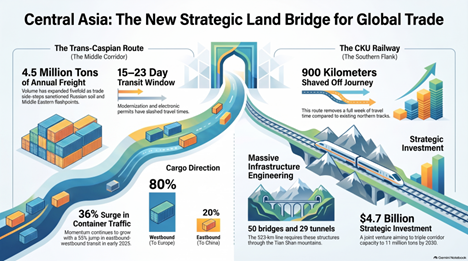
International lenders like the World Bank and the EBRD are pouring hundreds of millions of dollars into infrastructure to triple the corridor’s capacity to 11 million tons by 2030.
Kazakhstan is expanding dual-track rails and building a massive container hub at Aktau. Yet, the route faces stubborn hurdles. The Caspian Sea crossing remains a severe bottleneck, made worse by dropping water levels that force ships to travel light. Traffic is also heavily lopsided—roughly 80% of containers move west, leaving return legs mostly empty and forcing operators to slash eastbound rates just to bring containers back.
Westbound Cargo: ▓▓▓▓▓▓▓▓ 80%
Eastbound Cargo: ▓▓ 20%
Simultaneously, a southern flank is opening up via the long-delayed China–Kyrgyzstan–Uzbekistan (CKU) railway. After nearly thirty years of diplomatic foot-dragging, heavy machinery began carving out the mountainous Kyrgyz leg. It is a brutal engineering challenge: the 523-kilometre line must cut through the unforgiving Tian Shan range, requiring 50 bridges and 29 massive tunnels. Crews achieved their first breakthrough on the 210-metre Kosh Dobo North No. 2 tunnel, pushing total progress on the section to 17%.
Financed via a $4.7 billion joint venture—with China holding a controlling 51% stake and a syndicate led by the China Development Bank providing a $2.3 billion loan—the line is slated for a 2030 completion. When the first trains roll, the CKU will shave an estimated 900 kilometres and a full week off the overland journey to Europe compared to northern routes.
For the participating nations, the stakes are transformative but delicate. Uzbekistan extends its rail network toward its goal of becoming a regional logistics hub. China secures a reliable, non-Russian land route. Kyrgyzstan gains a direct rail link to the Chinese market and lucrative transit fees, though it significantly deepens its financial exposure to Beijing.
Ultimately, neither land corridor will replace the sheer volume of ocean shipping containers. But the geopolitical gravity pulling these trade routes together is permanent. Backed by the European Union’s Global Gateway initiative and China’s Belt and Road strategy, Central Asia is successfully shifting from the margins of global trade maps directly into the center of a newly diversified, multipolar Eurasian trade network. /// nCa, 17 September 2026