


Tariq Saeedi and Elvira Kadyrova
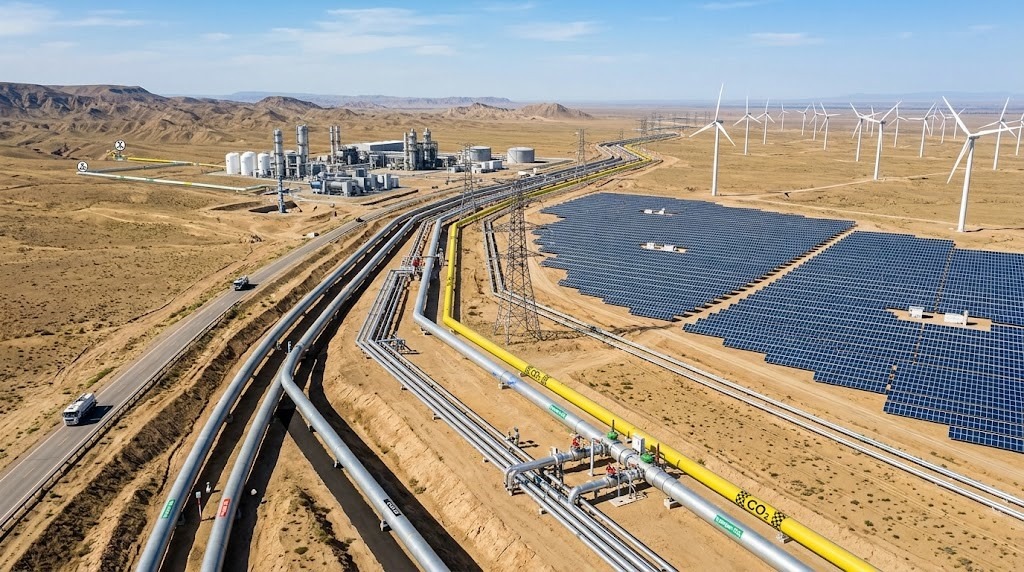
The global pipeline infrastructure is undergoing an irreversible paradigm shift. Driven by net-zero climate mandates and the need for long-term economic resilience, international midstream operators are looking past traditional hydrocarbons. Pipelines are no longer viewed strictly as rigid, single-commodity transit tubes for crude oil and natural gas. Instead, the modern energy sector is evolving toward non-conventional substances—such as hydrogen and carbon dioxide (CO₂)—and flexible, multi-purpose designs capable of acting as dynamic, adaptable energy corridors.
For Central Asian policymakers, this architectural transformation is not a distant trend to be monitored from afar; it is an immediate strategic imperative. Anchored by a massive web of legacy networks, the region stands at a historical crossroads. To maintain its status as an indispensable global energy hub, Central Asia must look beyond conventional cargo.
Simultaneously, current and prospective international partners—both sovereign states and multinational corporations—must recognize that the region’s traditional transit corridors are uniquely positioned to become the premier testing grounds for the next generation of energy infrastructure.
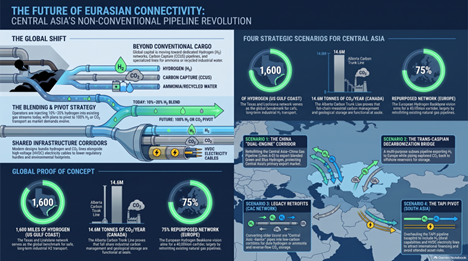
1. The Global Shift: A Roadmap for Policymakers and Investors
Building single-use, unadaptable pipelines is increasingly recognized by international financiers as an unacceptable regulatory and economic risk.
Two clear trends are redefining global midstream investments, offering a blueprint for what is possible in Eurasia:
Trend A: Moving Beyond Conventional Cargo
While traditional fossil-fuel projects face tightening international bottlenecks, global capital is surging into non-conventional, environmentally driven applications:
- Dedicated Hydrogen Networks: Hydrogen (H₂) is rapidly transitioning from a localized industrial chemical to a regional energy carrier, enabling long-distance renewable energy transport and seasonal storage.
- Carbon Capture, Utilization, and Storage (CCUS): Massive networks are being mapped worldwide to carry captured CO₂ away from heavy industrial clusters directly to permanent geological storage sites.
- Synthetic Fuels & Specialized Liquids: Parallel lines are increasingly planned for ammonia, e-methanol, and recycled industrial water.
Trend B: The Rise of Multi-Purpose “Future-Proof” Corridors
Modern pipeline networks are being designed to pivot dynamically over their lifecycles:
- The Blending Phase: Rather than building from scratch, modern gas transmission operators inject hydrogen blends (typically 10% to 20% by volume) into existing natural gas streams as a transitional mechanism.
- Dual-Service & Modality Shifting: Pipelines are engineered to transport natural gas today, shift to high-percentage hydrogen blends later, and eventually be purged to carry pure carbon dioxide as consumer demands change.
- Shared Infrastructure Corridors: Aggregated rights-of-way bundle several lines (e.g., hydrogen, CO₂, and water lines) alongside high-voltage direct current (HVDC) electricity cables, drastically lowering regulatory hurdles and community footprints.
2. Global Proof of Concept: Operational Realities
These paradigms are not merely theoretical concepts. Highly successful projects across the globe demonstrate that the non-conventional pipeline economy is actively unfolding, proving its operational viability to hesitant policymakers and corporate boards alike:
- The US Gulf Coast Hydrogen Networks: Spanning roughly 1,600 miles of operational hydrogen pipelines across Texas and Louisiana, this network serves as the global benchmark for safe, long-term industrial H₂ transport.
- The Alberta Carbon Trunk Line (ACTL): Located in Canada, this premier 240-kilometer system captures industrial carbon emissions and transports up to 14.6 million tonnes of CO₂ per year for permanent geological storage, proving full-chain carbon management is functional at scale.
- The European mosaHYc Project: A cross-border project where engineering crews successfully retrofitted out-of-service natural gas loops into a continuous, pure hydrogen cross-border infrastructure linking France and Germany.
- The European Hydrogen Backbone (EHB): An expansive infrastructure vision involving over 30 energy transmission operators aiming to establish a 40,000-kilometer hydrogen pipeline corridor across Europe by repurposing existing natural gas pipelines for 75% of the network.
3. Four Strategic Scenarios for Central Asia
Central Asia sits at the heart of Eurasian connectivity, linking East Asia to the Caucasus, and South Asia to Europe. By overlaying global multi-purpose pipeline trends onto the region’s vast network geography, four highly realistic scenarios emerge for policymakers and international investors to co-develop:
Scenario 1: The “Dual-Engine” Green Corridor to China
- The Opportunity: Retrofitting the existing Central Asia–China Gas Pipeline (Lines A, B, C, and the planned Line D) into a multi-commodity export corridor.
- The Mechanism: Western Kazakhstan and Turkmenistan possess immense, untapped solar and wind potential alongside vast natural gas reserves. By blending Green Hydrogen (produced via renewables) and Blue Hydrogen (produced via gas combined with carbon capture) into the existing pipelines running to Xinjiang, Central Asia can protect its primary energy export market as Beijing pursues its strict carbon neutrality goals. For China and its major state-owned energy corporations, investing in this transition ensures a highly stable, decarbonized energy flow without the need to secure entirely new land rights.
Scenario 2: The Trans-Caspian Decarbonization Bridge to Europe
- The Opportunity: Expanding the Southern Gas Corridor (SGC) framework by integrating multi-purpose subsea infrastructure across the Caspian Sea.
- The Mechanism: A Trans-Caspian Multi-Purpose Pipeline laid with “H2-ready” steel and parallel internal conduits could create a lucrative, two-way economic chain. Westbound, Central Asian states can export hydrogen or hydrogen-blended gas to Southern Europe and Türkiye, aligning perfectly with the European Hydrogen Backbone initiative. Eastbound, international corporate partners can utilize the infrastructure to establish a shared Industrial CO₂ Gathering Network around heavily industrialized Caspian energy hubs (like Tengiz or Kashagan), burying captured carbon deep within depleted offshore reservoirs.
Scenario 3: Legacy Retrofits for Sino-Russian Energy Swaps
- The Opportunity: Converting underutilized, older Soviet-era pipelines—such as the Central Asia–Center (CAC) pipeline network running through Turkmenistan, Uzbekistan, and Kazakhstan to Russia—into low-carbon transit corridors.
- The Mechanism: As regional players seek new methods to manage stranded gas assets and develop hydrogen ambitions, the legacy CAC network can be structurally partitioned. One branch can be retrofitted with specialized composite liners to handle pure hydrogen or ammonia for regional industrial hubs, while another can act as a reverse-flow mechanism to transport commercial CO₂ down to Central Asia’s massive geological salt domes for permanent storage. This turns an aging environmental liability into a geostrategic circular economy asset that should instantly attract infrastructure funds and regional majors.
Scenario 4: Future-Proofing South Asian Corridors (The TAPI Pivot)
- The Opportunity: Overhauling the long-delayed Turkmenistan–Afghanistan–Pakistan–India (TAPI) pipeline design before the final steel is laid.
- The Mechanism: Laying a pipeline solely for natural gas in the late 2020s or 2030s risks building an immediate stranded asset that modern international banks will refuse to finance. Altering the TAPI blueprint into a Shared Infrastructure Corridor changes the equation entirely. Instead of a lone gas pipe, the right-of-way can bundle a high-pressure, H2-blend-capable pipeline parallel to high-voltage direct current (HVDC) electricity lines and fiber-optic cables. This allows Turkmenistan to export both clean electricity and hydrogen-fossil mixes straight to South Asian grids via Afghanistan, turning a high-risk project into an attractive, multi-sector developmental cornerstone for international consortiums.
An Invitation to Transnational Partners
Central Asia is uniquely positioned to transition from a traditional fossil-fuel supplier to a pioneering global leader in non-conventional infrastructure. The region possesses the three critical ingredients that international energy corporations and sovereign wealth funds look for: vast geography optimized for mega-scale wind and solar production, existing pipeline rights-of-way that completely bypass modern land-acquisition legalities, and direct proximity to the world’s fastest-growing energy consumers.
For Central Asian policymakers, the message is clear: the exact cost-benefit analysis, tariff structures, and retrofitting metrics must be calculated by your ministries now—but the viability is undeniable. For external partners and global corporations, the potential is vast. By looking beyond conventional pipelines, Central Asian nations and their global partners can leverage legacy asset wealth to rewrite the rules of Eurasian energy politics for a net-zero world. /// nCa, 15 September 2026