


Central Asian leaders are gathering in Seoul this week for the first Central Asia–Republic of Korea Summit, marking a major upgrade in a cooperation format that has brought the region and South Korea together at the ministerial level since 2007.
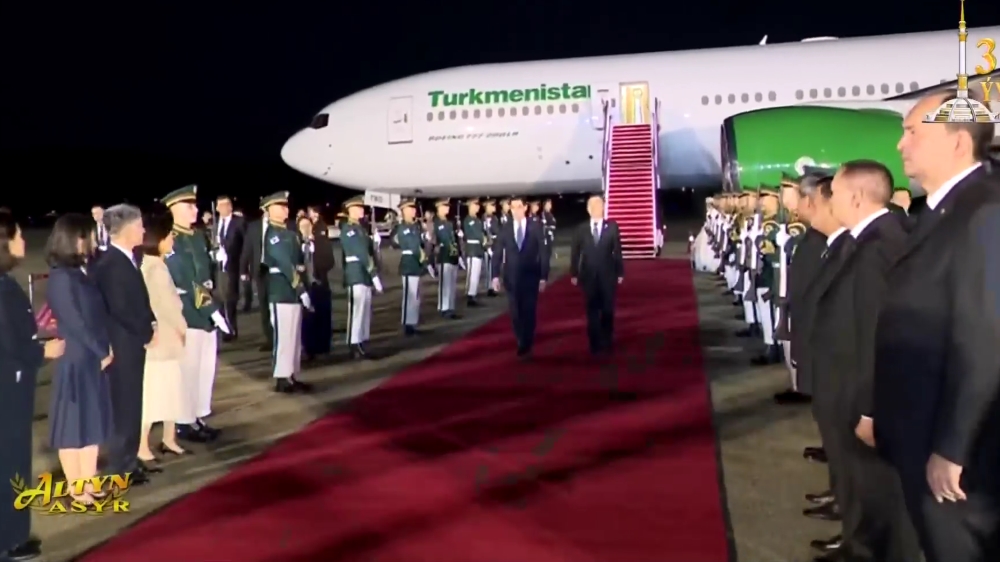
President of Turkmenistan Serdar Berdimuhamedov arrived in the Republic of Korea on 14 September for a state visit and will take part in the summit on September 16, the state news agency TDH reports.
The summit is being preceded by a series of high-level bilateral meetings between South Korean President Lee Jae Myung and the leaders of the five Central Asian countries.
Lee held talks with Uzbek President Shavkat Mirziyoyev in Seoul on 14 September. In the presence of the two leaders, the two sides exchanged 13 agreements and memorandums of understanding covering a wide range of areas, according to Korean media.
The agreements address cooperation in transport and aviation, agriculture, tourism, artificial intelligence, technical assistance, education, medical product regulation, environmental protection and climate change, intellectual property and archival affairs.
Kazakhstan President Kassym-Jomart Tokayev also arrived in South Korea on 14 September for a state visit. His talks with Lee on 15 September are expected to focus on strengthening the expanded strategic partnership between Kazakhstan and South Korea. Tokayev is also scheduled to meet executives of leading Korean companies.
Kyrgyz President Sadyr Japarov and Tajik President Emomali Rahmon arrived in South Korea on 15 September to participate in the summit programme.
The 16 September summit represents a significant step in the evolution of the Korea–Central Asia Cooperation Forum, which has been held annually at the ministerial level since 2007.
According to Yonhap, the new format is designed to turn the long-standing ministerial dialogue into a full-fledged leaders’ summit involving South Korea and all five Central Asian states.
The meeting is expected to produce the Seoul Declaration, establishing a medium- and long-term vision for cooperation and providing a framework for closer multilateral engagement.
The agenda reflects South Korea’s growing interest in Central Asia as well as the region’s search for new economic and technological partnerships. Discussions are expected to focus on critical minerals, energy, supply-chain diversification, digital technologies and innovation.
Security issues are also expected to feature prominently. The summit is expected to address the situation on the Korean Peninsula and cooperation against transnational threats, including drug trafficking, terrorism and cybercrime.
The leaders will then join the Korea–Central Asia Business Summit, designed to strengthen links between Korean and Central Asian companies and translate political agreements into practical economic cooperation.
The summit comes at a time when South Korea is seeking to deepen engagement with Central Asia, while the region is looking to expand access to Korean technology, investment and expertise in strategic sectors.
The new leaders-level format could therefore provide a broader political framework for cooperation that has until now largely developed through sectoral and ministerial channels.///nCa, 15 September 2026