


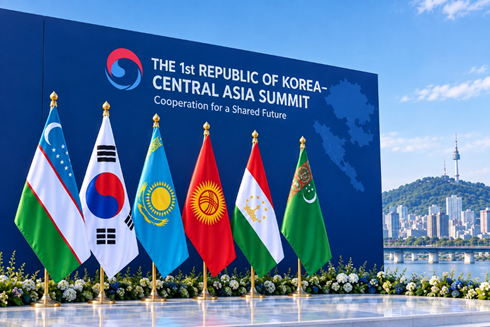
The following is the full text of an op-ed written by Foreign Minister Cho Hyun for Yonhap News Agency ahead of the first South Korea-Central Asia Summit.
Moving Beyond the Silk Road, Toward the Future: New Horizons for the Korea-Central Asia Cooperation
The First Korea-Central Asia Summit 2026 is to take place on September 16 in Seoul. It will be a historic occasion where the Leaders of the Republic of Korea and the five Central Asian countries – Uzbekistan, Kazakhstan, Turkmenistan, Kyrgyzstan, and Tajikistan – gather to discuss the future direction for the cooperation on the path ahead. The slogan for the First Korea-Central Asia Summit 2026 is “Walking Together Toward the Future: A Partnership for Trust and Prosperity.” The synergy between the Republic of Korea and Central Asian countries anchored in ties of trust and cooperation which have continued to be fostered between these nations for the past 30 years, since the establishment of the diplomatic relations in 1992, is at a new starting point.
Even before the major countries such as the United States, China, and the European Union (EU) consolidated the regional cooperation format with the Central Asian countries, in 2007, the Republic of Korea launched the leading ‘Korea-Central Asia Cooperation Forum’ which established the institutional basis for a sense of partnership between the Republic of Korea and the Central Asian countries. The Republic of Korea elevated the Korea-Central Asia Cooperation Forum to the ministerial-level in 2019 and has broadened the synergy on the economy, infrastructure, and people-to-people exchanges through the New Northern Policy. Now, drawing on these valuable achievements, the Republic of Korea embraces a vision of elevating the Korea-Central Asia coordination once more – to the summit level. The Korea-Central Asia Summit, the first such leaders meeting to take place, is expected to serve as a valuable foundation for the next thirty years ahead with the accumulated reciprocal trust and combined efforts of the past three decades as a firm basis.
Optimum Partners for Generating a Win-Win Synergy, Combining Each Other’s Respective Strengths to Move Further Forward Together
The trade volume between the Republic of Korea and Central Asia exceeded $10 billion for the first time last year. In addition to the qualitative growth of the scope of trade, considering the trade items evolving from simply those which are customer-focused to supply chain and high technology industry, well demonstrates that the relations between the Republic of Korea and Central Asia are embarking on a new chapter even in a qualitative sense. Within the context of this trend, with the Republic of Korea having a tremendous manufacturing industry and technological capability, and Central Asian countries having bountiful resources and growing markets, they will be able to emerge as optimum partners in terms of meeting each other’s needs. In particular, in the midst of the global landscape where the security environment is fast changing, once the potential of Central Asia and the high-tech manufacturing and processing capability of the Republic of Korea are combined in the field of strategic resources and critical minerals, they are expected to realize the shared goal of establishing stable supply chains and shaping a new industrial ecosystem. At this Summit, through an established cooperative framework in various fields such as critical minerals, supply chains, and AI, the diversification of the Korea-Central Asia teamwork will gain momentum.
In addition, as the shared efforts on future-oriented fields such as AI and technological transformation, as well as climate change response, are becoming increasingly necessary, indeed pivotal, the government of the Republic of Korea will strive for practical and reciprocal win-win endeavors by respecting each Central Asian country’s development strategy and choices. As they pool each other’s respective strengths on digital technology and eco-friendly green business as well, the Republic of Korea and Central Asia will be able to generate opportunities for new shared growth together in tandem.
Peace on the Korean Peninsula and Prosperity for Eurasia
The rapport with the Central Asian countries holds special meaning given the consideration of peace and stability of the Korean Peninsula. Central Asian countries face borders with Russia, Afghanistan, and Iran and yet contribute to peace and stability in the Eurasian region. Furthermore, they have smoothly resolved sensitive issues with regard to borders and hydropower through recent diplomatic discussions, and by launching the Consultative Meetings of Heads of State of Central Asia, they are realizing regional stability with their close unity and a deep sense of solidarity. The five Central Asian countries have supported the denuclearization of the Korean Peninsula and the Republic of Korea’s view with regard to peace and stability. Considering that the peace and stability of the Korean Peninsula and Central Asia are the very basis for the co-prosperity of Eurasia, the Republic of Korea is sincerely striving to continue this cooperative approach.
Walking Together Toward the Future: Trust Generated by People and through Culture
One of the reasons why the relations with Central Asia are so special is because of the existence of approximately 310,000 Koryo-saram. Koryo-saram fulfills a meaningful bridging role connecting the Republic of Korea and Central Asia, serving as a very symbol of the enduring bonds. The Republic of Korea and Central Asia together pour efforts into sharing and remembering historical heritage by preserving and maintaining the historical sites for the Korean independence movement which remain in Central Asia. As next year marks the 90th anniversary of the settlement of Koryo-saram in Central Asia, with the coordination of the government of the Republic of Uzbekistan, a ‘Koryo-saram History Museum’ will be established.
Recently, interest in Korean culture and a sense of friendship and goodwill are fast growing among the Central Asian public. About 5,000 business leaders and overseas Korean citizens in Central Asia and approximately 150,000 Central Asian students studying in the Republic of Korea and industrial workforce are also a strong link that connects these countries. These interactions and symbiosis will enable the Republic of Korea and Central Asia to gain an even deeper understanding of each other’s historical and cultural legacy and further anchor the relations between the two sides even further. When people connect and cultures interact, the ties can transform from ones that were ad-hoc into lasting bonds that are truly enduring.
The Silk Road of the past connected people to resources and brought civilizations together, generating the sharing of knowledge. Thousands of years later, today, the Republic of Korea and Central Asia are paving a new path. The link that connects this path traveled is not the camels or carriages of the past but rather affinity and technology, people and culture – and the vision embraced for a shared future. If the Silk Road of the past connected the civilizations of the East and the West, the Republic of Korea and Central Asia of today will nurture the opportunities and prosperity for the future on a basis of mutual respect and win-win reciprocity. The Republic of Korea and Central Asia are once again traveling a path, going beyond the Silk Road and stepping forward to embrace the promise of the future together.
/// Yonhap, 15 September 2026