


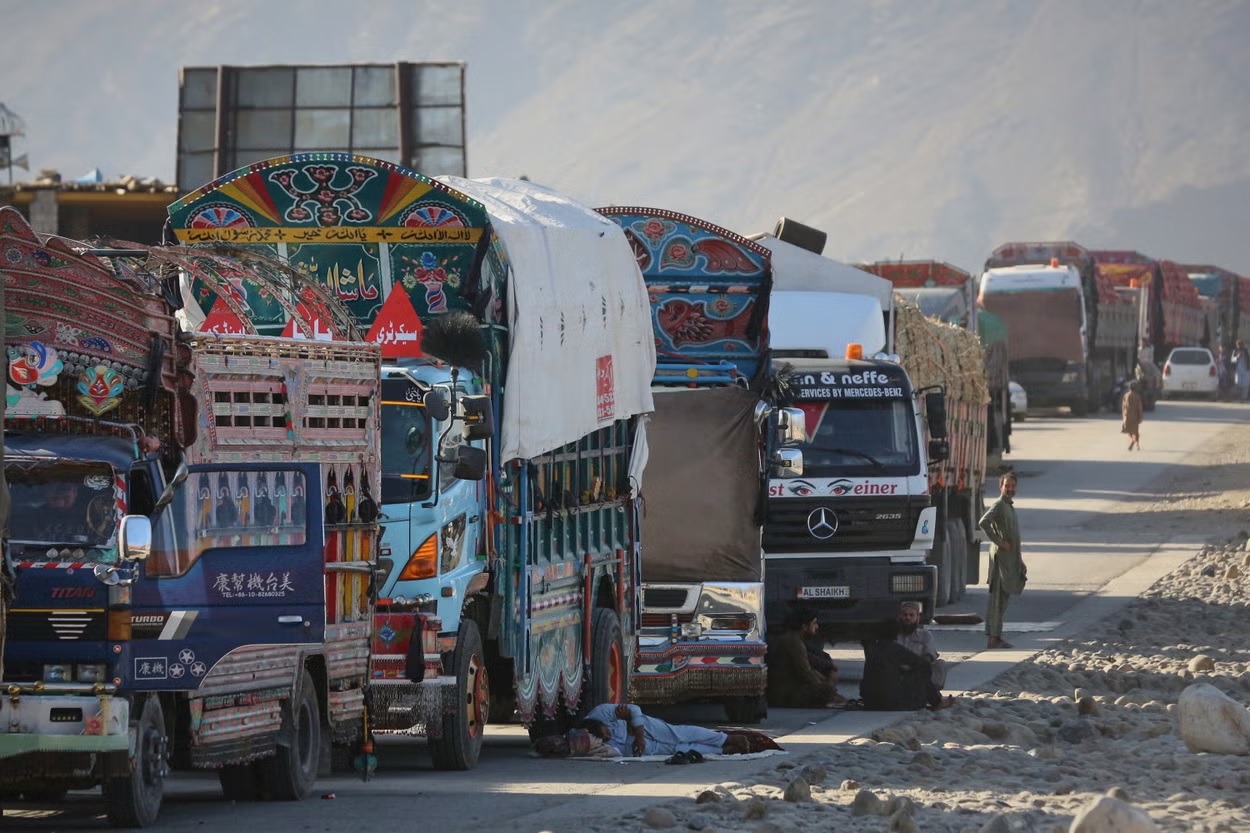
How border closures, a Taliban directive, and new transit corridors are redrawing Afghanistan’s economic map
Tariq Saeedi
For decades, Pakistan was Afghanistan’s principal commercial gateway to the outside world. Geography made the relationship almost unavoidable: Afghanistan is landlocked, and Pakistan offered the shortest overland route to the Arabian Sea and the ports of Karachi and Port Qasim. Pakistani markets were also significant destinations for Afghan agricultural produce, coal, and other commodities.
That relationship is now undergoing a sharp and, in large part, deliberate change. The deterioration of relations between Kabul and Islamabad — marked by the closure of the Torkham and Chaman crossings, armed clashes along the border in October 2025, and reciprocal trade restrictions — has accelerated a shift the Taliban administration had already set in motion: reducing Afghanistan’s dependence on Pakistan by building alternative commercial corridors through Central Asia and Iran.
The change is visible in the trade data, though the shape of that change is more sudden than gradual. Afghanistan’s trade with Pakistan held up, and by some measures grew, through the 2024-25 fiscal year — before collapsing abruptly after the October 2025 border clashes. Over the same period, trade with Uzbekistan, Turkmenistan, Kazakhstan, Tajikistan and Kyrgyzstan has moved steadily upward. The result is not simply a reaction to a border closure; there is growing evidence that Kabul is turning its crisis with Islamabad into a structural reorientation of Afghanistan’s external trade.
A relationship that held up longer than the disruption narrative suggests
At the end of the Ashraf Ghani government, Pakistan remained one of Afghanistan’s most important trading partners, and it stayed that way for longer than is often assumed. Reported bilateral trade figures vary by source — Pakistan’s Bureau of Statistics, the State Bank, and Afghan Ministry data do not always agree, partly because of differing fiscal-year conventions and partly because of how transit trade is counted. But the pattern that emerges from Pakistan’s own Ministry of Foreign Affairs is notable: bilateral trade reached close to $2.0 billion in fiscal year 2024-25 (July 2024–June 2025), broadly consistent with the trend of the preceding two years.
| Period | Pakistan–Afghanistan trade | Direction |
| FY2022-23 | ~$1.85 billion (approx., varies by source) | — |
| FY2023-24 | ~$1.60 billion (approx., varies by source) | ↓ |
| FY2024-25 (Jul 2024–Jun 2025) | ~$1.99–2.0 billion, per Pakistan’s Foreign Ministry | ↑ (pre-crisis) |
| H1 FY2025-26 (Jul–Dec 2025) | Exports alone fell 56%, to $219.5 million | ↓↓↓ (sudden) |
The picture changes abruptly, not gradually, from the second half of 2025. Trade between the two countries was suspended following deadly border clashes in October 2025, and Pakistan has maintained a near-total halt on commercial activity, including exports, since October 10 of that year. The State Bank of Pakistan reported that Pakistani exports to Afghanistan fell by approximately 56 percent during July–December 2025, to $219.5 million from $505.8 million in the same period a year earlier; imports from Afghanistan fell by a similar order of magnitude. This was not the culmination of a slow decline — it was a rupture.
Central Asia moves in the opposite direction
While Pakistan’s position weakened sharply, Afghanistan’s economic relationship with its northern neighbours strengthened steadily over the same years. In 2023, Afghan trade with the five Central Asian republics — Uzbekistan, Kazakhstan, Turkmenistan, Tajikistan and Kyrgyzstan — stood at roughly $1.48 billion. By 2024, according to Afghanistan’s Ministry of Industry and Commerce, that had risen to $1.679 billion in imports and $122 million in exports. The increase accelerated further in 2025: imports rose 43 percent to $2.399 billion, and exports rose 77 percent to $216 million.
| Year | Afghanistan–Central Asia trade | Change |
| 2023 | ~$1.48 billion | — |
| 2024 | $1.679 billion (imports) + $122 million (exports) ≈ $1.80 billion | ↑ |
| 2025 | $2.399 billion (imports, +43%) + $216 million (exports, +77%) ≈ $2.62 billion | ↑ ~46% |
| June 2026 | Central Asian corridors carry 48% of Afghan imports | — |
In two years, Afghanistan’s merchandise trade with the five Central Asian republics increased by more than $1.1 billion. Composition matters here as much as volume: Afghanistan imports electricity, fuel, flour, cooking oil, fertilisers, construction materials and industrial inputs from Central Asia, while exporting fresh and dried fruits, agricultural products, juices, talc and other basic commodities. Central Asia is not simply replacing Pakistan as a market — it is increasingly replacing Pakistan as a source of essential supplies.
Turkmenistan and Uzbekistan lead the shift
The Central Asian realignment is not evenly distributed. Turkmenistan has emerged as one of Afghanistan’s most important northern partners, with bilateral trade reaching roughly $670 million in 2024, of which about $645 million represented Afghan imports — a 35 percent increase over the previous year. Uzbekistan has grown similarly: Afghan imports from Uzbekistan reached approximately $587 million in 2024, while Afghan exports to Uzbekistan rose 104 percent to around $56 million.
These relationships carry the same advantage Pakistan once held — geographical proximity — but they also open something Afghanistan has historically lacked: broader access to the Eurasian economic space, including Russia, Kazakhstan, and, through further connections, China and Europe.
Diversification became state policy, not just a traders’ response
The most consequential development is that this shift has been institutionalised by the Taliban administration rather than left to individual traders. In November 2025, Deputy Prime Minister for Economic Affairs Mullah Abdul Ghani Baradar instructed Afghan traders and industrialists to end their reliance on Pakistan and gave them three months to wind up their contracts and accounts there, warning that the government would no longer intervene on their behalf if problems arose from continued trade through Pakistan. Afghanistan simultaneously intensified its use of Iran’s Chabahar port and routes through Turkmenistan, Uzbekistan and Tajikistan; Kabul’s Ministry of Industry and Commerce noted that six-month trade with Iran had already reached $1.6 billion, ahead of the $1.1 billion recorded with Pakistan over the same period.
Baradar went further still. In the same announcement, he ordered ministries to stop clearing Pakistani medicines, citing quality concerns. That order took formal effect on February 9, 2026, when Afghanistan’s Finance Ministry confirmed a complete ban on Pakistani pharmaceutical imports at all customs points — a measure with real costs, given that Afghanistan had relied on Pakistan for more than 60 percent of its medicine supply, worth roughly $200 million annually. The government urged importers to find “alternative and legal” sources instead.
A country whose trade is merely disrupted looks for temporary alternatives. A country that orders its traders to build alternative supply chains, and bans a category of imports outright, is pursuing diversification as deliberate policy.
Northern corridors are becoming permanent infrastructure
The policy has been matched by infrastructure investment. Turkmenistan and Afghanistan signed an agreement in 2025 to expand the Torghundi dry port in Herat province, including new warehouses and loading facilities along the Torghundi–Herat railway line, with discussions continuing through 2026 on further development of the corridor. In July 2026, Afghanistan, Iran and Tajikistan signed an agreement in Mashhad to establish a trilateral road-transit corridor, providing for trial cargo shipments, coordinated customs procedures, and reduced border waiting times.
These are not the actions of an economy waiting for Pakistan to reopen its borders. They indicate preparation for a multi-corridor trade system in which Pakistan is one possible route among several — and, for the moment, far from the principal one.
2026: the transformation becomes visible in the data
The clearest evidence comes from the World Bank’s Afghanistan Economic Monitor. In June 2026, Central Asian corridors accounted for approximately 48 percent of Afghanistan’s imports, up from 41 percent in May. Iranian routes accounted for another 46 percent. The share moving through Pakistan had fallen to almost zero. This is arguably the single most significant statistic in the entire transformation: Afghanistan has moved from a system in which Pakistan was its principal southern gateway to one in which Central Asia and Iran together dominate its import routes.
The shift is not without cost. The World Bank has also noted that the move to alternative routes has raised import costs, reduced export revenues in some sectors, and added inflationary pressure — and that Afghanistan’s growing dependence on a narrower set of trading partners and transit routes carries its own vulnerabilities. Agricultural exporters in particular have struggled: five southern provinces exported over 44,000 tonnes of grapes in 2025, most of it to Pakistan, but only around 256 tonnes so far in 2026, since fresh produce cannot easily absorb the longer, costlier alternative routes.
From dependency to optionality
The strategic logic extends beyond trade statistics. For decades, Pakistan’s control of the shortest practical route to the Arabian Sea gave it real leverage over Kabul — leverage that could be exercised, and was, through border closures whenever relations deteriorated. That leverage is being reduced, not eliminated. The emerging Afghan trade geography gives Kabul several alternatives: Uzbekistan, Turkmenistan, Kazakhstan and Tajikistan to the north, with onward connections to Russia and China; Iran and the ports of Chabahar and Bandar Abbas to the west; a potential eastern route to China through the Wakhan corridor; and Pakistan’s Arabian Sea ports to the south, available but no longer indispensable.
Central Asia stands to benefit from the same shift. Afghanistan is a market of more than 40 million people, and its demand for electricity, fuel, food and construction materials gives Central Asian producers a substantial nearby outlet. Afghanistan, in turn, offers Central Asia something it has historically lacked — a potential land bridge to South Asia and the Middle East. Uzbekistan has been particularly active in pursuing this; Kazakhstan and Turkmenistan have also pursued infrastructure and logistics projects, including a 2024 trilateral agreement with Afghanistan on a proposed logistics hub in Herat intended to connect Central Asian trade with South Asian and Gulf markets.
Pakistan’s exposure extends beyond the bilateral relationship
Pakistan is also losing ground as a transit country. Pakistani goods bound for Central Asia could historically move through Afghanistan; the breakdown in Afghanistan-Pakistan relations has disrupted this route as well, prompting Pakistan to develop its own alternative through Iran. In April 2026, Pakistan’s Directorate General of Transit Trade dispatched its first export shipment to Uzbekistan via the Gabd-Rimdan crossing into Iran, formally launching a new Pakistan-Iran transit corridor under the TIR system. By July 2026, more than 14,000 tonnes of cargo had moved through this and a parallel corridor via the Sost dry port on the Chinese border, with Uzbek, Kyrgyz and Tajik shipments already using the route.
The result is an outcome neither side fully intended: Afghanistan’s effort to reduce its dependence on Pakistan is, in parallel, prompting Pakistan to reduce its own dependence on Afghanistan as a bridge to Central Asia. The old regional trade geography is being rearranged on both sides of the border.
What Kabul appears to be pursuing
It would be an oversimplification to describe this purely as an anti-Pakistan policy. The lesson the Taliban administration appears to have drawn from its confrontation with Islamabad is that dependence on a single transit route confers disproportionate leverage on that neighbour. The response has been to construct alternatives across every available direction — north, west and, potentially, east — while leaving the southern route open but no longer central to Afghanistan’s commercial planning.
Every border closure has made the alternative routes more attractive by comparison. Every new customs facility, warehouse, or transit agreement makes the older, Pakistan-dependent system less necessary. Infrastructure builds habits, and habits build trade patterns; once established, these are likely to persist even if political relations between Kabul and Islamabad eventually improve.
A new economic geography, not a severed relationship
The central conclusion is not that Afghanistan has stopped trading with Pakistan — it has not, and commercial relations could recover if the security relationship stabilises. The more significant development is that Pakistan has lost its position as Afghanistan’s unavoidable economic gateway, while Central Asia has moved from the periphery of Afghanistan’s commercial system toward its centre. What began as diversification, accelerated by political tension, has since become explicit government policy — and by mid-2026, that policy is clearly visible in the trade statistics themselves.
For Central Asia, this represents a new market and a potential transit corridor. For Iran, it strengthens the strategic role of Chabahar. For Pakistan, it marks the erosion of a form of leverage that geography had granted it for decades. And for Afghanistan, the underlying calculation is straightforward: the less dependent Kabul is on any single neighbour, the greater its room for economic and strategic manoeuvre. /// nCa, 3 September 2026 [Photo credit – The Associated Press]