


Tariq Saeedi
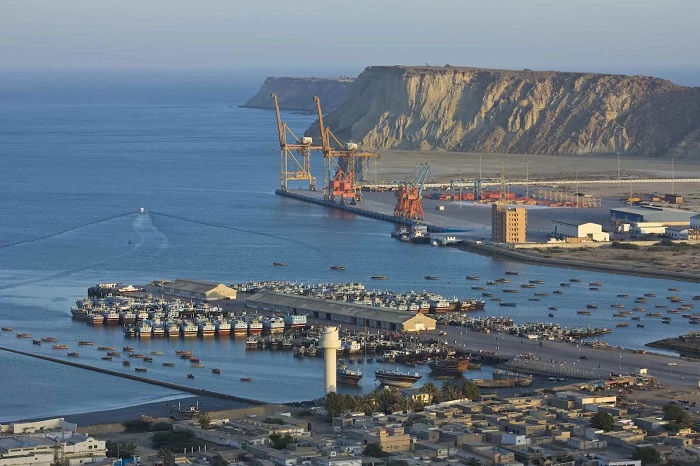
The conversation around Gwadar has never quite settled into a stable consensus. For a stretch, it’s the port that rewires Eurasian trade — the hinge point of a new regional order. Then the mood shifts, and it becomes the cautionary tale of ambition lapping execution, a facility with a master plan and not enough cargo to justify it. Both readings have had real evidence behind them at different moments.
Something has changed recently. Not in a single dramatic announcement, but in the quieter accumulation of infrastructure decisions, transit agreements, and freight volumes that are harder to wave away than diplomatic statements.
A recent piece by Advocate Mazhar Siddique Khan argues that Gwadar has crossed a meaningful threshold — from strategic concept to working piece of regional infrastructure. The claim deserves engagement rather than reflex skepticism or reflex enthusiasm.
What gives this moment its particular weight is the Central Asian dimension. Gwadar’s long-term significance won’t be settled by what happens in Islamabad or Beijing alone. It will depend heavily on whether the port earns a genuine role in how Central Asia solves one of its oldest and most consequential economic problems: getting its goods to the sea.
The Geographic Argument Is the Honest Starting Point
Remove the geopolitical noise and the case for Gwadar rests on something simple and verifiable: a map.
Central Asia is landlocked five times over. Kazakhstan, Uzbekistan, Turkmenistan, Kyrgyzstan, Tajikistan — not one of them touches open water. Every export and import moves through someone else’s territory. For most of the twentieth century that meant going north through Russia, because no other route was practically available.
The past two decades expanded the picture. Eastern corridors through China developed substantially. Caspian links brought European markets closer. But none of that changed a basic fact of geometry: for a significant portion of Central Asia, the shortest path to open ocean still runs south — toward the Arabian Sea, toward a port sitting almost exactly where a logistics planner staring at an unadorned map would want one to be.
Gwadar’s position near the mouth of the Gulf doesn’t only offer proximity to South Asian markets. It opens access to the Gulf states, East Africa, and the wider Indian Ocean trading world — all substantially closer from there than from ports these countries currently depend on.
This advantage is not new. It has existed for decades, largely unrealized. The question was always whether the political will, the infrastructure investment, and the security conditions would align for long enough to act on it. That alignment remains incomplete — but it is further along than it was, and the direction of movement matters.
What Infrastructure Decisions Tell Us
The most reliable signal of strategic intent is not what governments say. It is what they build.
Across Central Asia, real money and real political capital are being directed toward projects aimed at opening a southern corridor to Pakistani ports. The most-cited example is the Uzbekistan-Afghanistan-Pakistan railway. It is framed in the diplomatic language of regional connectivity, but its purpose is blunter: get Central Asian goods overland to the Arabian Sea coast.
That project deserves honest appraisal, though. It has been under discussion since at least 2021. It faces formidable engineering challenges across difficult Afghan terrain, requires sustained financing across three countries. After years of hiatus, the project is now almost past the feasibility study stage. According to the estimates of the participating countries, it may cost around USD 7 billion.
Uzbekistan — a country not given to strategic theatrics — has made this corridor a stated priority and is committing diplomatic effort to it. That is meaningful.
The same southward orientation shows up across broader regional transport planning. Whether the proposed path runs through Afghanistan, western China, or Iran, the destination keeps resolving to the same point — the Arabian Sea coast of Pakistan. Central Asia has registered a clear directional preference. How quickly and completely that preference translates into functioning infrastructure is a separate and still-open question.
Diversification, Not a Single Bet
One thing easy to miss in the corridor-versus-corridor framing: no Central Asian government is staking everything on Gwadar, or on any single route.
The past several years have made the cost of over-dependence vivid. Sanctions, armed conflict, and sudden supply-chain disruptions have demonstrated that routes assumed to be permanent can become unavailable very quickly. The regional response, across all five states, has been to pursue multiple options simultaneously rather than optimize around any one path:
The Trans-Afghan corridor toward Pakistani ports. Eastward connections feeding into the China-Pakistan Economic Corridor network. Southern routes through Iran linking onward to the Pakistani coast. Caspian crossings toward Europe. Emerging Eurasian freight corridors filling the remaining gaps.
The temptation is to read this as competing routes fighting for the same cargo. That misreads the logic. The goal is resilience — ensuring that when one corridor becomes unavailable, commerce continues through another. In that architecture, Gwadar isn’t trying to defeat the alternatives. It’s working to become one of the more valuable endpoints in a system built to have several.
Turkmenistan: Optionality as Strategy
Among the Central Asian states, Turkmenistan’s position in this picture has a particular character worth examining.
Ashgabat already occupies a natural crossroads — between Central Asia, the Caspian basin, Iran, and Afghanistan — and has built a rail network capable of handling meaningful transit freight. Its long-standing foreign policy doctrine centers on neutrality and connectivity: maintain relationships in multiple directions, avoid hard dependencies, preserve flexibility.
A reliable southern corridor through Pakistan fits neatly into that framework — one more option added to an existing portfolio.
The other Central Asian states reason along broadly similar lines, each with their own local calculus. The regional logic is shared; the specific risk tolerances and political constraints differ.
Beyond CPEC: A Necessary Widening of the Frame
There is a persistent tendency to analyze Gwadar almost entirely through the lens of the China-Pakistan Economic Corridor. This is understandable — CPEC is the reason the port reached its current scale, and Chinese investment remains central to how it operates. But it is increasingly the wrong frame for thinking about what Gwadar could become.
A port whose significance depends entirely on Chinese trade flows is, ultimately, a bilateral project with a single patron and the vulnerabilities that come with that. A port that develops a genuine regional role — drawing Central Asian transit, Gulf commerce, and Middle Eastern trade alongside the original CPEC flows — is something more durable. The two roles are not mutually exclusive, but the second one is what determines whether Gwadar matters in thirty years, not just in the current phase of Chinese infrastructure investment.
Early evidence suggests that broader role is being worked toward. Cargo volumes have grown. Road links have improved. Logistics infrastructure is being added. Incentives are being developed for shipping operators making decisions about which routes to commit to.
That progress is real. But the obstacles are also real, and naming them honestly matters. Infrastructure gaps remain significant. Customs and border management generate friction that adds cost and time to every shipment, and those are the kinds of unglamorous problems that determine whether a route is actually used or only theoretically attractive.
The urban development and local economic inclusion work needed to make Gwadar a sustainable city, not just a port facility, is substantially incomplete. These are not fatal objections — they are the normal conditions of infrastructure development in progress. But they are genuine constraints on how quickly and reliably the potential translates into reality.
A Caveat That Belongs Near the Front
Some of Gwadar’s recent cargo momentum has a specific and temporary explanation that deserves honest acknowledgment: shipping companies rerouting away from tensions in and around the Strait of Hormuz.
Traffic that arrives for tactical reasons — because a familiar route has become risky or congested — can depart for the same reasons when conditions change. Not every strong quarter at the port reflects the kind of structural, long-term shift in trade patterns that would justify the larger claims made about Gwadar’s emergence. Separating tactical rerouting from genuine integration is difficult in real time, and the current picture almost certainly contains both. Any assessment of Gwadar’s trajectory that doesn’t account for this is more optimistic than the evidence warrants.
The Security Variable Cannot Be a Footnote
One gap in most optimistic accounts of Gwadar’s rise is the treatment of security — acknowledged in passing, then set aside. That is not an honest reckoning with the situation.
Balochistan, the province where Gwadar sits, has experienced persistent insurgency and targeted attacks on infrastructure and personnel associated with CPEC projects. For a Central Asian logistics planner doing genuine due diligence on whether to route cargo through Gwadar, this is not a secondary consideration. It is a primary variable, weighed against the cost savings and time advantages the southern corridor might offer.
This does not make Gwadar unviable. Plenty of important trade routes operate through environments with elevated security risk — the question is always whether the risk is manageable and whether the economics justify accepting it. But the security situation needs to be stabilized and sustained over time before risk-averse shippers make long-term commitments.
Treating security as a solved or peripheral problem misrepresents where things actually stand.
What Has Been Settled, and What Hasn’t
The old debate — does Gwadar matter in principle? — has effectively answered itself. Not through analysis, but through what Central Asian governments chose to invest in. The geographic logic has been ratified by infrastructure budgets, and that is a more reliable verdict than any study or commentary.
The live questions now are more granular and in some ways harder. How many routes to Pakistani ports will Central Asia actually complete, and on what timeline? Can the customs and logistics environment improve quickly enough to make the corridor competitive on cost and time, not just on geography? How much of the recent cargo growth reflects durable structural change versus tactical rerouting that could reverse when Gulf tensions ease? And can the security situation in Balochistan be stabilized to the point where risk-averse international shippers make long-term route commitments?
None of those questions have clean answers yet. But the fact that they are the right questions now — rather than whether the project is serious at all — represents a genuine shift. The conversation has moved from conditional to conditional-but-advancing, which is not the same as arrival but is not nothing either.
Gwadar’s rising profile, understood clearly, is neither a Pakistani story nor a Chinese one in its essence. It is a Central Asian story — about five landlocked countries making a long, patient bet that economic security requires multiple roads to the sea, and slowly building them. As Eurasian trade routes continue to shift under the pressure of geopolitics, conflict, and supply-chain anxiety, Gwadar looks less like a project at the margins of those forces and more like a place where several of the responses to them are beginning to converge.
That convergence is real. It is also incomplete, fragile in places, and slower than its advocates tend to acknowledge. Both of those things are true at the same time, and holding them together is what honest analysis of this moment requires. /// nCa, 29 June 2026