


As part of the “White City Ashgabat 2026” international conference, a key panel discussion was held focusing on industrial development, materials, and supply chains in construction. The session featured high-ranking representatives from world-renowned mega-corporations and companies that have notched up several decades of successful operations in Turkmenistan. These include such giants of the construction, engineering, and industrial sectors as Toyo Engineering Corporation, Daewoo Engineering & Construction, Kawasaki Heavy Industries, PETRONAS Carigali, and Mitsubishi Corporation.
During the session, the heads of these branches and representative offices shared the successes of their long-standing partnership and outlined their strategic directions moving forward.
Toyo Engineering: From EPC Contracting to Modernization of the Kiyanly Plant
Tetsuji Miyazaki, Director of Toyo Engineering Corporation in Turkmenistan, shared a striking example of a comprehensive approach to industrial projects. Founded in 1961, the corporation has successfully completed more than thousands of projects across approximately 60 countries—encompassing feasibility studies to EPC lump-sum turnkey projects. The company boasts exceptional expertise in gas chemicals: since 1966, it has proudly delivered 49 ethylene plants and 36 polymer plants worldwide.
As the head of the representative office emphasized, TOYO Engineering Corporation supports the entire project lifecycle—not just EPC. The company provides end-to-end solutions that encompass R&D, feasibility studies, FEED (Front-End Engineering Design), EPC, and extend all the way to subsequent operation and maintenance.
Speaking about future prospects, Tetsuji Miyazaki noted that last year, TOYO’s President had the privilege of meeting with the President of Turkmenistan twice, during which he emphasized the potential for deepening and strengthening the partnership.
Leveraging its extensive experience, the company is eager to contribute to the implementation of the second phase of work, aimed at ensuring a reliable start-up of production at the Kiyanly Polymer Plant through a major overhaul of its existing production units. Currently, the project is divided into two phases.
At present, TOYO is focused on the first phase, which includes engineering, inspection, procurement for total equipment replacement, dismantling existing equipment, and project management for implementation. During the second phase, efforts will be dedicated to overcoming technological and production challenges to achieve successful production start-up.
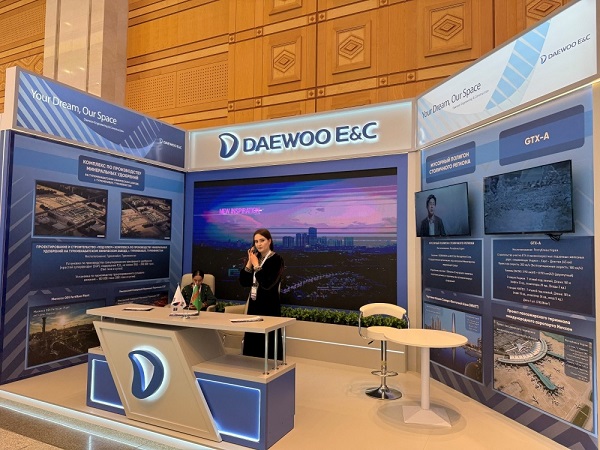
Daewoo E&C: Smart Cities, Digital Twins, and New Industry Standards
Min Man-joon, General Director of the branch of Daewoo Engineering & Construction Co., Ltd. in Turkmenistan, spoke about the large-scale transformation taking place across the entire EPC industry today. According to him, the industry is witnessing a transition from a company that simply builds within budget and schedule to a company that creates entire industries.
The modern approach of Daewoo E&C is built on four core pillars:
- Technology Transfer: Direct training of local engineers and upgrading the technical capabilities of local subcontractors to build a sustainable technical infrastructure that continues to function long after project completion.
- Digital Integration: Originally embedding digital twins, predictive maintenance systems, and intelligent platforms for operation management directly into the project layout.
- Financial Risk Allocation: Direct participation of EPC contractors as investors under Build-Own-Operate (BOO) or Build-Operate-Transfer (BOT) frameworks, or developing project financing structures through export credit agencies.
- ESG and Sustainable Development: Implementing low-carbon design, carbon capture and storage (CCS) technologies, and green hydrogen projects, without which it is becoming increasingly difficult to secure project financing from international financial institutions.
Daewoo E&C plans to deploy this international expertise in Turkmenistan across three key areas. First is the development of new cities. Since Turkmenistan is planning a new smart city Ashgabat project, drawing on the experience of building the major city of Arkadag, the Korean corporation—which systematically drives smart city developments abroad—wishes to take an active part.
In terms of environmental solutions, Daewoo proposes converting municipal solid waste landfills into ecologically sustainable facilities alongside introducing energy recovery and utilization technologies. The other two areas will include urban infrastructure construction, as well as localization and the establishment of joint ventures to support the national development strategy of the Government of Turkmenistan.
Kawasaki Heavy Industries: The Human Factor and GTG Plant Contract Extension
Tomohiro Takashina, Director of the Representative Office of Kawasaki Heavy Industries, Ltd. in Turkmenistan, emphasized in his speech that over nearly 20 years of operations in the country, long-term cooperation and trust from the State of Turkmenistan have been paramount to staying successful. During this time, Kawasaki has constructed three major facilities: the Marycarbamide plant, a cement plant, and the GTG (gas-to-gasoline) plant. Two of these plants have remained under the operation of the Japanese side from the very beginning to the present day, based on service contracts with the State Concern “Turkmenhimiya”.
For Kawasaki, it is vital not just to build a plant, but to maintain its stable and efficient operation for many years. They were among the first in Turkmenistan to offer a format of further plant operation with the provision of their own personnel immediately after handing the plant over to the client.
A prime example of this professional cooperation was the recent capital overhaul of the GTG plant, which was completed ahead of schedule thanks to the joint efforts of “Turkmenhimiya” and Kawasaki engineers, guided by clear instructions from the Chairman of “Turkmenhimiya”.
Looking ahead, Tomohiro Takashina notes that remote operation control technologies and online project monitoring automation will play a major role, potentially enabling real-time project tracking and local workforce consultation directly from Japan using AI (Artificial Intelligence). However, technologies will never replace live human interaction. In massive industrial projects, meeting in person, building mutual understanding, and cultivating trust play a decisive role.
It is this long-term approach, responsibility, and honest cooperation that help Kawasaki maintain its strong position. In confirmation of this mutual trust, a contract extension for the operation of the GTG plant is planned to be signed with the State Concern “Turkmenhimiya” in the very near future.
PETRONAS: Developing Block 1 and Synergy with Turkmen Petrochemicals
Ismadi Bin Ismail, Chief Executive Officer of PETRONAS Carigali Sdn Bhd in Turkmenistan, shared a success story that dates back to 1996. The company launched its first production in 2011, marking 15 years of gas production on the Caspian shelf. In the initial stages, volumes were very small—below 250 million standard cubic feet per day (mmscfd). The situation changed fundamentally when the Government of Turkmenistan built its first downstream facility, the Kiyanly Polymer Complex, near the PETRONAS plant. This boosted the company’s production to close to 500 mmscfd and provided a reliable market.
Ismadi Bin Ismail highlighted that Turkmenistan has successfully expanded beyond just upstream business. The country has established a robust petrochemical industry, with a new urea plant and a GTG plant under construction, adding high value to these natural resources. PETRONAS, drawing on its vast experience as a major petrochemical player in Malaysia over and above being an upstream operator, is actively assessing any potential in this country’s petrochemical sector to transfer its best practices.
The company’s future layout is monumental: it will take between 3-5 to 10 years to fully develop the rich gas resources in Block 1. This involves more than 7 trillion standard cubic feet of gas volume and more than 200 million barrels of liquid hydrocarbons. The head of the branch called on the EPC contractors and macro petrochemical players present in the hall to work together on this front alongside the Turkmen government to bring more industries onto the land of Turkmenistan.
Mitsubishi Corporation: Trade and Investment Potential and New Projects
Yasunori Sakamoto, General Manager of Mitsubishi Corporation for Turkmenistan and Türkiye, and Representative for the Caucasus and Central Asia, strongly emphasized that the significance of Turkmenistan is not only due to its geographic location and resources. Leveraging these abundant resources, the country has positioned the production of high-value-added products and the diversification of export goods as key pillars of its national strategy.
A vital role is also played by the positive policy and real actions of the government toward enriching regional cooperation with the country’s talented human resources.
Operating as a trade and investment company, Mitsubishi Corporation has participated in the development and realization of many projects during these 30 years in Turkmenistan within the fields of gas chemicals, energy, textile production, and construction materials.
Yasunori Sakamoto stated that together with its affiliate company, Mitsubishi Corporation Machinery, the corporation intends to continue its joint journey with Turkmen partners for future development and to keep rendering a substantial contribution to the economy of Turkmenistan. ///nCa, 25 May 2026