


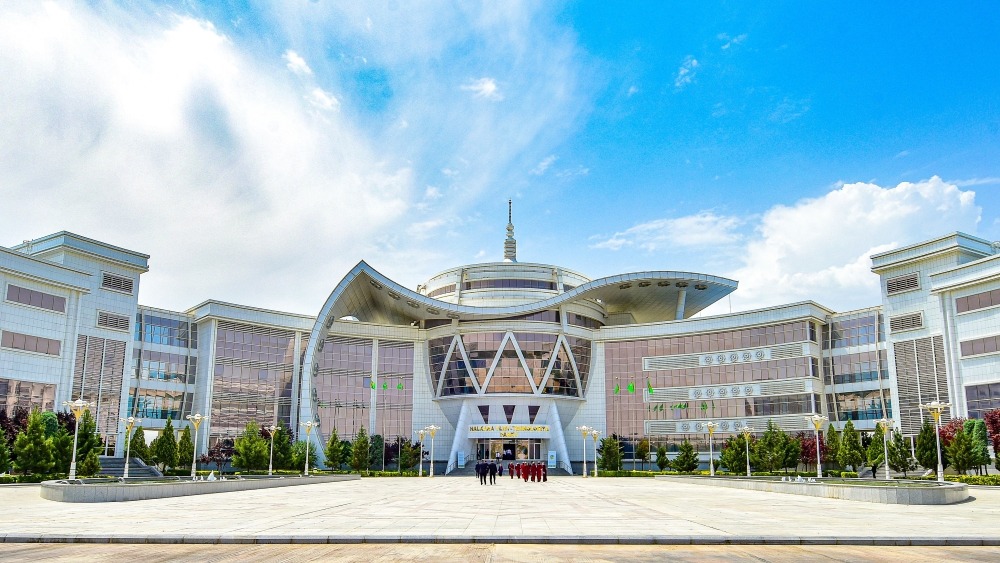
At the intersection of Ashgabat’s urban landscape and the picturesque foothills of the Kopetdag Mountains lies what can quite literally be described as the “scientific heart” of Turkmenistan — the International Scientific and Technological Park.
Spanning an area of approximately 70,000 square meters, this flagship of innovation serves as a key platform for research vital to the sustainable development of virtually all sectors of Turkmenistan’s economy. The center’s activities and major developments are highlighted in a commentary published by the State News Agency of Turkmenistan (TDH).
The Tech Park houses specialized laboratories equipped with technical facilities that enable complex physicochemical, biological, genetic, and engineering testing without the need to involve foreign scientists. Its facilities include laboratories specialising in information and communications technologies, renewable energy, biotechnology, materials science and geographic information systems, each focused on addressing specific needs of the public and private sectors.
Key Developments by Sector
Ecology: As part of climate change adaptation efforts, the Tech Park conducts continuous environmental monitoring, evaluating conditions in the Caspian Sea coastal zone and the Aral Sea region. Based on the gathered data, scientists develop mathematical models and practical recommendations for biodiversity conservation, land degradation prevention, and efficient water resource management.
Biotechnology: Researchers at the Tech Park have patented a method for deep soil remediation and restoration of land contaminated with oil products. The technology relies on cultivating specialized strains of local degrader microorganisms capable of breaking down heavy hydrocarbons under conditions of extreme summer heat and soil salinity. This method replaces costly and environmentally unsafe chemical reagents during cleanup operations at oil and gas facilities.
Renewable Energy: The Alternative Energy Laboratory conducts research to optimize photovoltaic panel performance and develop new hybrid solar-wind energy systems. Key initiatives include autonomous solar power installations designed to supply power and water to remote settlements in the Karakum Desert as well as livestock pastures.
Waste Recycling: Utilizing technical sulfur — a byproduct of natural gas purification at oil and gas fields — the Tech Park has engineered an organomineral sulfur-polymer concrete. This innovative construction material boasts exceptional strength, high density, and resistance to harsh chemical environments and moisture. It could have wide applications in hydraulic engineering, including irrigation canals, drainage systems for highly mineralized water and port infrastructure. Conventional cement concrete can deteriorate rapidly under such conditions as a result of exposure to salts.
Materials Science: The Tech Park is launching a groundbreaking focus on bionanocomposites derived from photosynthetic cyanobacteria. Materials produced using this biomimetic approach are lightweight, flexible, and durable. They are in high demand across various fields — from eco-friendly “smart” housing construction to precision instrument manufacturing and biomedical components. In the future, these biodegradable materials could replace environmentally harmful plastics and synthetic polymers.
Food Security: The center has patented a technology for producing organomineral fertilizers using brown coal from the Tuverkyr deposit. Enriched with humic acid, these fertilizers stimulate plant growth, significantly improve soil structure, enhance moisture retention, and reduce irrigation water requirements.
Researchers have also developed methods for the deep, zero-waste processing of Jerusalem artichoke, or sunchoke, to obtain valuable polysaccharides such as inulin and pectin. Both are in high demand in the food and pharmaceutical industries, where they are used as natural prebiotics and stabilisers.
Herbal Formulations: One of the centre’s research outputs is a range of nanoemulsions produced from extracts of Kopetdag wormwood and other medicinal plants. The formulations have demonstrated strong antibacterial and antioxidant activity.
Partnership with private business: The Technopark is also expanding its public-private partnership framework, giving entrepreneurs access to physicochemical testing of raw materials, development of technical specifications, design of production lines and independent environmental assessments of industrial facilities under construction.
The International Scientific and Technological Park thus illustrates how scientific research can be translated into practical economic solutions. By patenting its own technologies and developing applications tailored to local conditions, the centre is contributing to Turkmenistan’s technological independence and its drive for sustainable, innovation-led growth. /// nCa, 18 August 2026