


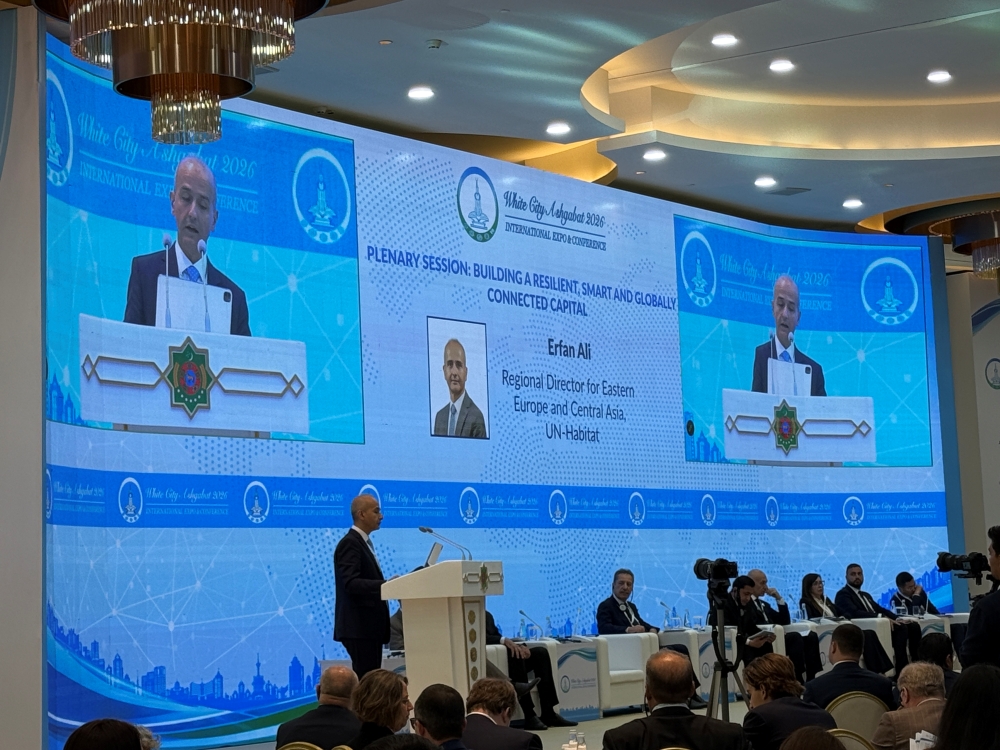
The capital of Turkmenistan Ashgabat – stands at a pivotal moment in its sustainability journey. Speaking at the International Conference “White City Ashgabat 2026”, Erfan Ali, the UN-Habitat Regional Director for Eastern Europe and Central Asia, highly commended the country’s long-term national development strategy, the Vision of Ashgabat 2045, and outlined key priorities for the emerging cooperation between the UN agency and the Turkmen government.
According to the UN official, Ashgabat’s strategic vision offers a clear and ambitious direction, successfully bringing together modern urban planning, advanced infrastructure, digital governance, environmental sustainability, and inclusive growth within one coherent framework to meet the demands of a rapidly changing urban world.
“Cities are no longer only centers of population and administration. They are also where economic opportunities are generated, where innovation is tested, and where the effects of climate change, climate change, resource pressures, and social transformation are most directly felt. A capital city such as Ashgabat has the opportunity to serve its own residents well and to set a good practice, a standard for the wider region”, Erfan Ali stated.
Three Core Pillars for a Future-Ready Capital
In his address, the Regional Director highlighted three essential strategic messages required to drive the city’s ongoing transformation:
Resilience Built from the Inception: A resilient capital anticipates risks, plans intelligently, and invests early in systems that can withstand stress and shocks. That means a stronger infrastructure, climate climate-responsive design, water efficiency, better land management, and development choices that reduce vulnerability rather than create it.
People-Centered Smart Governance: smart governance is about more than technology. Digitalization matters, but it must remain people-centered. The value of smart systems lies in helping urban authorities make better decisions, improve transparency, strengthen service delivery, and respond more effectively to the needs of residents.
A Regional Hub for Innovation and Investment: “Ashgabat has the potential to become a regional hub for investment and innovation. This is about attracting the right kind of capital, investment that supports long-term urban values, strengthens local capacity, and advances sustainable development. International partnerships will be essential in this regard”, the speaker said.
Building this future requires robust international cooperation, as no capital city can succeed in isolation without development partners, financial institutions, and the private sector.
Expanding UN-Habitat Presence in Turkmenistan
According to Erfan Ali, the forthcoming UN-Habitat presence in Ashgabat will work closely with national counterparts and the United Nations system, and it would help translate that vision into sustained technical cooperation and follow-up.
Through the emerging country program of cooperation, the joint priorities will focus on concrete, measurable goals: stronger urban governance, better data and monitoring systems, improved territorial planning, sustainable neighborhood development, housing policies.
Concluding his remarks, Erfan Ali stressed that Ashgabat’s future is as described in its strategic vision, focuses on building a stronger capital while also creating a more collective and a greener city that inspires. He expressed readiness to continue this journey with the government of Turkmenistan, the city of Ashgabat, the pearl of Asia, and all the partners committed to shaping a future-ready capital. ///nCa, 24 May 2026