


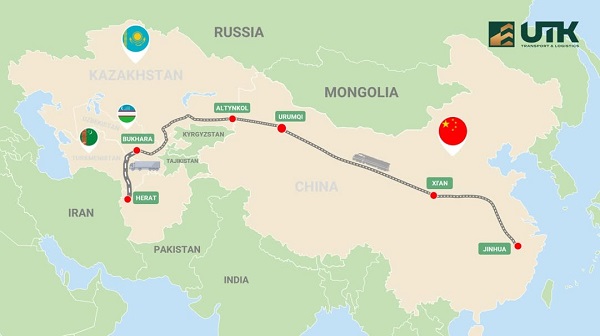
As part of the strategy to diversify transport and logistics corridors in the region, a new multimodal route has been launched for the delivery of containerized cargo from China to Afghanistan. The new path is designed to be a more efficient alternative to traditional maritime shipping. This was reported by Uztemiryulkonteyner (the container fleet operator of Uzbekistan Railways).
The logistics chain combines rail and road transport, passing through the territories of three Central Asian countries:
- Rail Stage: Containers depart from China and cross the border via the Altynkol border crossing (Kazakhstan). The train then proceeds to Uzbekistan.
- Consolidation: Cargo arrives at the Bukhara logistics center (JSC Uztemiryulkonteyner), which serves as a key hub for this route.
- Road Stage: In Bukhara, the cargo is transloaded onto trucks. The final leg of the journey transits through the territory of Turkmenistan to the Afghan city of Herat.
Prior to the launch of this corridor, the main flow of goods from China to the western provinces of Afghanistan followed a lengthy sea route. Cargo was delivered to the Iranian port of Bandar Abbas, after which it was transported by truck to the Afghan border. On average, such a logistics chain takes between 31 and 55 days.
The transition to the land-based multimodal route allows for significant optimization of key indicators:
- Distance: The total length of the route is 7,400 km.
- Timeframe: Transit time has been reduced to 30 days.
The launch of this route highlights the growing role of Central Asian states as transit hubs in Eurasian logistics. Utilizing the infrastructure of JSC Uztemiryulkonteyner in Bukhara and the transit capabilities of Turkmenistan not only accelerates delivery but also increases the reliability of supplies to Afghanistan, creating conditions for stronger economic cooperation in the region. ///nCa, 7 May 2