


nCa Report
The 59th Annual Meeting of the Asian Development Bank (ADB), held from 3–6 May 2026 in Samarkand, concluded with a clear message: Asia’s future lies in connectivity—across energy systems, digital networks, and supply chains.
Bringing together more than 3,000–4,000 delegates from nearly 70 member countries—including finance ministers, central bank governors, development institutions, and private sector leaders—the meeting served as one of the most important economic forums in the Asia-Pacific calendar.
Held under the theme “Crossroads of Progress: Advancing the Region’s Connected Future,” the gathering focused on how regional integration can help economies navigate an increasingly fragmented and uncertain global environment.
Connectivity Becomes the Core Development Strategy
The most defining outcome of the meeting was the ADB’s strategic pivot toward cross-border connectivity as the backbone of development policy.
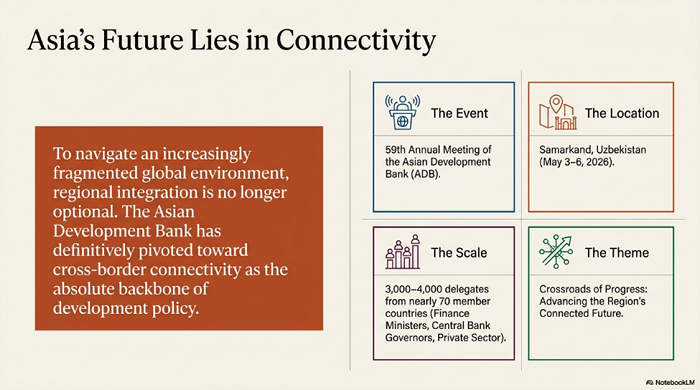
ADB President Masato Kanda emphasized that traditional, isolated approaches are no longer sufficient in a world where shocks—whether in energy markets, supply chains, or digital systems—spread rapidly across borders.
This vision translated into concrete initiatives, most notably:
- A $70 billion regional programme to connect electricity grids and digital infrastructure across Asia
- Expansion of cross-border energy trade and renewable integration
- Development of a region-wide digital backbone to close connectivity gaps
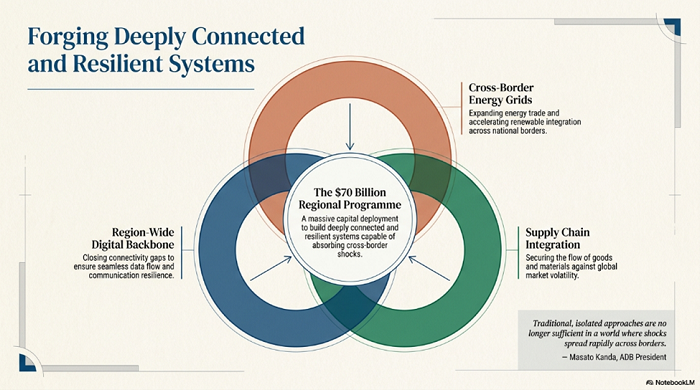
Together, these measures aim to build what ADB describes as “deeply connected and resilient systems” across the region.
Major Financial Commitments and Partnerships
Beyond regional initiatives, the meeting produced substantial country-level agreements, particularly for Central Asia.
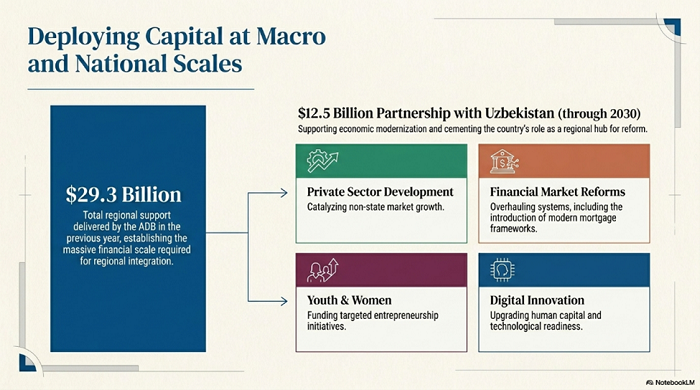
A key highlight was a $12–12.5 billion partnership programme with Uzbekistan, designed to support economic modernization through 2030.
The programme focuses on:
- Private sector development
- Financial market reforms, including mortgage systems
- Youth and women’s entrepreneurship
- Digital innovation and human capital
This underscores Uzbekistan’s growing role as a regional hub for reform and investment.
More broadly, ADB reaffirmed its financial scale, noting that it delivered $29.3 billion in support to the region in the previous year, while preparing to expand its operations further.
New Focus: Critical Minerals and Industrial Value Chains
Another significant outcome was the launch of a Critical Minerals-to-Manufacturing Financing Partnership Facility.
This initiative reflects a strategic shift:
- From exporting raw materials
- Toward building full value chains, including processing, manufacturing, and recycling
The move is particularly relevant for Central Asia, which holds significant reserves of rare earths and minerals essential for clean energy technologies.
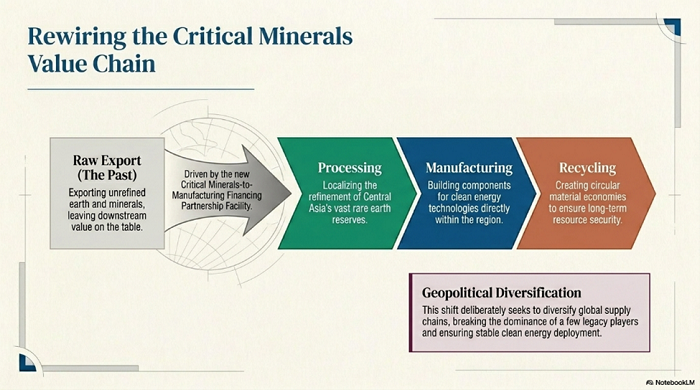
It also carries geopolitical implications, as it seeks to diversify global supply chains currently dominated by a few players.
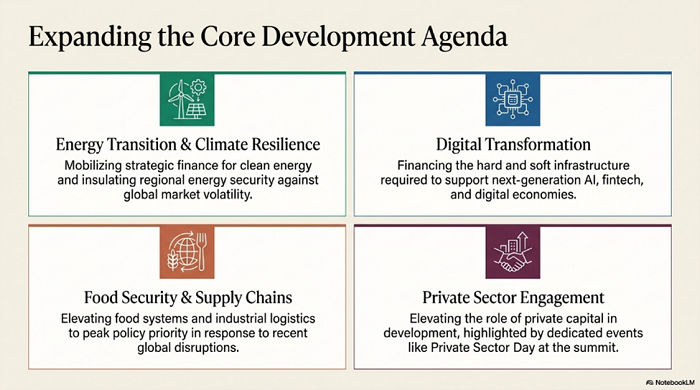
Expanding the Development Agenda
Discussions throughout the meeting converged around several core priorities shaping ADB’s future work:
1. Energy transition and climate resilience
Mobilizing finance for clean energy and improving energy security were central themes, especially amid global market volatility.
2. Digital transformation
Countries emphasized the need for infrastructure that supports AI, fintech, and digital economies.
3. Food security and supply chains
Recent disruptions have pushed food systems and industrial supply chains higher on the policy agenda.
4. Private sector engagement
ADB highlighted the growing role of private capital, reinforced by dedicated events such as “Private Sector Day.”
Central Asia Moves to the Forefront
The decision to host the meeting in Samarkand was not symbolic—it reflected Central Asia’s rising strategic importance.
Uzbek President Shavkat Mirziyoyev used the platform to highlight ongoing economic reforms and the country’s ambition to integrate more deeply into global markets.
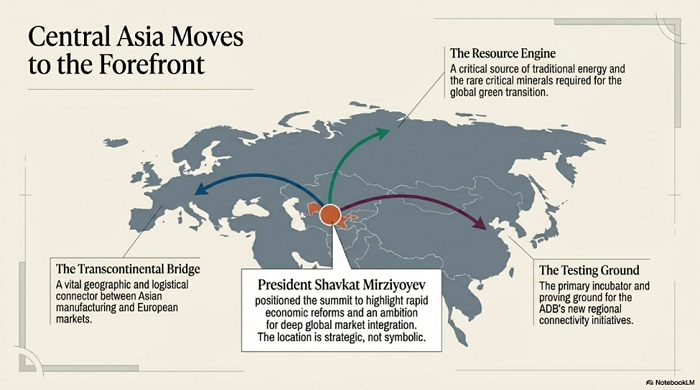
The region is increasingly seen as:
- A bridge between Asia and Europe
- A source of energy and critical minerals
- A testing ground for regional connectivity initiatives
A Meeting That Signals Direction, Not Just Decisions
Unlike some multilateral gatherings that produce a single headline declaration, the Samarkand meeting’s significance lies in the convergence of multiple strategic shifts:
- From national to regional infrastructure systems
- From isolated sectors to integrated energy–digital–industrial ecosystems
- From financing projects to shaping value chains and markets
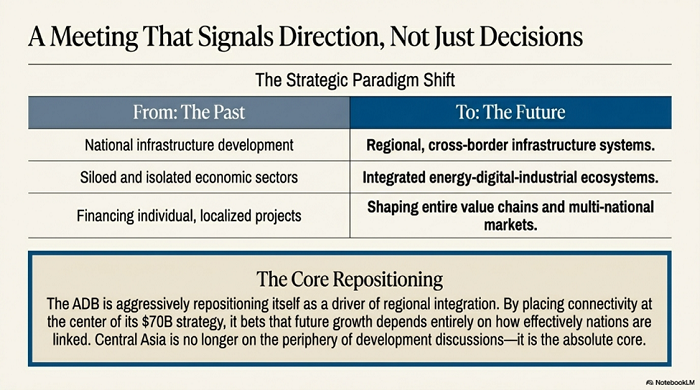
The $70 billion connectivity initiative, major country financing packages, and new minerals strategy all point in the same direction: ADB is repositioning itself as a driver of regional integration in a fragmented world.
End Note
The 59th ADB Annual Meeting in Samarkand was more than a routine institutional gathering—it marked a turning point in how development is conceptualized in Asia.
By placing connectivity at the center of its strategy, the ADB is betting that the region’s future growth will depend not just on investment, but on how effectively countries are linked—through power grids, data networks, and supply chains.
For Central Asia in particular, the message is clear: the region is no longer on the periphery of development discussions—it is increasingly at their core. /// nCa, 6 May 2026