


Antalya, Turkiye, 11 November 2026 – The Government of Turkmenistan and the United Nations Development Programme (UNDP) have signed a new five-year project to support the development of renewable energy, particularly solar power, and improve access to reliable and cleaner energy in remote communities across the country.
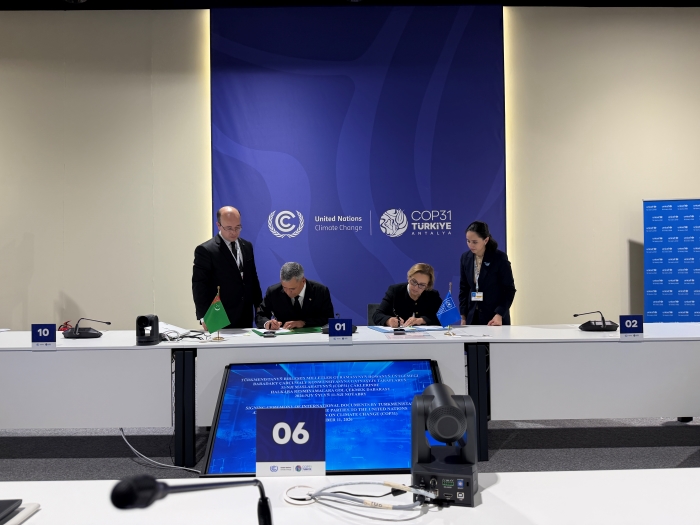
The signing ceremony took place in Antalya, Türkiye, on the sidelines of the 31st Conference of the Parties to the United Nations Framework Convention on Climate Change (COP31). The project, “Supporting the Energy Transition for Remote Settlements in Turkmenistan”, is funded by a grant of more than US$4.17 million from the Global Environment Facility (GEF). The project will be implemented by the United Nations Office for Project Services (UNOPS) in close cooperation with the Ministry of Environmental Protection and the Ministry of Energy of Turkmenistan.
The initiative aims to establish the institutional, regulatory and technical foundations for wider adoption of renewable energy in Turkmenistan, while demonstrating practical solar energy solutions in remote settlements that currently rely predominantly on diesel generators for electricity supply.
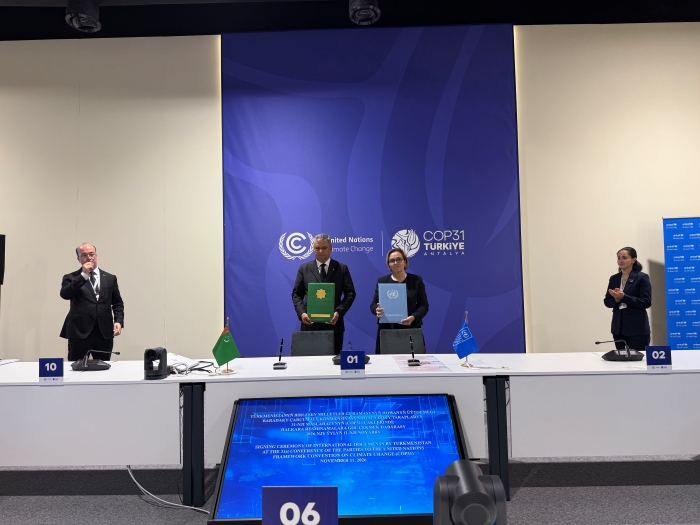
“Expanding access to reliable and cleaner energy is an important investment in people’s well-being, resilient communities and Turkmenistan’s sustainable development. This project offers an opportunity to translate the country’s renewable energy ambitions into practical solutions, combining policy development, national capacity-building and tangible investments in solar energy. Together with our partners, we aim to help create the conditions for wider adoption of renewable energy, strengthen energy security and ensure that communities, including women and other vulnerable groups, can benefit from more reliable energy services,” said Narine Sahakyan, UNDP Resident Representative in Turkmenistan.
A key component of the project will be the installation and commissioning of up to 10 pilot solar mini grids, with a combined capacity of up to 2 megawatts, in remote settlements. These demonstration installations will help showcase practical approaches to solar power generation and create a foundation for expanding renewable energy solutions to other parts of the country.
Building on these pilots, the project will support feasibility assessments and the preparation of technical solutions for the potential deployment of solar energy systems in a further 120 remote settlements, creating opportunities for future investment and replication by the Government.
By combining policy and institutional support with practical solutions and national capacity development, the project will help create a more enabling environment for the transition to green energy in Turkmenistan by strengthening the regulatory and institutional framework for renewable energy, and developing national expertise through training and capacity-building, while advancing the country’s national priorities on renewable energy and climate action, as outlined in its National Strategy for the Development of Renewable Energy until 2030 and National Climate Change Strategy. It will also contribute to fulfilling Turkmenistan’s commitments under the Paris Agreement and advancing the objectives of the 2030 Agenda for Sustainable Development. ///nCa, 11 November 2026 (in cooperation with UNDP Turkmenistan)