


Tariq Saeedi
History frequently weaves ironies that outshine fiction, but few chapters carry the dramatic symmetry of the life of Saif al-Din Qutuz. It is the story of a young prince from the Oghuz-Turkmen heartlands of Central Asia who was stripped of his name, lineage, and freedom by the Mongol juggernaut—only to rise four decades later as the supreme military commander who delivered the Mongol Empire its first decisive, irreversible strategic defeat.
The Shattering of Khwarazm
In the early decades of the thirteenth century, the Khwarazmian Empire stood as a sprawling powerhouse across the Eurasian landmass, bridging the ancient oasis cities of the Silk Road. Its ruling elite belonged to the Anushteginid dynasty, of Turkic and Oghuz lineage. Among the royal household in the fertile basin of the Amu Darya was a young prince named Mahmud—the son of Prince Mamdud and the nephew of Sultan Jalal al-Din Mangburni.
That world collapsed between 1219 and 1221. Following the catastrophic diplomatic rupture at Otrar, Genghis Khan unleashed the full might of his armies upon Khwarazm. Great cities—Gurganj, Merv, Nishapur—were reduced to ruins. The Khwarazmian royal family was slaughtered or scattered across the steppe.
Young Prince Mahmud was captured amidst the chaos. Stripped of his royal identity, his captors bestowed upon him a harsh name: Qutuz—a word derived from the Turkic root for “fierce” or “vicious dog.”
The Long Journey to Cairo
Sold into slave markets, Qutuz passed through the hands of merchants along the ancient trade routes, reaching Damascus before eventually being purchased in Cairo. He entered the Mamluk system—an elite military institution comprised of young men, primarily of Turkic and Kipchak stock, purchased into rigorous martial brotherhoods.
In Cairo, Qutuz served in the house of Sultan Al-Mu’azzam Aybak (Aybek). His royal bloodline was forgotten by most, but his tactical discipline, imposing physical presence, and innate leadership quickly brought him to the fore of the Bahri Mamluk regiment. Rise through the ranks was swift: commander, prime minister (Na’ib al-Saltan), and finally, in November 1259, Sultan of Egypt.
He seized supreme power at a moment of existential crisis. The grandson of Genghis Khan, Hulagu, had sacked Baghdad in 1258, putting an end to the Abbasid Caliphate, and was advancing through Syria. The Mongol war machine seemed utterly unstoppable. When Hulagu’s emissaries arrived in Cairo bearing a terrifying ultimatum—demanding immediate capitulation—Qutuz made a calculated point of no return: he executed the envoys, ensuring his ranks had no option left but to fight.
The Battle of Ain Jalut: Poetic Justice at the Well of Goliath
On September 3, 1260, the Mamluk army marched north into the Levant, meeting the Mongol forces commanded by the general Kitbuqa at Ain Jalut (“The Spring of Goliath”).
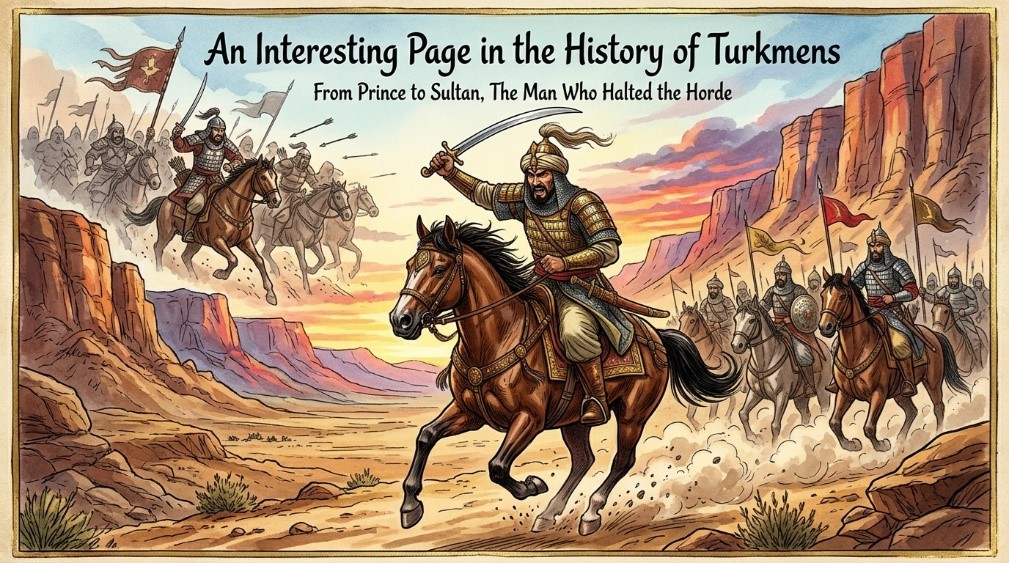
The engagement was fierce. At a critical juncture, the Mongol heavy cavalry smashed into the Mamluk left flank, sending it into visible disarray. Recognizing the moment where destiny hung in the balance, Qutuz threw off his helmet so his men could clearly identify his face, mounted a rising embankment, and shouted his legendary rallying cry: “Wa Islamah!” (“O my Islam!”).
Leading the cavalry reserve in a devastating counter-attack, Qutuz broke the Mongol lines. Kitbuqa was slain on the field, and the Mongol vanguard was routed.
The Legacy of the Full Circle
The victory at Ain Jalut shattered the aura of Mongol invincibility and permanently drew the western border of the Mongol conquests at the Syrian desert. North Africa and the Nile Valley were saved from devastation.
For historians of Central Asia, the triumph of Sultan Qutuz represents a rare historical loop. The same imperial conquests that broke the Khwarazmian state ultimately scattered its sons into the broader Mediterranean basin, where one of those surviving princes drew the line in the sand. Qutuz’s brief reign remains one of the most remarkable operational achievements in the annals of Turkmen and Near Eastern military history. /// nCa, 12 November 2026