


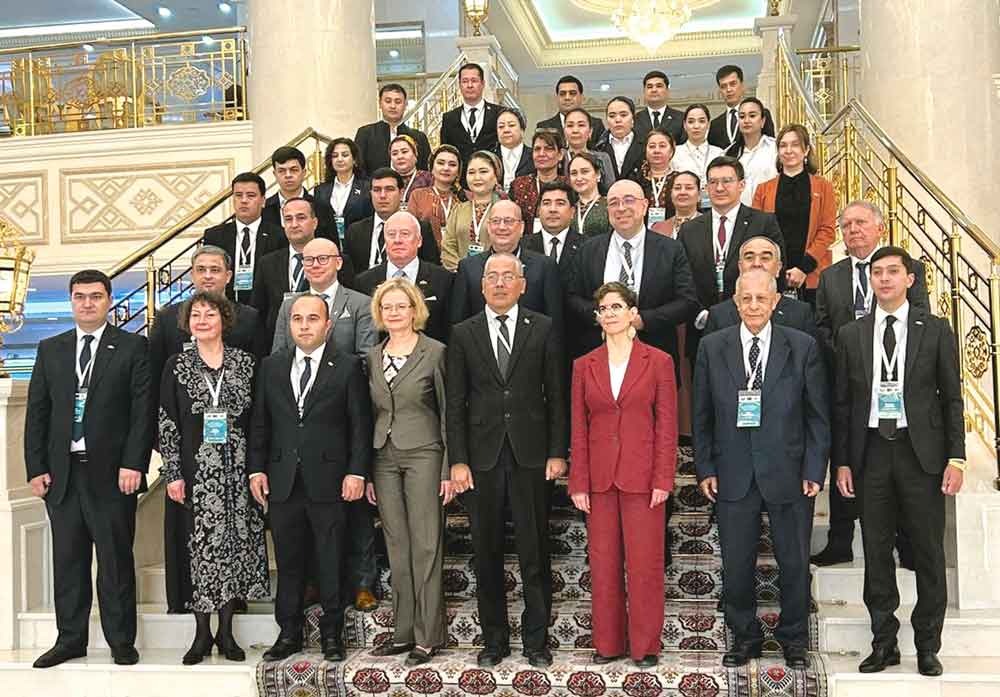
Turkmenistan and Finland are exploring opportunities to expand professional cooperation in meteorology, geological data management and environmental monitoring, with Finnish specialists presenting forecasting technologies and regional initiatives during a series of meetings in Ashgabat, according to Neutral Turkmenistan newspaper.
The Finnish delegation included experts from the Geological Survey of Finland and the Finnish Meteorological Institute. Their visit focused on exchanging technical expertise, learning about the work of Turkmen institutions and identifying potential areas for bilateral and regional cooperation.
At a climate and environmental geology seminar titled ‘Modern Innovations in the Development of Turkmenistan’s Ecosystem,’ representatives of Turkmenistan’s hydrometeorological and geological services presented their organisations’ activities, technical capabilities and experience in introducing new technologies.
The presentations covered the work of the Ministry of Environmental Protection’s hydrometeorological department, Türkmengidromet and the Turkmen Geological Exploration Expedition of the state concern Türkmengeologiýa.
Philipp Schmidt-Thomé, head of international projects at the Geological Survey of Finland, said the presentations had provided the Finnish delegation with a comprehensive overview of geological exploration, mineral resources, deposit development and the technologies used at different stages of production.
He said continued dialogue and direct exchanges between specialists could help both sides identify mutually beneficial areas of cooperation.
Weather forecasting and regional early-warning systems
The Finnish Meteorological Institute presented its technical expertise in weather and climate services, air quality monitoring, space-related research and oceanography.
Matti Eerikäinen, head of international projects and expert services at the institute, said the organisation had extensive experience in research and consultancy, carrying out around 100 research and consulting projects annually. Finnish specialists, he added, were ready to share their knowledge and introduce tools relevant to their Turkmen counterparts.
One of the technologies presented was SMART-Met, a digital forecasting system used in Finland and several European Union countries and already introduced in parts of Central Asia.
The system collects and processes meteorological observations from multiple sources, including weather stations, radars and marine buoys. Its automated processing enables forecasts to be updated as new observations become available, helping specialists refine short-term predictions and prepare urgent weather warnings more quickly.
The discussions also covered plans for a proposed regional initiative, ‘Finland–Central Asia: Harmonising Meteorological and Air Quality Services’ (CAFIMET). According to Yulia Varley, project manager at the Finnish Meteorological Institute and moderator of the seminar, preparatory work is planned for the near future, subject to financing from Finland’s Ministry for Foreign Affairs.
The initiative is being developed in consultation with prospective beneficiaries in the five Central Asian countries, taking into account their priorities, existing national capacities and previous investments in the region.
Its proposed areas of focus include improving the delivery of timely information to the public and authorities about transboundary air pollution and major weather events, including sand and dust-salt storms.
The project’s objectives are aligned with the United Nations’ “Early Warnings for All” initiative, which aims to ensure that everyone is protected by effective early-warning systems by the end of 2027.
Geological data and mineral resource management
Geological cooperation was another focus of the meetings. Marcus Valkama, an information solutions specialist at the Geological Survey of Finland, highlighted the potential for regional collaboration, noting Turkmenistan’s significant resources of solid minerals and hydromineral raw materials.
A proposed platform for cooperation is the project titled ‘Improving Geodata Management in Central Asia,’ coordinated by the Geological Survey of Finland and supported by the European Union and Finland’s Ministry for Foreign Affairs.
The initiative envisages adapting, testing and introducing modern approaches to geological data management and mineral resource mapping. It also seeks to explore ways to promote a circular economy in the mining sector, including the more effective use of mining waste.
In addition to the seminar, Finnish specialists visited several relevant Turkmen institutions, including the Environmental Control Service of the Ministry of Environmental Protection. The meetings provided further opportunities to exchange views and discuss possible areas of cooperation. ///nCa, 27 October 2026