


Laos joins as the 29th member as Azerbaijan secures an extended chairmanship; leaders call for stronger institutions, regional connectivity and practical cooperation
nCa Report
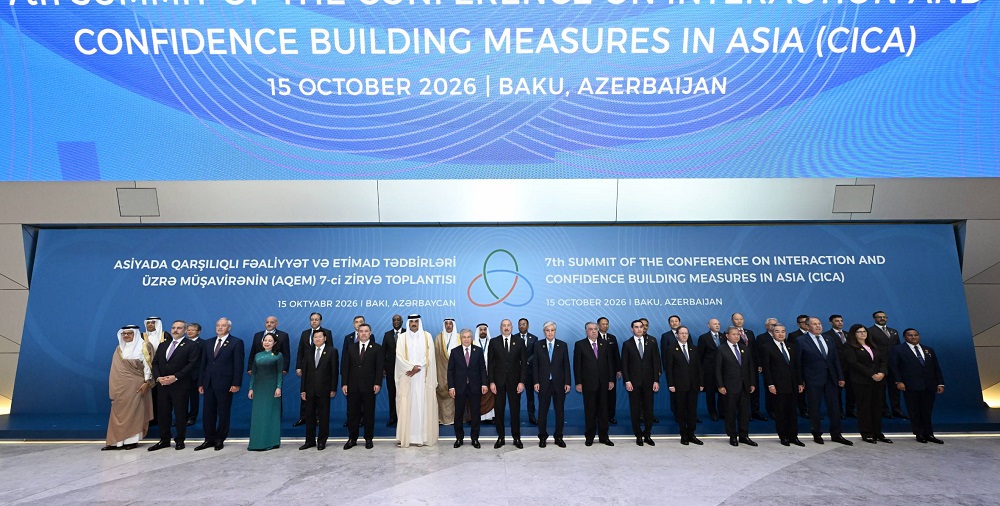
The Seventh Summit of the Conference on Interaction and Confidence Building Measures in Asia (CICA), held in Baku on 15 October 2026, has given fresh momentum to the efforts to develop the forum into a more effective instrument of regional cooperation, with member states endorsing Azerbaijan’s continued chairmanship, admitting Laos as a new member and reaffirming the importance of dialogue, confidence-building and practical cooperation.
Hosted by Azerbaijani President Ilham Aliyev, the summit brought together Asian heads of state, government leaders, foreign ministers and other senior representatives. The proceedings combined discussion of regional and international security with proposals for cooperation in transport, energy, digitalisation, climate resilience and human development.
The outcomes included the adoption of the Baku Declaration, the extension of Azerbaijan’s chairmanship for 2026–2028 and the appointment of Azerbaijani diplomat Sultan Hajiyev as CICA Secretary-General for 2026–2030, according to reports of the summit’s conclusions. The admission of the Lao People’s Democratic Republic raised CICA’s membership to 29 states. These decisions mark progress in the forum’s institutional development, although the longer-term objective of establishing a fully fledged international organisation remains a work in progress.
A forum seeking a more consequential role
CICA was established to promote dialogue, confidence-building and cooperation among Asian states, bringing together countries with different political systems, security interests and international alignments. Its breadth is both its principal strength and a source of institutional difficulty: consensus can provide a basis for inclusive cooperation, but it can also constrain the scope and pace of collective action.
The transformation of CICA into a full-fledged international organisation was endorsed in principle at the Sixth Summit in Astana in 2022. The Baku meeting continued that process, with participants supporting further institutional strengthening and work on a CICA Charter.
Kazakh President Kassym-Jomart Tokayev, whose country initiated the CICA process, argued that the changing international environment made stronger regional institutions increasingly necessary.
“In essence, there is a gradual erosion of the very foundations of the international security’s architecture with a worrying shift towards the primacy of force over the rule of law,” Tokayev said, according to the official account published by Kazakhstan’s presidential administration.
He also called for a shift from general political commitments towards practical outcomes, urging member states to translate their collective will into initiatives capable of producing tangible results.
Tokayev’s intervention captured one of the summit’s central questions: whether CICA can evolve from a platform for exchanging views into a mechanism that helps prevent disputes, facilitate cooperation and deliver measurable results without losing its inclusive character.
The extension of Azerbaijan’s chairmanship provides continuity for this work. Its success, however, will depend on the extent to which member states agree on the organisation’s future legal status, institutional responsibilities and practical priorities.
Who attended the Baku summit?
The summit brought together heads of state and government, senior ministers and other national representatives. The following list identifies the principal participants reported in official summit coverage. It distinguishes leaders attending in person from other delegation heads; it should not be read as a complete register of every delegation or observer organisation.
| Country or organisation | Principal participant | Representation |
| Azerbaijan | Ilham Aliyev | President; summit host and chair |
| Kazakhstan | Kassym-Jomart Tokayev | President |
| Uzbekistan | Shavkat Mirziyoyev | President |
| Kyrgyzstan | Sadyr Japarov | President |
| Tajikistan | Emomali Rahmon | President |
| Turkmenistan | Serdar Berdimuhamedov | President |
| Lao PDR | Thongloun Sisoulith | President |
| Qatar | Sheikh Tamim bin Hamad Al Thani | Emir |
| Israel | Isaac Herzog | President |
| Cambodia | Hun Manet | Prime Minister |
| Vietnam | Vo Thi Anh Xuan | Vice President |
| China | Wang Yi | Foreign Minister; special representative of President Xi Jinping |
| Russia | Sergey Lavrov | Foreign Minister |
| Türkiye | Hakan Fidan | Foreign Minister |
| India | Kirti Vardhan Singh | Minister of State for External Affairs |
| United Arab Emirates | Khalifa bin Shaheen Al Marar | Minister of State |
| Iran | Kazem Gharibabadi | Deputy Foreign Minister, as reported in the supplied participant list |
| Palestine | Varsen Aghabekyan Shahin | Foreign Minister |
| Bangladesh | Senior government delegation | Representation below head-of-government level in the published summit account |
| Bahrain | Senior government delegation | Representation below head-of-government level in the published summit account |
| Sri Lanka | Vijitha Herath | Minister of Foreign Affairs, Foreign Employment and Tourism |
| Belarus | Igor Sergeyenko | Chairman of the House of Representatives |
| United Nations | Kaha Imnadze | Special Representative of the Secretary-General for Central Asia, UNRCCA |
Editorial note: Uzbekistan’s official summit report specifically identifies the heads of state attending and the heads of government or foreign ministries representing Bahrain, Bangladesh, Cambodia, China, India, Palestine, Russia, Sri Lanka, Türkiye, the UAE and Vietnam. Other countries and international organisations were represented by senior officials. The complete delegation register was not available at the CICA Secretariat website at the time of publishing of this report. The list given in the table above, therefore, cannot be considered exhaustive.
The presence of both heads of state and lower-level delegations reflects CICA’s broad membership and its flexible diplomatic format. It also underlines the importance of distinguishing political participation at the summit from representation at the level of the head of state.
Voices from the podium: Security, sovereignty and practical cooperation
The leaders’ interventions revealed both common ground and different emphases. Several called for stronger multilateral institutions and peaceful dispute settlement, while proposals from Central Asian states placed particular weight on transport and energy links, technological cooperation and climate resilience.
Ilham Aliyev: Sovereignty and the implementation of international decisions
As host and chair, Aliyev used his address to highlight Azerbaijan’s experience of conflict, the restoration of its territorial control and the need for international decisions to be implemented.
“Until mechanisms are developed to ensure the implementation of decisions and resolutions of the UN Security Council and other international organizations, wars and conflicts will continue, and new ones will emerge,” he said.
Aliyev also described the peace between Azerbaijan and Armenia as fragile and in need of consolidation. His remarks placed the implementation of international decisions and the principle of territorial integrity at the centre of his argument about regional security.
The address reflected Azerbaijan’s national perspective on the consequences of unresolved conflicts and the effectiveness of international institutions. It should be understood as the position advanced by the Azerbaijani president, rather than as a collective assessment agreed by every summit participant.
Aliyev also reviewed Azerbaijan’s chairmanship, highlighting work on transport connectivity, digitalisation, environmental cooperation, tourism, education and science. He credited the support of member states with strengthening CICA’s institutional capacity and welcomed the decision to continue the Azerbaijani chairmanship for another two years.
Kassym-Jomart Tokayev: From declarations to institutions
Tokayev placed CICA’s institutional evolution at the centre of his address. He argued that the deterioration of the international security environment made it increasingly important to strengthen regional mechanisms capable of bringing countries together.
“Therefore, it is clear that Asia needs stronger institutions. Time of declarations of good-will is getting over,” he said.
For Kazakhstan, the development of CICA is particularly significant because the initiative originated with President Nursultan Nazarbayev in 1992. Tokayev reiterated support for transforming the Conference into a full-fledged international organisation and said Kazakhstan looked forward to the adoption of a CICA Charter.
He also linked security to economic and technological cooperation. The Trans-Caspian fibre-optic line, being developed by Kazakhstan and Azerbaijan, was presented as an important step towards faster and safer data transmission across Eurasia.
“This unique Digital Silk Way project will ensure faster and safer data transmission across Eurasia, thereby strengthening Asia’s digital potential and opening new opportunities for cooperation,” Tokayev said.
He also highlighted the Caspian Green Energy Corridor initiative involving Kazakhstan, Azerbaijan and Uzbekistan, intended to connect electricity grids and facilitate the transmission of electricity towards European markets through the Black Sea. The proposal for a possible International Water Organisation within the United Nations system was another example of his call for stronger multilateral mechanisms.
Tokayev’s address thus linked CICA’s institutional future to a broader regional agenda: infrastructure, digital connectivity, energy diversification and cooperation on shared environmental challenges.
Shavkat Mirziyoyev: An Asian infrastructure of trust
Uzbek President Shavkat Mirziyoyev advanced a particularly broad programme of practical initiatives, arguing that trust among states must be supported by predictable conduct, respect for commitments and regular cooperation.
“I am convinced that its principal goal should be to build a comprehensive infrastructure of trust in Asia,” he said.
Mirziyoyev proposed developing a Concept for Building an Infrastructure of Trust in Asia to establish long-term priorities and specific measures for strengthening cooperation. He identified joint transport and energy projects, trade, digital links and cultural and humanitarian exchanges as important components.
The Uzbek president also placed emerging technology on the summit’s agenda. He proposed an Asian Initiative on Technological Trust and the Responsible Use of Artificial Intelligence, supported by an expert platform within CICA through which specialists could develop common recommendations and practical measures.
Climate adaptation formed another part of his programme. Mirziyoyev proposed a Partnership for Climate Resilience to promote water-saving technologies, green energy and environmental monitoring.
On the human dimension, Uzbekistan offered to host a Human Development Forum in 2027, focusing on opportunities for young people and women, access to quality education and human rights in the context of digital transformation. He also supported developing a CICA Programme of Action for the period up to 2028.
These proposals are significant because they suggest ways of turning confidence-building into a programme of practical work. Their implementation, however, will depend on subsequent agreement among member states and the resources they are prepared to commit.
Emomali Rahmon and Sadyr Japarov: Support for regional cooperation
Tajik President Emomali Rahmon thanked Azerbaijan for the organisation of the summit and the welcome extended to participating delegations. His published remarks, as reported by the Azerbaijani presidential website, emphasised the quality of the arrangements and the value of the meeting.
Kyrgyz President Sadyr Japarov likewise welcomed Azerbaijan’s contribution to CICA and expressed Kyrgyzstan’s readiness to support its further development.
Turkmenistan: Neutrality and multilateral dialogue
President Serdar Berdimuhamedov represented Turkmenistan at the summit. The country’s foreign policy places particular emphasis on permanent neutrality, sovereign equality, peaceful cooperation and the role of multilateral dialogue in international relations.
Turkmenistan’s participation is relevant to CICA’s broader effort to maintain a forum in which states with differing foreign-policy orientations can discuss common concerns. Transport connectivity, energy cooperation, environmental security and regional stability are areas where the interests of Turkmenistan and other Central Asian states overlap. [Complete text of the speech of the president of Turkmenistan is available separately in this Bulletin and at our website. Ed.]
Foreign Minister Rashid Meredov conducted consultations with Azerbaijani and Uzbek counterparts on the sidelines. [A story on this meeting is available separately in this Bulletin and at our website. Ed.]
Other delegations: A wider range of priorities
The summit also included foreign ministers and other senior representatives from China, Russia, Türkiye, India, the UAE, Iran, Palestine and other participating states. Their presence underscored CICA’s ability to bring together countries whose bilateral relationships and strategic outlooks differ considerably.
Principal outcomes
Laos becomes CICA’s 29th member
The summit approved the accession of the Lao People’s Democratic Republic, bringing the number of full member states to 29.
The admission extends CICA’s geographical reach into Southeast Asia and reinforces its stated ambition to provide an inclusive platform for Asian dialogue. Laos’s accession documents had been signed in Baku on 14 October, ahead of the summit’s formal decision.
Membership expansion is a concrete institutional outcome. It does not, by itself, establish that the organisation has acquired new enforcement powers or that its members have agreed on a common approach to every regional security question.
Azerbaijan’s chairmanship extended through 2028
Member states supported extending Azerbaijan’s chairmanship for the 2026–2028 period.
The extension gives Baku additional time to pursue its priorities and continue work on CICA’s institutional development. It also provides continuity as member states work towards agreement on the organisation’s future legal framework.
New Secretary-General appointed
Ambassador Sultan Hajiyev was appointed CICA Secretary-General for the 2026–2030 period, according to the reported summit outcomes.
The Secretariat will have an important role in supporting member-state consultations, coordinating confidence-building measures and helping translate political commitments into practical programmes.
Further institutional development
The summit reaffirmed the direction established at the 2022 Astana Summit: transforming CICA into a full-fledged international organisation. Tokayev and Mirziyoyev both referred to the importance of a CICA Charter and stronger institutional foundations.
The distinction between political commitment and legal completion remains important. The summit’s support for institutional transformation should not be confused with confirmation that the Charter has already entered into force or that all legal and organisational steps have been completed.
The Baku Declaration: Connectivity, security and emerging challenges
The Baku Declaration provides the political framework for the summit’s conclusions. Its significance lies in bringing conventional security concerns into closer connection with the economic, technological and environmental issues that increasingly affect regional stability.
Four broad areas stand out in the summit discussions and the leaders’ published statements.
Security and international law. Aliyev stressed the implementation of international decisions, while Tokayev and Mirziyoyev emphasised peaceful dispute settlement, dialogue and stronger multilateral institutions. These positions share a concern about the effectiveness of international cooperation, although individual countries may differ in how they interpret specific disputes.
Transport, energy and digital connectivity. The leaders’ interventions highlighted cross-border infrastructure as a means of supporting economic growth and building mutual interests. The Trans-Caspian fibre-optic line and the proposed Caspian Green Energy Corridor illustrate the relationship between physical connectivity, digital infrastructure and energy diversification.
Artificial intelligence and technological trust. Mirziyoyev’s proposal for an Asian initiative on responsible AI use offers a possible framework for exchanging expertise and developing common recommendations. It should be treated as a proposal for future cooperation, rather than evidence that CICA already has an agreed, operational AI governance regime.
Climate resilience and human development. Water management, environmental monitoring, green energy, education and cultural exchanges featured in the initiatives presented at the summit. These areas offer scope for confidence-building through cooperation on practical challenges that cross national borders.
Assessment: The next test is implementation
The Baku summit demonstrates that CICA continues to attract high-level political engagement and that member states remain interested in strengthening its institutional capacity. The admission of Laos, the extension of Azerbaijan’s chairmanship and the appointment of a new Secretary-General are tangible outcomes.
The more consequential question is whether the forum can translate its political ambitions into sustained cooperation.
Three challenges deserve particular attention.
First, the organisation must agree on its future legal and institutional structure. A Charter could clarify the Secretariat’s responsibilities and establish a more durable framework for cooperation, but its effectiveness will depend on the terms agreed by member states and their willingness to implement them.
Second, CICA must identify practical activities on which its diverse membership can cooperate. Transport connectivity, digital infrastructure, water management, climate resilience and responsible technological development offer potential areas for progress. These initiatives will require coordination with existing regional institutions and national development programmes.
Third, the forum must preserve its inclusive character while producing useful results. Its value derives partly from bringing countries together that may not share the same security partnerships or geopolitical outlooks. That breadth can make consensus difficult, but it also gives CICA a role that more narrowly constituted groupings cannot necessarily perform.
The Baku summit should therefore be seen as a step in an ongoing institutional process, rather than the completion of CICA’s transformation. Its lasting importance will be determined by the quality of the institutional arrangements that follow, the resources made available for joint work and the extent to which the participating states turn their declarations into measurable outcomes.
Background: What is CICA?
The Conference on Interaction and Confidence Building Measures in Asia was proposed by Kazakhstan’s President Nursultan Nazarbayev at the 47th session of the United Nations General Assembly in October 1992. Its first summit was held in Almaty in June 2002.
CICA seeks to promote peace, security, stability and cooperation through dialogue and confidence-building measures. Its activities encompass military-political issues, economic cooperation, environmental concerns, the human dimension and emerging challenges.
The forum has developed through a series of summits and ministerial meetings, gradually expanding its membership and organising cooperation across several fields. The decision taken at the 2022 Astana Summit to pursue transformation into a full-fledged international organisation marked an important stage in this process.
Following Laos’s admission in Baku, CICA has 29 member states. Its broad geographical reach gives it substantial potential as a platform for Asian dialogue, although membership alone does not confer the authority or operational capacity of a treaty-based collective-security organisation.
The Seventh Summit’s central message is consequently one of ambition tempered by the need for practical follow-through: CICA has a wider membership and renewed political support for institutional development, but its future standing will depend on whether it can convert these advantages into durable cooperation and concrete results. /// na, 16 October 2026