


Elvira Kadyrova, Tamir Shakirov
While the Sustainable Development Goals (SDGs) are often discussed in international summits and government ministries, their ultimate success depends on the choices billions of individuals make every day.
The scale of global challenges can feel overwhelming, leading to apathy or the belief that single actions do not matter. However, systemic change and individual action are mutually reinforcing: personal habits drive market demand, shape social norms, and build political momentum.
By intentionally aligning daily routines with sustainable principles, every person can actively contribute to the 2030 Agenda. Here are actionable personal habits, alongside the specific SDGs they directly support.
1. Conscious Consumption & Sustainable Eating
Our food systems account for a significant portion of global greenhouse gas emissions, biodiversity loss, and water consumption. Simple shifts in how we purchase, store, and consume food yield immediate benefits.
- Habit: Plan meals to reduce household food waste, adopt a more plant-forward diet, choose local and seasonal produce, and buy from fair-trade or eco-certified brands.
- SDGs Supported:
- SDG 2 (Zero Hunger): Minimizing waste helps relieve pressure on global food supply chains and resources.
- SDG 12 (Responsible Consumption and Production): Direct contribution through sustainable buying choices and reducing household waste.
- SDG 13 (Climate Action): Plant-forward diets and reduced food waste significantly lower carbon footprints.
- SDG 15 (Life on Land): Reduces the demand for land clearance associated with intensive deforestation and over-farming.
2. Energy Mindfulness & Resource Conservation
Energy and water usage at home directly impact carbon emissions and local natural ecosystems. Developing a “mindful conservation” mindset reduces environmental footprint while lowering living costs.
- Habit: Turn off lights and unplug unused electronics, switch to energy-efficient appliances and LED lighting, conserve domestic water (shorter showers, fixing leaks), and adjust thermostats by a degree or two.
- SDGs Supported:
- SDG 6 (Clean Water and Sanitation): Direct conservation of precious freshwater resources.
- SDG 7 (Affordable and Clean Energy): Reduces overall demand on the power grid and promotes energy efficiency.
- SDG 13 (Climate Action): Decreases fossil fuel dependence and greenhouse gas emissions associated with energy production.
3. Rethinking Mobility & Transport
Transportation is one of the fastest-growing sources of global carbon emissions. Shifting away from reliance on single-occupancy, fossil-fuel vehicles transforms local air quality and urban livability.
- Habit: Walk or cycle for short errands, utilize public transit, carpool with colleagues, or transition to electric/hybrid options when replacing a personal vehicle.
- SDGs Supported:
- SDG 3 (Good Health and Well-being): Active mobility (walking, cycling) improves personal health and reduces air pollution-related illnesses.
- SDG 11 (Sustainable Cities and Communities): Eases urban congestion, lowers noise pollution, and encourages pedestrian-friendly urban infrastructure.
- SDG 13 (Climate Action): Cuts direct fossil-fuel emissions from personal transport.
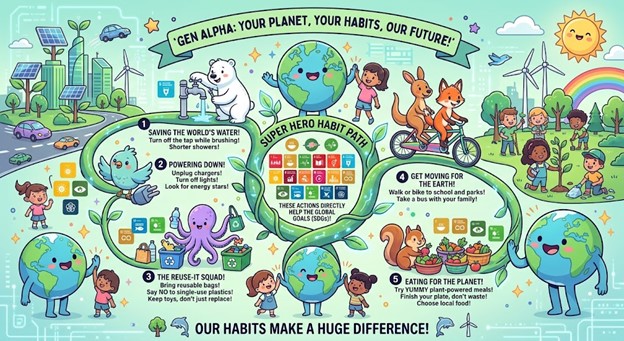
4. Embracing Circular Living (Refuse, Reduce, Reuse)
The linear “take-make-waste” economic model generates millions of tons of municipal waste annually, polluting oceans and landfills. Moving toward a circular mindset treats materials as valuable resources.
- Habit: Carry reusable bags, water bottles, and containers; avoid single-use plastics; repair items before replacing them; participate in clothing swaps or thrift shopping; and sort recyclables properly.
- SDGs Supported:
- SDG 12 (Responsible Consumption and Production): Directly drives the shift toward circular waste reduction.
- SDG 14 (Life Below Water): Prevents plastic pollution from entering waterways, rivers, and oceans.
- SDG 15 (Life on Land): Minimizes landfill waste and reduces the extraction of virgin raw materials.
5. Digital & Financial Responsibility
How we spend, save, invest, and manage our digital footprints has a surprisingly high impact on social equality and environmental health.
- Habit: Choose ethical banks or pension funds that screen out fossil fuels and environmental destruction; support local businesses and social enterprises; delete unnecessary cloud storage and emails to reduce data center power draw; and buy refurbished tech.
- SDGs Supported:
- SDG 8 (Decent Work and Economic Growth): Directs capital toward sustainable industries, local businesses, and fair labor practices.
- SDG 9 (Industry, Innovation, and Infrastructure): Encourages green financial mechanisms and sustainable technological innovation.
- SDG 10 (Reduced Inequalities): Supporting fair-trade and community businesses builds local economic resilience.
6. Active Community Engagement & Lifelong Learning
Sustainable development is not merely environmental—it is deeply social. Fostering inclusive, supportive, and educated communities builds the social fabric necessary to sustain long-term change.
- Habit: Volunteer with local community groups or youth programs, stay informed on civic issues, mentor others, practice digital empathy, and advocate for inclusive policies in workplaces and schools.
- SDGs Supported:
- SDG 4 (Quality Education): Sharing knowledge, mentoring, and promoting continuous learning.
- SDG 5 (Gender Equality): Championing equal opportunity, active listening, and standing against bias in everyday interactions.
- SDG 16 (Peace, Justice, and Strong Institutions): Building trust, supporting community initiatives, and participating constructively in local civic life.
- SDG 17 (Partnerships for the Goals): Creating local networks, community coalitions, and volunteer groups working toward collective action.
Summary Matrix: Personal Habits to SDG Alignment
| Habit Area | Key Daily Actions | Core SDGs Supported |
| Conscious Consumption | Plan meals, reduce food waste, eat plant-rich foods | SDG 2, 12, 13, 15 |
| Resource Conservation | Save water, use LED lighting, adjust thermostats | SDG 6, 7, 13 |
| Sustainable Mobility | Walk, cycle, use public transit, carpool | SDG 3, 11, 13 |
| Circular Living | Avoid single-use plastics, reuse, repair, recycle | SDG 12, 14, 15 |
| Financial/Digital Choices | Support ethical banking, local buying, green tech | SDG 8, 9, 10 |
| Community & Advocacy | Volunteer, mentor, champion inclusion, continuous learning | SDG 4, 5, 16, 17 |
Conclusion: The Multiplier Effect
No single person can single-handedly achieve the Sustainable Development Goals. However, when individual habits become cultural norms, businesses shift their practices, governments adapt their policies, and systemic transformation occurs. By recognizing that our daily micro-choices ripple into global outcomes, we move from passive observers of global challenges to active co-creators of a sustainable future. /// nCa, 13 October 2026