


Elvira Kadyrova
While the states of Central Asia (Kazakhstan, Uzbekistan, Kyrgyzstan, Tajikistan, and Turkmenistan) were completely absent from the formal agenda in Washington, the strategic posture struck by Trump and Xi directly alters the geopolitical chessboard of the region.
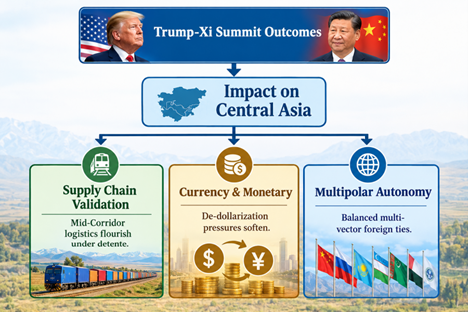
1. Validation of the “Mid-Corridor” and Logistics Infrastructure
Because the summit successfully preserved a temporary trade peace and prevented immediate global tariff shocks, Central Asia’s role as a vital geopolitical land bridge is heavily reinforced.
- Under the framework of China’s Belt and Road Initiative (BRI) and the designated Years of High-Quality Development of China-Central Asia Cooperation (2025–2026), Beijing has poured immense capital into the Trans-Caspian International Transport Route (Mid-Corridor).
- The strategic detente in Washington ensures that Western markets remain open to goods flowing out of East Asia. This guarantees a steady, uninterrupted volume of transit trade running directly through Kazakhstan and Uzbekistan, validating their massive infrastructure investments.
2. Temporary Relief from Secondary Sanctions Compliance
A highly volatile, aggressive U.S.-China breakdown typically forces Central Asian financial institutions into a dangerous geopolitical corner—forcing them to meticulously comply with sweeping Western secondary sanctions or risk losing access to the global SWIFT banking network. The strategic “floor” established at this summit temporarily eases this pressure. Central Asian capitals can maintain their deep economic integration with China without immediately fearing punitive, retaliatory measures from a hostile U.S. Treasury department.
3. Softening the Pressure for Rapid De-dollarization
Had the Washington summit completely collapsed into an open economic war, Beijing would have likely accelerated its encouragement to Central Asian partners to aggressively shift all bilateral energy and commodity trade exclusively into the Renminbi (RMB). The extension of the trade truce stabilizes the status quo, allowing Central Asian nations to manage their currency reserves at a more measured pace without being forced to take a definitive, systemic side in a global monetary schism.
4. Preservation of the “Multi-Vector” Foreign Policy
For decades, Central Asian republics have successfully utilized a multi-vector foreign policy, balancing the competing interests of Russia, China, the European Union, and the United States.
- The fact that Trump and Xi demonstrated a capacity to manage their rivalry through high-level pageantry provides a safe diplomatic environment for this balancing act to continue.
- It allows Central Asian states to freely court Chinese green energy, tech, and agricultural investments while simultaneously participating in U.S.-led regional diplomatic platforms like the C5+1, without either superpower demanding exclusive geopolitical loyalty. /// nCa, 26 September 2026