


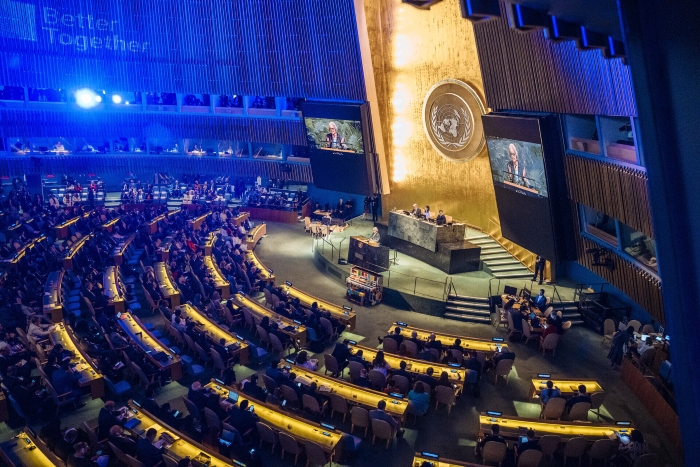
Smugglers and criminal networks operate across borders, exploiting gaps. Governments must respond the same way with solutions across the routes people travel. That is the message IOM Director General Amy Pope is bringing to the UN General Assembly this week.
The International Organization for Migration (IOM) is calling on states to address shared challenges and opportunities across entire migration routes, from where they leave to where they arrive. The aim is solutions that work for everyone.
“Smugglers don’t see borders. They see a route, and they run it like a business. They plan ahead, and they move to exploit gaps between countries.” said DG Pope. “When countries work together, they can save lives, disrupt criminal networks, and manage their borders more effectively. That is one of the main topics we are putting on the table this week.”
This is in line with the Route-Based Approach, which involves identifying the challenges along key migration routes and making sure partners work together to address them effectively – from tackling root causes of irregular migration to disrupting smuggling networks to ensuring migrants’ rights are protected along the whole route. Countries plan together and act at the same time. Each government retains full control of its own borders and laws, while sharing information, coordinating actions, and closing the gaps criminal networks seek to exploit.
War, climate shocks and economic hardship are forcing millions of people from their homes. More than 83 million were living in internal displacement at the end of 2024, according to IOM’s World Migration Report 2026. Many others cross several countries on one journey, and smugglers and traffickers exploit them along the way. Smuggling and trafficking are both billion-dollar businesses, and people pay with their lives.
Nearly 8,000 people died or went missing on migration routes worldwide in 2025, according to IOM data. As of 15 September, arrivals in Europe by sea this year are down 39 per cent, yet at least 2,292 people have died or gone missing on the way, up from 1,999 at the same point last year. In July, IOM warned that hundreds of thousands of people have been trafficked and forced to run online scams.
IOM is calling on governments at the Assembly to focus on three practical areas: share information along their routes; expand more legal ways to work and travel, so fewer people turn to smugglers; and invest in people at home, with jobs and help after climate shocks, so leaving is a choice, not the only option. Well-managed migration also builds public trust, because people can see order, fairness and results.
Business has a role to play too. Companies create jobs, and legal jobs offer a safer alternative to abusive journeys. IOM is working through the UN Network on Migration and with private-sector partners, local communities and faith groups along the key migration routes.
As Member States call for a UN that delivers more effectively, IOM continues to contribute to UN80, the UN’s reform effort to reduce duplication and focus on results. IOM is sharing services, data and innovation with other UN agencies to deliver just that. More than 93 per cent of its operational budget goes directly to field projects.
“Every dollar has to work. Governments are right to ask that, and we hold ourselves to the same standard,” said DG Pope. “But efficiency is not the only goal. People are at heart of this, making sure the resources entrusted to us reach the people who need them most.”
This year also marks IOM’s 75th anniversary and 10 years as part of the UN system. Over the past decade, IOM has helped an average of 29.3 million people a year in 170 countries, by responding to crises and supporting recovery. ///IOM, Photo: IOM/Muse Mohammed, 2025