


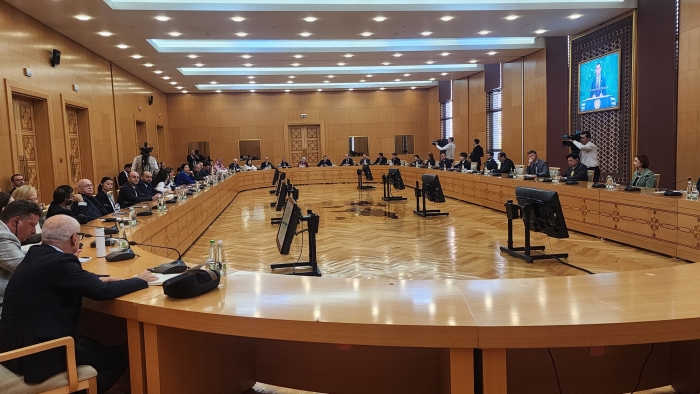
Turkmenistan continues to view the Energy Charter Treaty as a practical and relevant platform, primarily for advancing energy security principles. This was stated by Atageldi Haljanov, Head of the International Economic Relations Department at the Ministry of Foreign Affairs of Turkmenistan, during a briefing for the diplomatic corps, as well as national and foreign journalists, in Ashgabat on 18 September 2026.
According to Haljanov, the Energy Charter Treaty is currently undergoing a structural revision against the backdrop of shifting approaches by a number of European nations toward their participation in the mechanism.
“As is well known, several European partners have been reassessing the format of their involvement in the treaty in recent years, guided by their own climate and energy policy priorities,” Haljanov noted.
He highlighted that Turkmenistan regards these changes as a natural phase in the evolution of multilateral energy institutions.
“The Turkmen side respects the sovereign right of every state to determine the scope and parameters of its participation in international frameworks. We view the ongoing processes as a natural stage in the evolution of multilateral energy institutions rather than a decline in the platform’s significance,” the MFA official stated.
Turkmenistan’s perspective on the Energy Charter Treaty is largely shaped by its own energy capacities and export priorities.
“For Turkmenistan, which possesses significant hydrocarbon potential and consistently pursues a policy of diversifying its export routes, the Energy Charter Treaty retains its practical value—primarily as a platform for promoting the principles of energy security, reliable transit, and investment protection in the energy sector,” Haljanov emphasized.
He also pointed out the ongoing cooperation among Central and South Asian countries within the Energy Charter framework.
“We note with satisfaction that the nations of Central and South Asia continue their active engagement under the Charter, which underscores the continued relevance of this format specifically in our part of the continent,” the official added.
He reaffirmed that Turkmenistan intends to maintain its involvement in multilateral energy frameworks while adhering to its policy of permanent neutrality.
“Guided by the principles of permanent neutrality, Turkmenistan advocates a constructive, non-politicized dialogue on energy cooperation. We stand ready to share our experience and potential with all interested partners, both bilaterally and through multilateral platforms, including the Energy Charter,” Haljanov stated.
Ashgabat’s stance underscores the commitment to preserving the Energy Charter’s practical role as a forum for energy dialogue—particularly regarding transit, investment cooperation, and energy security—while taking into account the evolving approaches of individual member states. At the same time, Turkmenistan clearly demonstrated its strong support for a non-politicized approach to global energy dialogue. /// nCa, 18 September 2026