


Tariq Saeedi
Half a millennium before Christopher Columbus ever set sail, a scientist sitting in the rugged hills of Central and South Asia deduced that two massive, unknown continents must lie hidden across the ocean.
He had never seen the Atlantic, nor possessed a telescope, yet through pure trigonometric precision and physical logic, he predicted the existence of the Americas—both North and South—500 years before the famous navigator was even born.
That mind belonged to Abu Rayhan al-Biruni, a polymath whose genius redefined astronomy, geodesy, and physical geography.
The Nandana Experiment: Measuring the Earth’s Radius
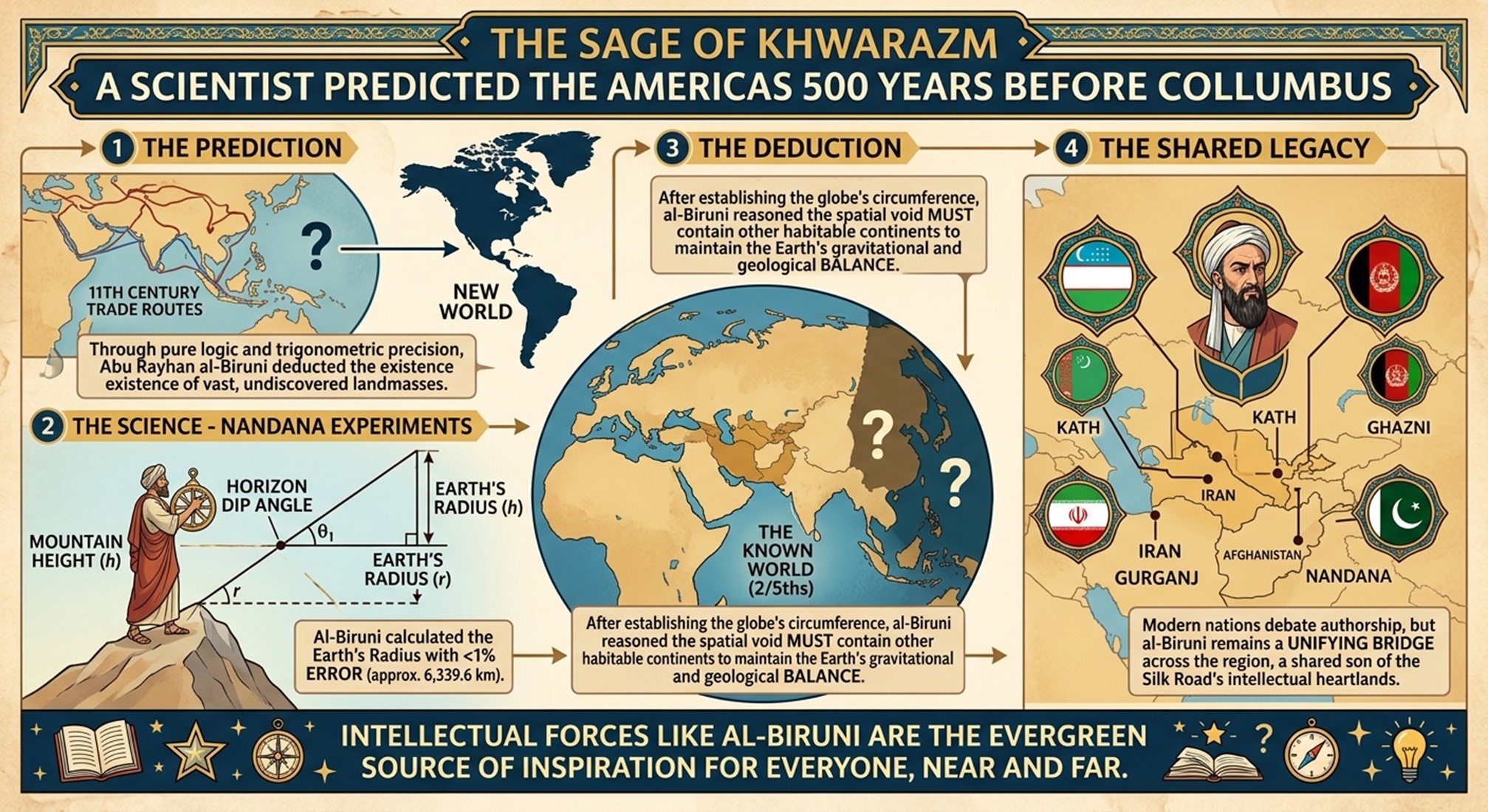
Al-Biruni’s startling hypothesis was not a lucky guess; it was the mathematical fruit of a breakthrough experiment he conducted at the Fort of Nandana, located in the Salt Range of modern-day Pakistan.
At the time, determining the size of the Earth traditionally required measuring vast, flat stretches of land on foot—a labor-intensive process prone to cumulative human error. Al-Biruni devised an extraordinarily simple yet revolutionary alternative using trigonometry, a mountain, and a specialized astrolabe.
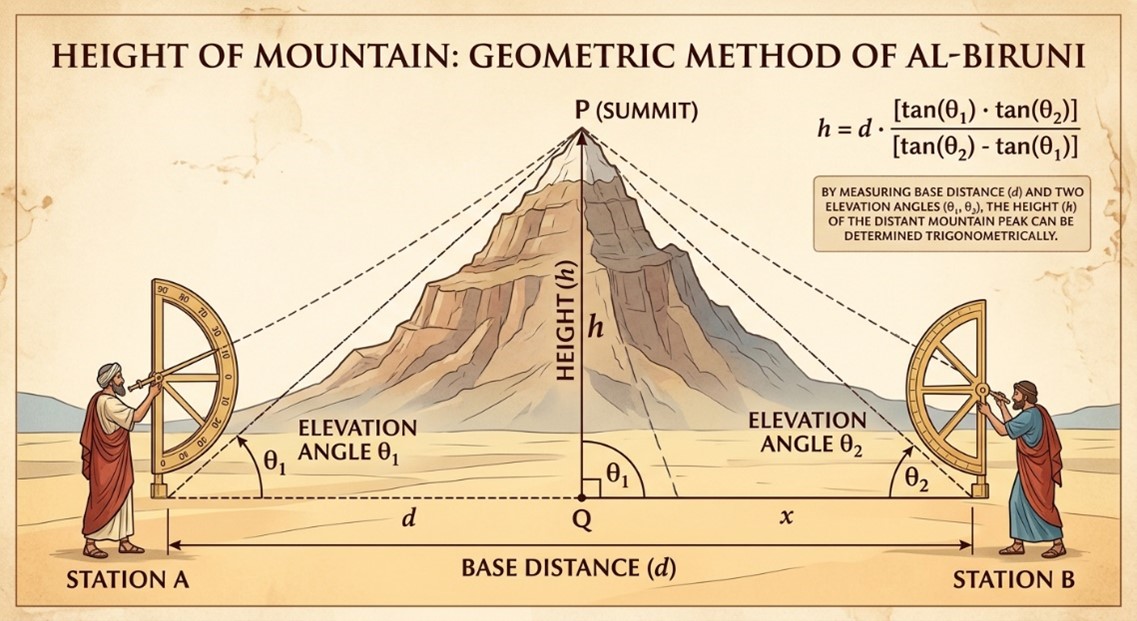
The Big Idea
Imagine trying to figure out how big a giant ball is while standing on it. Al-Biruni realized he didn’t need to travel around the entire globe; he just needed a tall mountain, a bit of geometry, and a clever view from above!
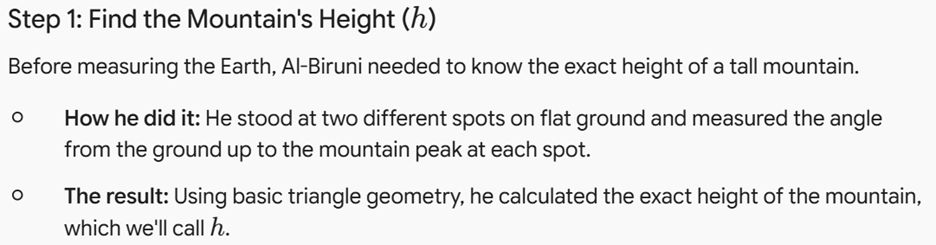
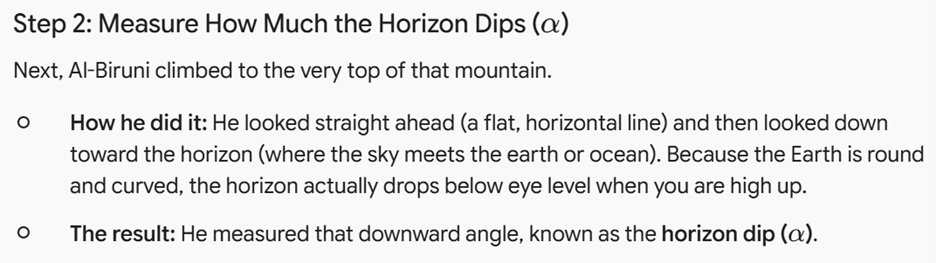
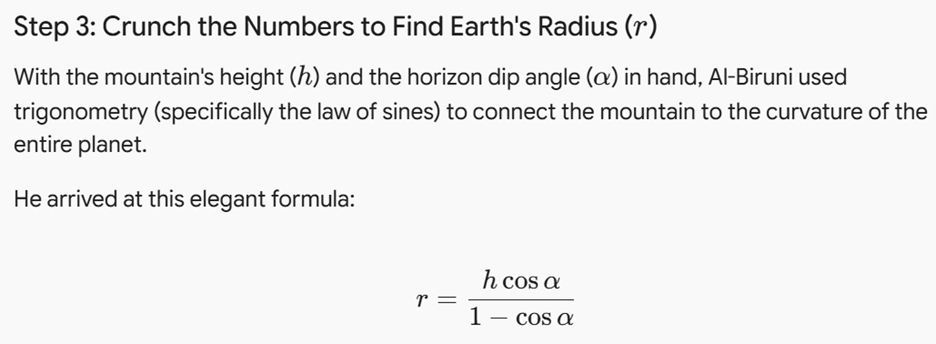
By plugging his measurements into this equation, he successfully isolated $r$ (the radius of the Earth)—coming remarkably close to the actual modern measurement, all over a thousand years ago!
His calculation yielded a radius of approximately 6,339.6 kilometers—an accuracy within less than 1% of the modern polar value (~6,357 km).
The Spatial Void: Deducing the Americas
Once al-Biruni held the exact surface area of the globe in his hands, he mapped all known landmasses—stretching from the Atlantic coast of West Africa and Western Europe to the eastern bounds of China.
He immediately noticed a profound geographic imbalance: Eurasia and Africa accounted for barely two-fifths of the Earth’s total surface area.
Classical Eurasian scholars assumed that the remaining three-fifths was simply an endless, unbroken ocean. Al-Biruni systematically dismantled this assumption using two fundamental physical principles:
- Geological and Mechanical Equilibrium: Drawing on his work in specific gravity, he reasoned that if three-fifths of the globe were made of lighter water while Eurasia held the bulk of heavy rock and soil, the Earth’s center of gravity would be dangerously displaced, destabilizing the planet’s rotation.
- Universal Physical Processes: He argued that the natural forces that created mountains and continents across Eurasia must operate elsewhere on the globe.
He concluded that vast, inhabited or habitable landmasses must fill the ocean void between Europe and Asia. When Columbus crossed the Atlantic in 1492—ironically operating on flawed map calculations that drastically underestimated the size of the planet—he bumped into the very landmasses al-Biruni had mathematically established five centuries earlier.
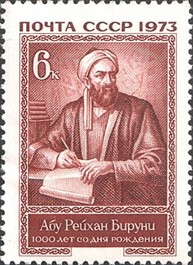
Biruni on a 1973 postage stamp of USSR
A Shared Inheritance Across Nations
Because of his staggering legacy, several modern nations have legitimate right to claim al-Biruni:
| Nation / Region | Historical & Cultural Basis of Claim |
| Uzbekistan | His birthplace was Kath (renamed Beruniy), the ancient capital of Khwarazm along the Amu Darya delta in modern Karakalpakstan. |
| Turkmenistan | He spent pivotal years at the famed Ma’mun Academy in Gurganj (Konye-Urgench), collaborating with the era’s greatest scholars. |
| Afghanistan | The mature half of his career was anchored in Ghazni under the Ghaznavid Empire, where he completed his major astronomical texts and passed away. |
| Pakistan | Home to the Fort of Nandana in the Salt Range, the physical laboratory where his ground-breaking Earth-measurement experiment took place. |
| Iran | He was an ethnic Khwarazmian of Eastern Iranian lineage who wrote extensively in Persian as well as Arabic, operating within the Greater Khorasan cultural sphere. |
Rather than a source of division, al-Biruni stands as a unifying bridge across Central Asia, South Asia, and the Middle East—a shared native son of the Silk Road’s intellectual heartlands.
An Evergreen Beacon of Human Inquiry
Abu Rayhan al-Biruni reminds us that absolute intellectual honesty knows no geographic boundaries. He approached the world with an open, empirical mind—learning Sanskrit to write the most objective study of Indian culture of his era, refining tools to measure the cosmos, and trusting logic over dogma even when it pointed to unseen worlds across the seas.
For thinkers, scientists, and explorers everywhere—near and far—his legacy remains an evergreen source of inspiration: a testament to what the human mind can accomplish when driven by unyielding curiosity, mathematical discipline, and a quiet trust in truth.
* * *
The Four Scholars: The pavilion at the UN Office in Vienna features statues of four prominent medieval Persian and Islamic-era scientists and scholars:
- Al-Biruni (astronomer and polymath)
- Avicenna / Ibn Sina (philosopher and physician)
- Omar Khayyam (mathematician, astronomer, and poet)
- Muhammad ibn Zakariya al-Razi / Rhazes (physician and chemist) [1, 2]
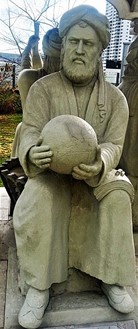
Statue of Biruni in UN Office in Vienna
Three of them had very direct connection with the land of the present-day Turkmenistan:
| Scholar | Direct Connection to Turkmen Land? | Nature of the Connection |
| Al-Biruni | Yes | Born in historic Khwarazm; lived and worked for years in Kunya-Urgench. |
| Omar Khayyam | Yes | Lived for years in Merv; built a world-class observatory under Seljuk patronage. |
| Avicenna | Yes | Lived and wrote in Kunya-Urgench; traveled through Merv, Nasa, and Abiverd. |
Al-Razi (Rhazes), born a century before Al-Biruni and Avicenna, had no direct physical connection with the lands of Turkmenistan but his academic works such as Al-Hawi were taught at the educational establishments in Merv and Gurganj. /// nCa, 3 November 2026