


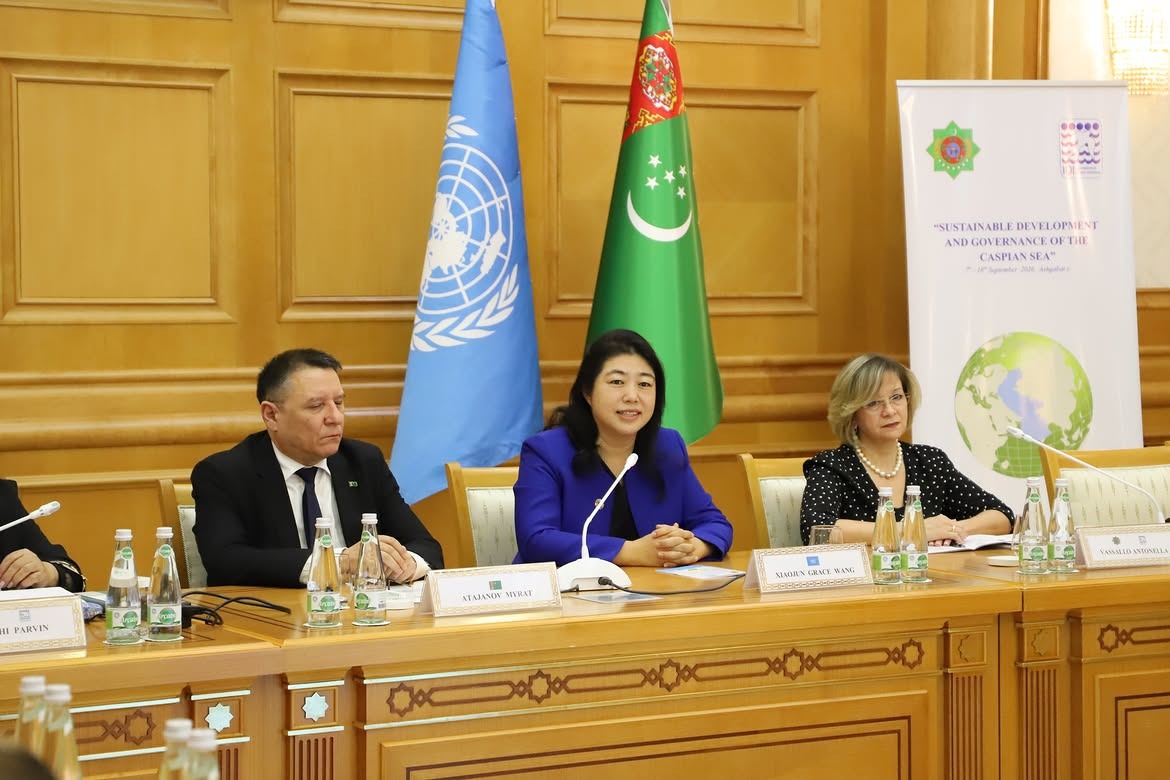
The future of the Caspian Sea depends on successfully bringing together all three dimensions of sustainable development—economic, social, and environmental. Putting people and future generations at the center, ensuring science and evidence inform policy choices, and using international law as the framework for cooperation—it is on these three principles that the United Nations (UN) stands firm to partner with the countries of the Caspian region.
This was stated by the UN Resident Coordinator in Turkmenistan, Ms. Xiaojun Grace Wang, at the opening of the training course “Caspian Sea: Sustainable Development and Management” in Ashgabat on 7 September 2026.
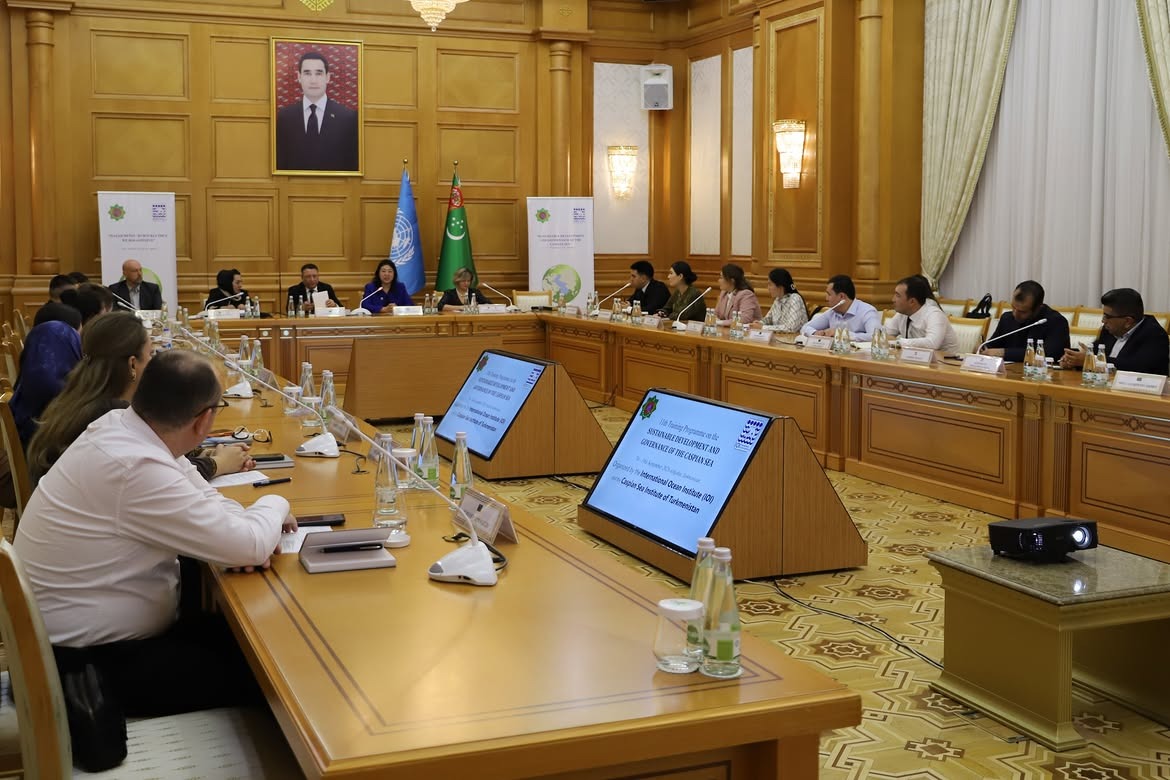
“The Caspian Sea is a strategic space for sustainable development. It is a unique ecosystem, rich in biodiversity but increasingly affected by climate change, pollution and changing water levels. It is an economic space supporting energy, fisheries, ports, transport corridors, trade and connectivity. And it is a social space source of livelihoods, identity and opportunity for communities around its shores,” Ms. Xiaojun Grace Wang emphasized.
Combining economic, social, and environmental interests raises difficult governance questions for the countries of the region: how to expand trade and infrastructure without increasing pressure on fragile ecosystems, and how to capture the economic potential of the Caspian while accounting for long-term environmental and social costs.
In response to these challenges, Ms. Wang highlighted three principles.
First, put people and future generations at the center. Decisions on infrastructure, natural resources, environmental protection or economic development should be judged not only by immediate economic returns, but by their impact on livelihoods, resilience, inclusion and the opportunities we leave to those who come after us. For the Caspian, she noted, this means asking not only what development is possible today, but what kind of Caspian we want to pass to the next generation.
Second, ensure that science and evidence inform policy choices. Evidence must travel the full distance—from monitoring and research to policy, investment and action. Reliable and comparable evidence on water levels, biodiversity, pollution and climate risks—combined with socioeconomic data—can help governments anticipate risks, assess trade-offs and make better policy and investment decisions.
Third, use international law as the framework for cooperation and implementation. Ms. Xiaojun Grace Wang recalled that the five littoral states have established important foundations through the Convention on the Legal Status of the Caspian Sea, the Tehran Convention and its Protocols. The Caspian Sea offers a practical example of how international law can support sustainable development—not simply through agreements, but through their effective implementation.
“On all three principles, the United Nations stands firm to partner with the Caspian countries,” Ms. Wang stated.
A strong foundation of broad partnership has already been established. UNEP supports regional environmental governance under the Tehran Convention. UNOPS, UNEP, the World Bank and partners are advancing the GEF-supported Blueing the Caspian Sea initiative. ESCAP is also supporting regional cooperation on the Caspian Sea, including through its work on sustainable transport, connectivity and economic cooperation, helping to strengthen the links between environmental sustainability and the region’s evolving trade and transport corridors. UNDP and other UN entities are supporting work on marine litter, waste management, water governance and climate resilience. IOM is helping strengthen understanding of the links between climate change, environmental pressures, human mobility and communities. FAO and others bring expertise relevant to food systems, water, ecosystems and livelihoods.
Thus, the UN approach does not involve choosing between economic development and environmental protection, but rather finding solutions that address both simultaneously. Technology, financing, and partnerships should help translate scientific knowledge and regional commitments into practical action.
“The Caspian can demonstrate how a shared strategic space can become a shared opportunity for sustainable development, peace and prosperity,” Ms. Xiaojun Grace Wang concluded, assuring that the United Nations stands ready to be with the Caspian countries in that effort. ///nCa, 8 September 2026