


nCa Commentary
The strategic partnership between Turkmenistan and Japan remains one of the most stable, technologically transformative, and mutually beneficial relationships in Eurasia.
The Turkmen-Japanese relationship is anchored in decades of high-value industrial execution, technical cooperation, and deep-seated institutional trust. The partnership is quietly preparing for its next evolution—moving from heavy infrastructure toward high-tech, green industrialization and human capital development.
1. The Bedrock: A History of Deep Economic Integration
Unlike platforms defined primarily by political declarations, Japanese engagement in Turkmenistan is visible in the physical geography of the nation’s economy.
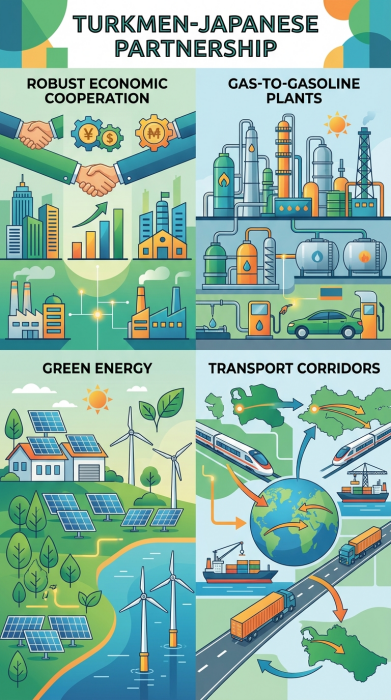
Japanese technology, financing, and engineering have served as key catalysts for Turkmenistan’s strategy of raw material diversification. Major state-of-the-art facilities across the country bear the distinct signature of Japanese consortiums (including Kawasaki Heavy Industries, Mitsubishi Heavy Industries, Sojitz, and Itochu):
- Gas-to-Gasoline (GTG) Innovations: The world-class GTG plant in Ovadan-Depe stands as a prime example of high-tech processing, turning natural gas into synthetic gasoline.
- Petrochemical and Fertilizer Complexes: From the Kiyanly Polymer Plant to large-scale carbamide and ammonia manufacturing units in Mary and Garabogaz, Japanese capital and technology transformed raw hydrocarbon extraction into high-value downstream commodities.
- Energy Infrastructure: Advanced gas-turbine power generation facilities across the provinces have directly enhanced Turkmenistan’s energy security and export capabilities.
These projects were delivered through a durable model combining technology transfers, structured long-term credit from Japanese financial institutions (such as JBIC), and public-private cooperation under the framework of the Turkmen-Japanese Economic Committee.
2. Unlocking Unmapped Potential: Areas for Expansion
While past cooperation concentrated on mega-scale petrochemical and energy projects, the scope for future collaboration expands into new, critical domains:
A. Hydrogen Energy and Methane Mitigation
As Turkmenistan pursues low-carbon transitions and methane reduction, Japan brings world-leading expertise in hydrogen supply chains, carbon capture, utilization, and storage (CCUS), and flare gas recovery. Joint research in green and blue hydrogen production presents immediate opportunities for strategic collaboration.
B. Circular Economy and Waste Management
Recent inter-ministerial dialogues emphasize cooperation in waste recycling, resource recovery, and sustainable manufacturing. Japanese technology can assist Turkmenistan in building municipal waste management systems and eco-friendly manufacturing units.
C. Digital Logistics and Transport Connectivity
With Turkmenistan positioning itself as a central Eurasian transit hub—connecting the Caspian Sea region to Central Asia—Japanese digital logistics management, railway automation, and port management technologies offer opportunities to enhance the operational throughput of the Turkmenbashi International Seaport and national transport corridors.
D. Education, Science, and Human Capital
In modern industrial development, technological hardware must be supported by local technical expertise.
- Japanese language programs at Oguz Han Engineering and Technology University and other higher education institutes provide a strong foundation for ongoing student exchanges.
- Expanding technical vocational training, joint research initiatives, and specialized engineering scholarships will ensure that Turkmenistan’s young workforce is equipped to manage next-generation smart infrastructure.
3. The Path Ahead: “Central Asia + Japan” Strategic Continuity
Diplomatic schedules are naturally cyclic. The recent execution of a foreign ministry cooperation program for 2027–2029 and preparations surrounding high-level multilateral frameworks like the “Central Asia + Japan” Dialogue Summit demonstrate that Tokyo and Ashgabat remain committed to long-term coordination.
Turkmenistan’s policy of positive neutrality provides a balanced foundation for international partnerships. Foreign investments and diplomatic dialogues elsewhere do not diminish the value of Japanese engineering quality, financial reliability, and operational standards.
Conclusion
The Turkmen-Japanese partnership is built on durable foundation stones: modern plants, reliable power grids, shared research, and trained specialists. By expanding beyond traditional oil and gas processing into green hydrogen, circular economy initiatives, and digital infrastructure, Ashgabat and Tokyo can ensure their strategic partnership remains a powerful engine for Eurasian development. /// nCa, 26 October 2026