


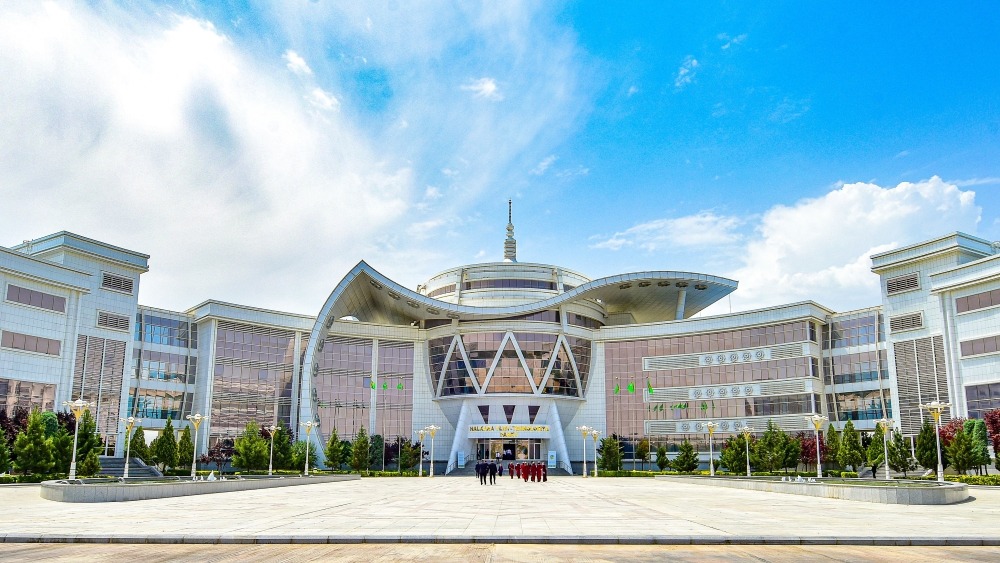
Artificial intelligence is gradually moving beyond its traditional areas of application and becoming a tool for addressing practical economic challenges. In Turkmenistan, modern digital technologies are increasingly being used to improve water resource management in agriculture, optimize freight transportation and advance renewable energy.
These areas are now among the priority research fields of the International Scientific and Technological Park of the Academy of Sciences of Turkmenistan. The Park is developing solutions designed not simply to remain at the research stage, but to be applied directly in production and infrastructure.
AI in Agriculture
One of these areas is the use of artificial intelligence in agriculture. In particular, a crop-yield forecasting system is being adapted to local agro-climatic conditions.
At the same time, solutions for smart irrigation and automated soil monitoring are being developed. For a country with a hot and arid climate, efficient water management has direct economic importance.
According to the developers, the use of soil-moisture sensors for precision irrigation can reduce water consumption by 20–30 percent while increasing crop yields. Such technologies are particularly relevant to cotton and vegetable production.
These solutions can also be introduced gradually. A basic smart irrigation system does not require a major overhaul of existing agricultural infrastructure. It involves the installation of controllers and sensors, after which the system can be adapted to the specific conditions of an individual farm.
Digitalization of Logistics
Transport logistics is another promising area for the application of digital technologies.
The Park is studying solutions for the digital management of freight transportation along the transport corridor across the Caspian Sea. Algorithms for forecasting freight flows and optimizing routes are intended to help carriers plan cargo movements more efficiently.
As part of the project, algorithms are being developed to take into account a range of factors, from projected freight volumes to optimal delivery routes. In pilot regions, the use of such solutions has helped reduce costs by 15 percent.
Renewable Energy
Another area of research is renewable energy and energy storage technologies.
Particular attention is being paid to the potential use of plant and household waste, as well as waste from industrial production, poultry farming and livestock breeding, as an energy resource.
This approach can address two challenges simultaneously: generating energy from readily available resources while reducing the volume of waste requiring disposal.
An Applied Approach to Innovation
The laboratory places particular emphasis on the practical application of the technologies it develops. An innovation must be not only scientifically sound, but also economically viable.
That is why priority is given to solutions that can be introduced relatively quickly and without major capital investment. Smart irrigation systems can be adapted for small farms, while digital logistics platforms can be integrated with existing infrastructure and customs systems.
Building the Skills Base
Economic development requires not only technology, but also specialists capable of developing and implementing it.
The International Scientific and Technological Park of the Academy of Sciences of Turkmenistan is training students and young researchers pursuing postgraduate studies. Groups of engineers and agronomists have already been formed to participate in pilot projects, support the deployment of new systems and train specialists directly at project sites.
For Turkmenistan, this process represents a gradual expansion of the country’s approach to economic diversification. While traditional industries remain an important part of the national economy, new technologies can create additional areas of growth — from digital agriculture and intelligent logistics to the processing of biological waste and renewable energy. ///nCa, 8 September 2026 (based on materials from the newspaper ‘Neutral Turkmenistan’)