


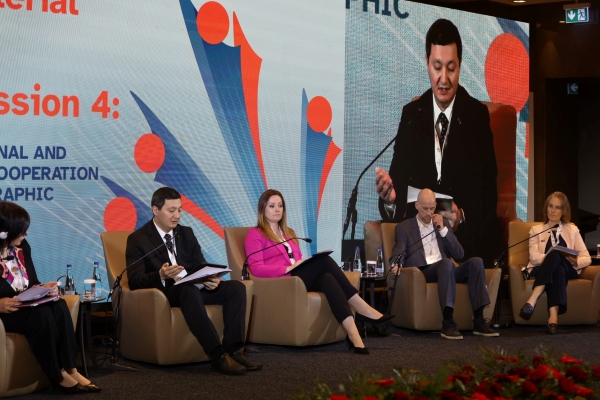
Skopje, North Macedonia, 8 May 2026 — On 7–8 May, the 2nd Regional Ministerial Conference titled “Leading Change: People-Centred Paths to Demographic Resilience” was held in Skopje. The event was organized by the Government of North Macedonia in cooperation with the United Nations Population Fund (UNFPA). A delegation from Turkmenistan, led by Deputy Minister of Education Mr. Azat Atayev, participated in the forum, which brought together ministers and international experts from over 30 countries to discuss strategies for responding to global demographic transformations.
During the conference, participants discussed demographic change as a defining megatrend of our time, affecting the resilience of social systems and economic growth across Europe and Central Asia. Special attention was paid to the contrast between population ageing processes in European countries and the potential of the “demographic dividend” in Central Asia. The primary objective of the discussions was the transition to building resilience through public policies based on human rights and evidence-based data analysis.
Speaking at the panel discussion on international and regional cooperation, the head of the Turkmen delegation presented the country’s experience in integrating demographic indicators into long-term economic planning. He noted that Turkmenistan views demographic shifts as a “window of opportunity” for the country.
The Deputy Minister emphasized the importance of a scientific approach to forecasting workforce needs and introduced an innovative tool—an analytical calculator that allows for simulating the impact of various demographic scenarios on GDP growth.
Azat Atayev stressed that Turkmenistan maintains a strong partnership with UNFPA, whose contribution is essential in providing sound policy advice and demographic foresight necessary for informed decision-making in education. In this regard, he noted: “In parallel, under the UNFPA Country Programme for 2026-2030, we plan to strengthen demographic foresight; the development of a National Demographic Resilience Strategy is underway to integrate demographic trends into human capital planning and mid-term development frameworks.”
Within the framework of ongoing cooperation between UNFPA and Turkmenistan, special attention is paid to the integration of digital solutions and demographic analysis into the development of the evidence-based National Strategy for Demographic Resilience. A vital stage of this work has been the digitalization of data collection systems, including the 2022 complete population and housing census conducted using electronic devices and the completion of the seventh round of the Multiple Indicator Cluster Survey (MICS7), which featured a module on violence against women introduced with UNFPA support. These efforts to transition to ‘big data’-driven governance, alongside the digitalization of the civil registry system, enable the government to make timely and evidence-based decisions in the social sphere to promote sustainable development and social well-being.
***
The 1st Regional Ministerial Conference on Demographic Resilience was held on 1-2 December 2021 in Sofia, Bulgaria. It served as the first high-level platform bringing together countries of the region under the UN auspices to discuss demographic change. Following that meeting, the UNFPA Regional Demographic Resilience Programme was launched, which laid the foundation for current strategies to adapt societies to changing population dynamics. ///nCa, 8 May 2026 (in cooperation with UNFPA Turkmenistan)